

“I come back from a week of vacation to 400+ emails and I genuinely consider quitting.”
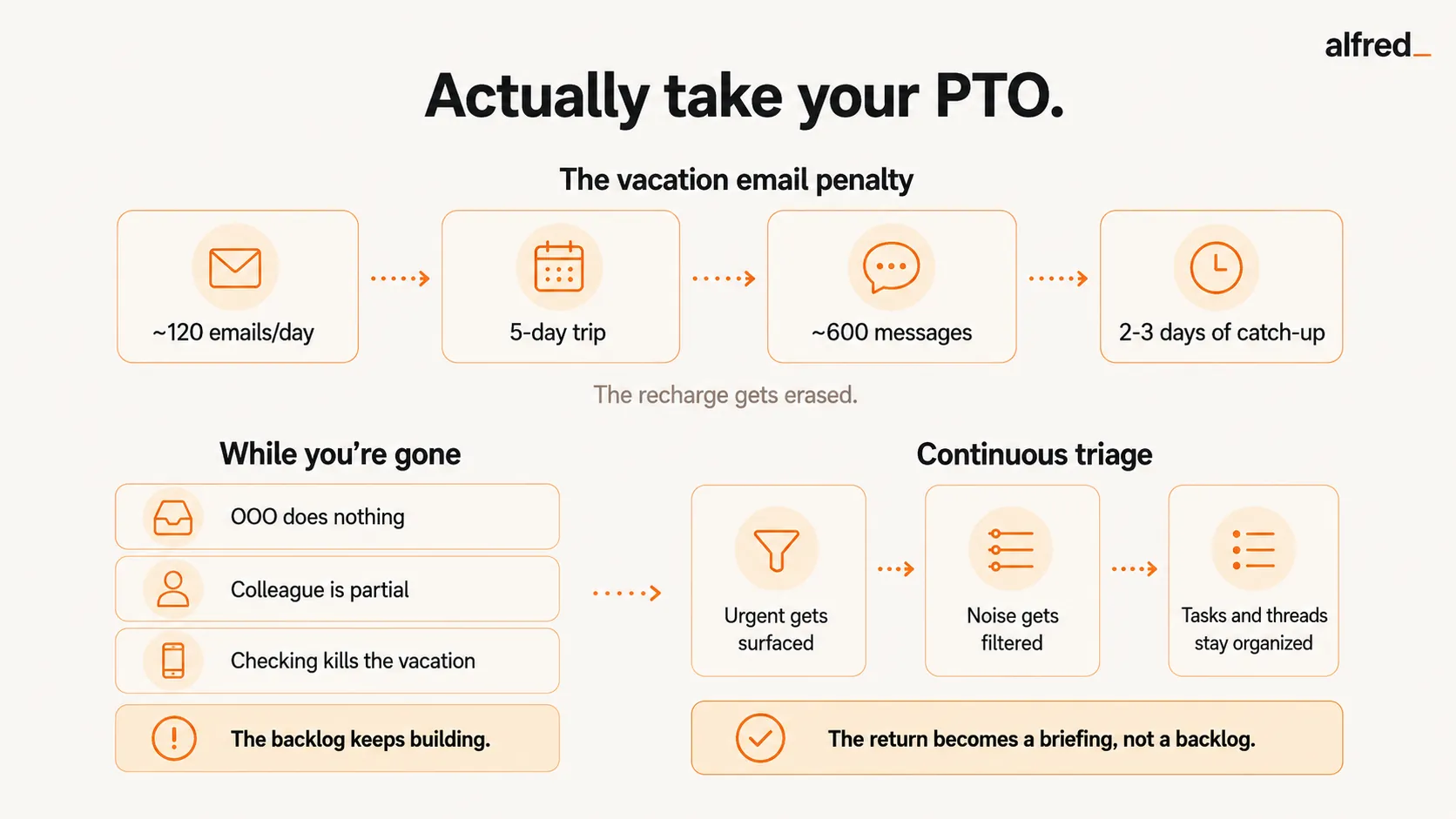
You know the math before you even leave. Five days away. 121 emails per day on average. That is roughly 600 messages waiting when you get back. Some are noise, newsletters, automated notifications, CC threads nobody needed you on. But buried somewhere in that pile are client emails that needed responses three days ago, a meeting reschedule you did not see, a follow-up you promised before you left, and at least one small crisis that someone handled poorly because you were not there.
The vacation was supposed to recharge you. Instead, you spend the last two days of it dreading the inbox. And the first three days back clearing it. The recharge is erased by the catch-up.
This is the vacation email penalty. And it is one of the cruelest ironies of modern work.
The Penalty Nobody Talks About
The numbers are worse than you think.
43% of people cite “return to a mountain of work” as a reason for not taking vacation at all, a figure that has been rising in recent years. 62% of Americans do not use all their paid time off. Collectively, American workers left 768 million vacation days unused in 2018 alone. 23% have not taken a single vacation day in the past year.
The reason is not overwork. It is not dedication. It is not “hustle culture.” It is email.
More specifically, it is the math of email. At 121 messages per day, here is what different vacations cost you:
| Time Away | Emails Accumulated | Catch-Up Time (at 2 min/email) | Catch-Up in Work Days |
|---|---|---|---|
| Long weekend (3 days) | ~360 | 12 hours | 1.5 days |
| One week (5 days) | ~600 | 20 hours | 2.5 days |
| Two weeks (10 days) | ~1,200 | 40 hours | 5 full days |
Two minutes per email is fast. That assumes you scan, decide, and act on each message in 120 seconds. For emails that need thoughtful replies, the real number is 5-10 minutes. For emails that reference threads you missed while away, add another 5 minutes of context-gathering.
A two-week vacation, the kind that actually restores you, requires a full week of catch-up. The vacation was 10 days. The penalty is 5. You gained 10 days of rest and paid 5 back in stress. Net benefit: maybe.
89% of people feel refreshed after PTO. But nearly 60% return to a “noticeably more stressful workload” all or most of the time. 43% say they dread returning to work after time off. The vacation refreshes you. The return erases it.
The Checking-on-Vacation Compromise
Here is what actually happens. You know it because you have done it.
49% of full-time employees check work email while on PTO. 42% respond to messages. Nearly half report feeling tied to their emails on vacation. And here is the part that makes the productivity advice useless: 95% of younger employees who work during vacation say they do it by choice.
Not because their boss demands it. Not because company policy requires it. By choice. Because the anxiety of not knowing what is piling up is worse than the interruption of checking.
This is not a discipline problem. You are not “bad at vacations.” You are making a rational calculation: if I check email for 20 minutes twice a day, I stay on top of the critical stuff and avoid the 600-message wall when I return. The cost is that I never actually disconnect. The vacation becomes performative, physically away, mentally at the office.
“Sunday nights are ruined because I’m mentally pre-triaging Monday’s inbox.”
Now extend that to vacation. It is not just Sunday night. It is every night of the trip. The poolside phone check. The “just quickly looking” after dinner. The early morning scan before anyone else wakes up. Nearly half of Americans feel tied to their emails on vacation because the alternative, true disconnection, feels like an act of faith they cannot afford.
35% feel anxious just requesting PTO. Before the vacation even starts, the email penalty is already creating stress.
Why Out-of-Office Replies Solve Nothing
You have set up the out-of-office auto-reply. You crafted a polite message. You included an emergency contact. You feel responsible and prepared. Here is what actually happens:
Step 1: You set an OOO auto-reply. It says you will be back on the 15th and to contact Alex for urgent matters.
Step 2: Emails keep arriving. 121 per day. Your OOO reply fires dutifully for each one. The emails do not stop.
Step 3: Some senders read the OOO and decide to wait. Most do not. They needed an answer, and “I’m on vacation” is not an answer.
Step 4: Some senders email again because they did not read the OOO. Now you have duplicate threads.
Step 5: Alex, your emergency contact, handles the truly urgent items. Maybe. If Alex has time. If Alex understands the context. If Alex does not feel like they are doing your job for free.
Step 6: You return. The wall of email is waiting. 600 messages. No triage. No indication of what matters. No context about which threads resolved themselves and which need you. The OOO reply did not prevent a single email from arriving.
Step 7: You spend 2-3 days triaging before you can do any actual work. The vacation benefit is erased by the catch-up penalty.
The out-of-office reply is a courtesy. It tells people you are gone. It does not stop emails from arriving, triage what is urgent, draft responses for when you return, surface what actually needs attention in the pile, or prevent the backlog that makes people skip PTO in the first place.
What Actually Works
Here is an honest assessment of your options, evaluated specifically for the vacation email problem:
| Approach | What Happens While You Are Gone | What You Return To |
|---|---|---|
| OOO auto-reply | Nothing. Emails pile up. | 600 undifferentiated messages |
| Ask a colleague | They triage if they have time and context | Partial coverage, relationship cost |
| Check on vacation | You stay on top of it but never disconnect | No backlog, no vacation |
| SaneBox ($7–$36/mo) | Filters noise automatically | Smaller pile, but no triage of what matters |
| Clean Email ($9.99–$29.99/mo) | Nothing. It is a cleanup tool | Helps blast through the pile faster |
| alfred_ | Continuous triage, drafts, context tracking | A briefing, not a backlog |
Asking a colleague is the most common workaround. You find someone you trust, give them access or ask them to monitor your inbox, and hope they catch the important stuff. This works when: the colleague has time, understands your priorities, knows your clients, and does not resent doing your job on top of theirs. In practice, it is an imposition that strains the relationship and provides incomplete coverage. They miss things because they lack context. You spend the first day back reviewing what they handled and fixing what they missed.
SaneBox provides passive value during vacation. It filters noise while you are gone, so the pile contains less junk when you return. The Daily Digest summarizes what was filtered. This is genuinely helpful, returning to 300 emails instead of 600 is measurably less painful. But SaneBox does not triage the remaining 300. You still have no idea which of those “important” emails needs you first, which ones are about the deal closing this week, which ones were urgent three days ago and now require damage control. The volume is reduced. The uncertainty is not.
Clean Email ($9.99-$29.99/month) is a cleanup tool, not an ongoing assistant. It helps after the fact, grouping and mass-archiving newsletters, notifications, and noise so you can clear the backlog faster. For the “I have 600 emails and need to get to the 50 that matter” scenario, its Smart Folders and Auto Clean rules speed up the bulldozing. But it does not understand which of those 50 emails actually need your attention first.
alfred_ takes a fundamentally different approach. It does not wait for you to return. While you are on vacation, it is working. Continuously. Every email that arrives is read, understood in context, and triaged by urgency. Replies are drafted in your voice for messages that need responses. Follow-ups are tracked. When you sit down on Monday morning, you do not face a wall of 600 emails. You face a briefing.
What Coming Back Looks Like When It Works
You land Sunday night. Your phone is in your pocket. You do not check email at the airport. You do not check it in the car. You do not check it before bed. There is nothing to check for.
Monday morning. 8 AM. Coffee. Laptop open. The briefing is waiting.
While you were gone: 587 emails arrived over 5 days. Here is the breakdown:
- 12 items need your attention. Each one has context: who sent it, what it references, why it matters, what happened in the thread while you were away.
- 8 have draft replies. Your tone. Your style. Referencing the right details. Ready for your review.
- 3 resolved themselves. The client question was answered by your colleague. The meeting was rescheduled by the organizer. The vendor followed up and got what they needed from someone else.
- The rest: 340 newsletters, notifications, and automated messages, archived. 224 CC threads and informational emails, categorized and summarized. Zero action needed.
You review the 12 items. Send the 8 drafts after adjusting two of them. Spend 20 minutes on the remaining 4 that need your actual brain. Total catch-up time: about an hour.
The catch-up that would have taken 2-3 days took an hour. The vacation was actually a vacation. You disconnected because there was nothing to stay connected for. Someone was watching the inbox.
And that someone costs next to nothing.
The Real Question
The vacation email penalty exists because of a gap in coverage. When you are at your desk, you are the coverage. When you are on vacation, there is no coverage. The emails arrive at the same rate, pile up with no triage, and wait for you to manually process every single one when you return.
The question is not “how do I deal with email after vacation.” That is the wrong question. The right question is: “How do I make sure my inbox is covered while I am gone?”
A human assistant covers it for $3,000-$8,000 per month. Asking a colleague covers it partially, at a social cost. Checking on vacation covers it, at the cost of the vacation itself.
alfred_ covers it. It reads every email. It understands the context. It triages by urgency. It drafts replies. It tracks follow-ups. It does this whether you are at your desk or on a beach.
768 million vacation days went unused by American workers in 2018 alone. Not because people do not want time off. Because the email penalty makes time off feel like a net negative. The catch-up erases the recharge. The anxiety of disconnecting is worse than the exhaustion of not disconnecting.
That does not have to be how it works. Take the vacation. Actually take it. Your inbox is covered.