

You took the CTO title because you’re the best technical person at the company. You assumed you’d spend your time on architecture, code reviews, technical strategy, and building the systems that define the product.
Instead, you spend your day answering emails about hiring timelines, customer escalations, investor update requests, and cross-functional “alignment” threads. The technical work, the reason you have the title, gets pushed to 9 PM. Or Saturday morning. Or the 45-minute gap between meetings where you try to context-switch from a board deck back into a codebase.
You are the CTO. Your calendar says you are an account manager who occasionally reviews pull requests.
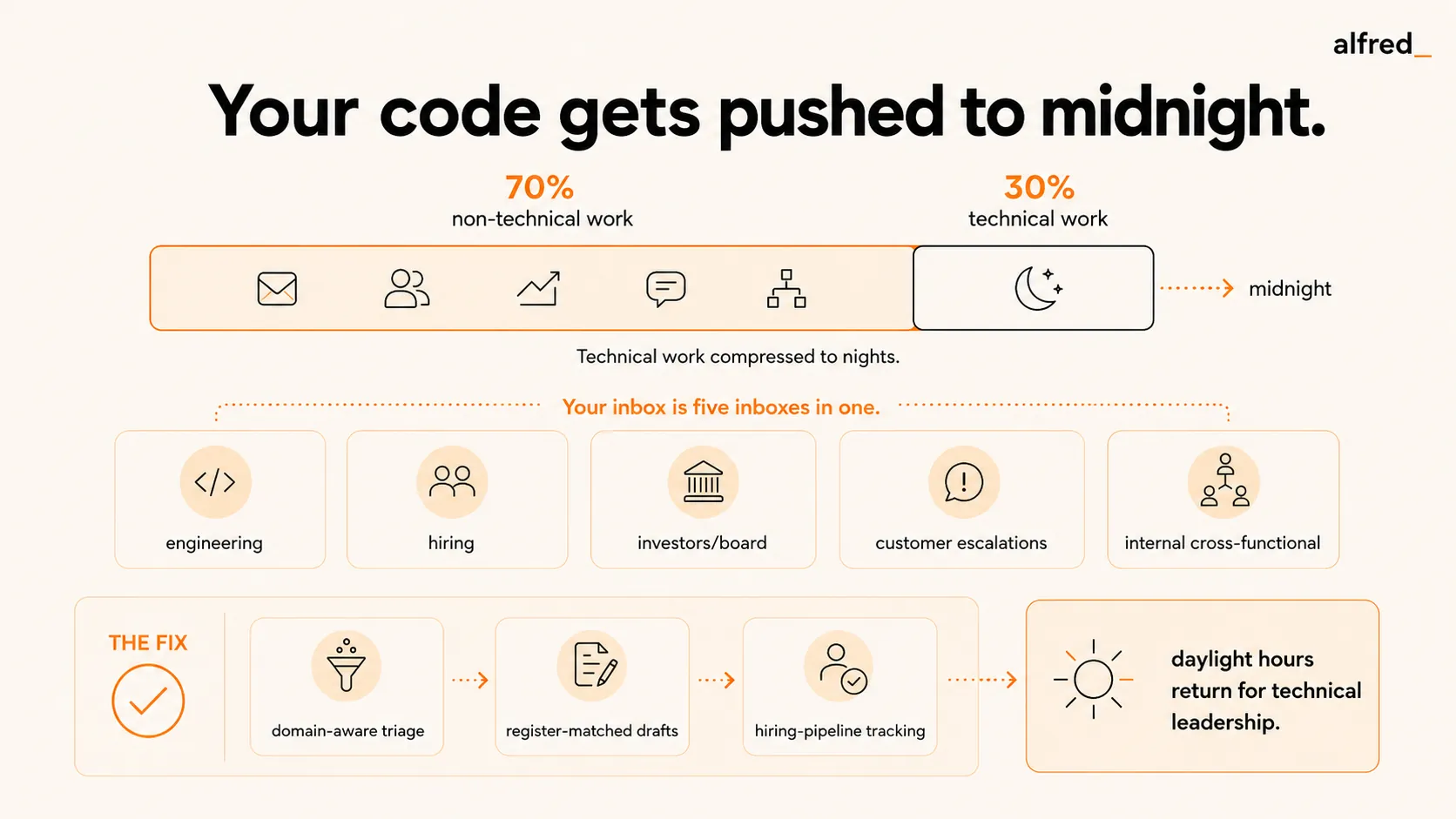
The 60/40 Split (That’s Actually 70/30)
Startup CTOs commonly report spending 60-70% of their time on non-technical work: communication, meetings, hiring, stakeholder management, and administrative overhead. Only 30-40% goes to technical contribution, and that percentage shrinks as the company grows.
Let’s map a typical startup CTO’s day:
7:30-8:00 AM, Check inbox. Overnight customer escalation about API latency. Investor wants updated metrics for a partner meeting. Recruiter submitted three candidates. VP of Sales forwarded a prospect’s technical questions. Engineering manager flagged a dependency conflict. 17 emails before you’ve had coffee.
8:00-10:00 AM, Two meetings. Standup with the engineering team. Product review with the PM, designer, and CEO. Both are necessary. Neither is technical work.
10:00-10:45 AM. Your only unscheduled block until 2 PM. You open the PR that’s been waiting for review since yesterday. You get 20 minutes in. Slack notification: the customer escalation from this morning is getting worse. You switch to email, draft a response to the customer success team, loop in the on-call engineer. The PR sits open.
10:45 AM-12:00 PM, Interview a backend engineering candidate. You’re the final round. Thirty minutes of interview, twenty minutes writing up your assessment.
12:00-2:00 PM, Lunch meeting with a potential vendor. Sprint planning for next week. Neither of these required a CTO. Both of them got put on your calendar because “you should be in the loop.”
2:00-3:00 PM. You try to return to the PR review. Three new emails. The recruiter needs your feedback on the candidate by end of day. The investor’s associate is following up on the metrics request. A new engineer has questions about the deployment pipeline. You answer the emails.
3:00-5:00 PM, Cross-functional meeting about Q3 roadmap. 1:1 with your engineering manager. By 5 PM you’ve been in meetings or email for 9 hours and written zero lines of code.
9:00 PM. You open your laptop. The house is quiet. You finally review the PR, refactor the authentication module, and make the architecture decision you’ve been putting off for a week. This is your “technical time.” It’s also your family’s time.
“The code gets pushed to midnight. Every night I tell myself I’ll protect tomorrow morning for technical work. Every morning the inbox has other plans.”
The Five Inboxes in One Inbox
A startup CTO’s email is uniquely brutal because it spans domains that have nothing to do with each other:
Engineering threads. Architecture discussions, incident postmortems, deployment notifications, security alerts, vendor API changes. These require deep technical context.
Hiring pipeline. Recruiter submissions, candidate follow-ups, interview scheduling, reference checks, offer negotiations. At a startup, the CTO is often the final technical interviewer for every engineering hire.
Investor/board communication. Metric requests, technical due diligence questions, quarterly update drafts, board meeting prep. These require translating technical reality into business language.
Customer escalations. Production issues, API questions, integration support, feature requests that get escalated because they’re “technical.” These require technical knowledge AND diplomatic communication.
Internal cross-functional. Product roadmap discussions with PMs, infrastructure budget negotiations with finance, security questionnaires from enterprise prospects, vendor evaluations for sales engineering.
Each of these is essentially a different job. Each requires a different communication style, different context, different expertise. And they all arrive in the same inbox, interleaved, throughout the day.
Clockwise research on engineering productivity has found that engineering leaders get remarkably little uninterrupted focus time per day, often just 2 hours or less. For startup CTOs, it’s even worse, because the “interruptions” aren’t optional, they’re the investor who funded your company, the customer who’s paying for your product, the candidate who might be your next senior hire.
Why Engineering Tools Don’t Help
You have GitHub for PRs. Linear or Jira for tickets. Slack for team communication. PagerDuty for incidents.
None of these handle the email layer. The investor update request doesn’t come through Linear. The recruiter’s candidate submission isn’t a GitHub issue. The customer escalation that requires a diplomatic response to the VP of IT at your biggest client doesn’t live in PagerDuty.
Notion organizes documents. It doesn’t triage your inbox. Asana tracks projects. It doesn’t draft the response to your board member’s question about burn rate. Slack might be where your engineering team communicates, but the external world, investors, candidates, customers, vendors, communicates by email.
The email layer is the connective tissue between all your other tools. And it’s the one layer with no automation, no delegation, and no help.
What You Actually Need
You need something that reads your inbox and understands that the email from your lead investor about a Series B timeline is not the same as the email from a SaaS vendor trying to sell you monitoring software. That the customer escalation about data loss is urgent and requires a specific, technical response. That the recruiter’s candidate submission can be acknowledged with a quick reply while you review the resume later. That the all-hands follow-up request from the CEO needs to be done by Friday but not this second.
You need judgment applied to a multi-domain inbox, with drafts that match the register of each domain. Technical precision for engineering threads. Executive clarity for investor communication. Warmth and professionalism for candidate outreach. Diplomatic care for customer escalations.
And you need it on a startup budget, not a Fortune 500 one.
How alfred_ Works for Startup CTOs
alfred_ connects to your email and calendar and immediately starts learning the shape of your communication across all five domains.
Domain-aware triage. Your morning brief is organized by the domains that define your role. “Engineering: deployment failure alert from monitoring, on-call engineer already notified, summary attached. Hiring: Senior backend candidate responded, available Thursday 2 PM, calendar hold suggested. Investors: Partner at Acme Ventures requesting updated ARR numbers, draft with latest figures attached. Customers: Enterprise client’s VP of Engineering asking about SOC 2 timeline, draft response ready. Internal: CEO wants your section of the board deck by Friday, outline attached from last quarter’s format.” You spend 10 minutes on what used to take 90.
Register-matched drafts. The response to your investor is structured, concise, and metrics-driven. The response to the engineering candidate is warm and enthusiastic. The response to the customer is technically specific and confidence-building. The response to your engineering manager is casual and action-oriented. alfred_ learned these patterns from your actual email history. The drafts sound like you in each context because they’re trained on how you actually write in each context.
Hiring pipeline tracking. The three candidates in the pipeline. The reference check you’re waiting on. The offer that’s been pending for 4 days. The recruiter who needs feedback. alfred_ tracks all of it and drafts the follow-ups. You stop losing great candidates because the scheduling email sat in your inbox for a week.
Meeting context. Before your 1:1 with the VP of Product, alfred_ pulls together the recent email threads, the open action items, and the product decisions that need technical input. Before the investor call, it compiles the metrics they asked about and the update from last quarter. You walk into meetings prepared instead of spending the first 5 minutes scrambling for context.
The Real Cost
The cost of a startup CTO doing email isn’t measured in hours. It’s measured in what doesn’t get built.
The architecture decision that got deferred for two weeks because there was never time to think deeply. The code review that sat open for 5 days because the day was consumed by communication. The technical debt that accumulated because refactoring requires focus time and there was none. The system design that was done hastily at 11 PM instead of thoughtfully at 10 AM.
Your company’s technical foundation is being built in the margins of your schedule, late at night, between meetings, in a state of cognitive depletion. The quality of that foundation determines everything about the company’s technical future. And you’re building it on fumes.
If alfred_ gives you back 2 hours per day of focus time, moving technical work from midnight to midday, the value isn’t measured in billable hours. It’s measured in the quality of the systems you build, the candidates you don’t lose because you responded in 2 hours instead of 5 days, and the customer relationships you don’t damage because the escalation response went out before lunch instead of after dinner.
Try alfred_.
Your company hired a CTO. Give them the time to be one.