

You saw the Slack message 3 minutes ago. You know you saw it. They know you saw it. The little “Seen” indicator confirmed it for both of you.
You can’t respond yet. You’re in the middle of something, a document, a thought, a sentence that was almost fully formed before the notification pulled you out. You need ten minutes to finish the thought and craft a real response.
But the clock is ticking. Not a real clock. A social clock. The one that started the moment the “Seen” indicator appeared next to your name. Three minutes. Now four. The longer you wait, the louder the anxiety gets. They’re going to think I’m ignoring them. They’re going to think I don’t care. They’re going to escalate.
So you stop what you’re doing. You switch contexts. You type something fast and shallow, “Looking into this!”, just to stop the clock. The thought you were building is gone. The document sits half-finished. But at least you responded.
This is the tyranny of instant replies. And it’s eating your ability to think.
The Culture of Speed as Performance
Somewhere along the way, fast response became a proxy for competence. Not formally. Nobody put it in the employee handbook. But everyone absorbed the signal: the people who respond quickly are the ones who are “on it.” The people who take two hours are the ones who are “hard to reach.” The people who take a day are “dropping the ball.”
The numbers confirm what you already feel. Research shows that nearly 90% of customers expect a response within one hour, and 41% of workers expect coworkers to respond within an hour (Toister Performance Solutions). A study by researchers at USC and Yahoo analyzing millions of email response patterns found that the most common response time is just 2 minutes, meaning millions of people are essentially doing real-time email, responding the moment messages arrive.
The expectation isn’t written anywhere. It doesn’t have to be. It’s encoded in every “following up” email, every Slack message followed by “??” thirty minutes later, every meeting where someone says “I sent you that yesterday, did you see it?” with a tone that makes “see” rhyme with “prioritize.”
“My boss doesn’t explicitly say respond immediately. But if I don’t reply within 15 minutes he starts pinging me on different channels. That’s the same thing.”
How Communication Tools Turned Silence into a Signal
There was a time when not responding to a letter for three days was normal. Not responding to an email for a few hours was fine. The sender had no way to know whether you’d received it, opened it, or read it. Your silence was invisible.
That era is over.
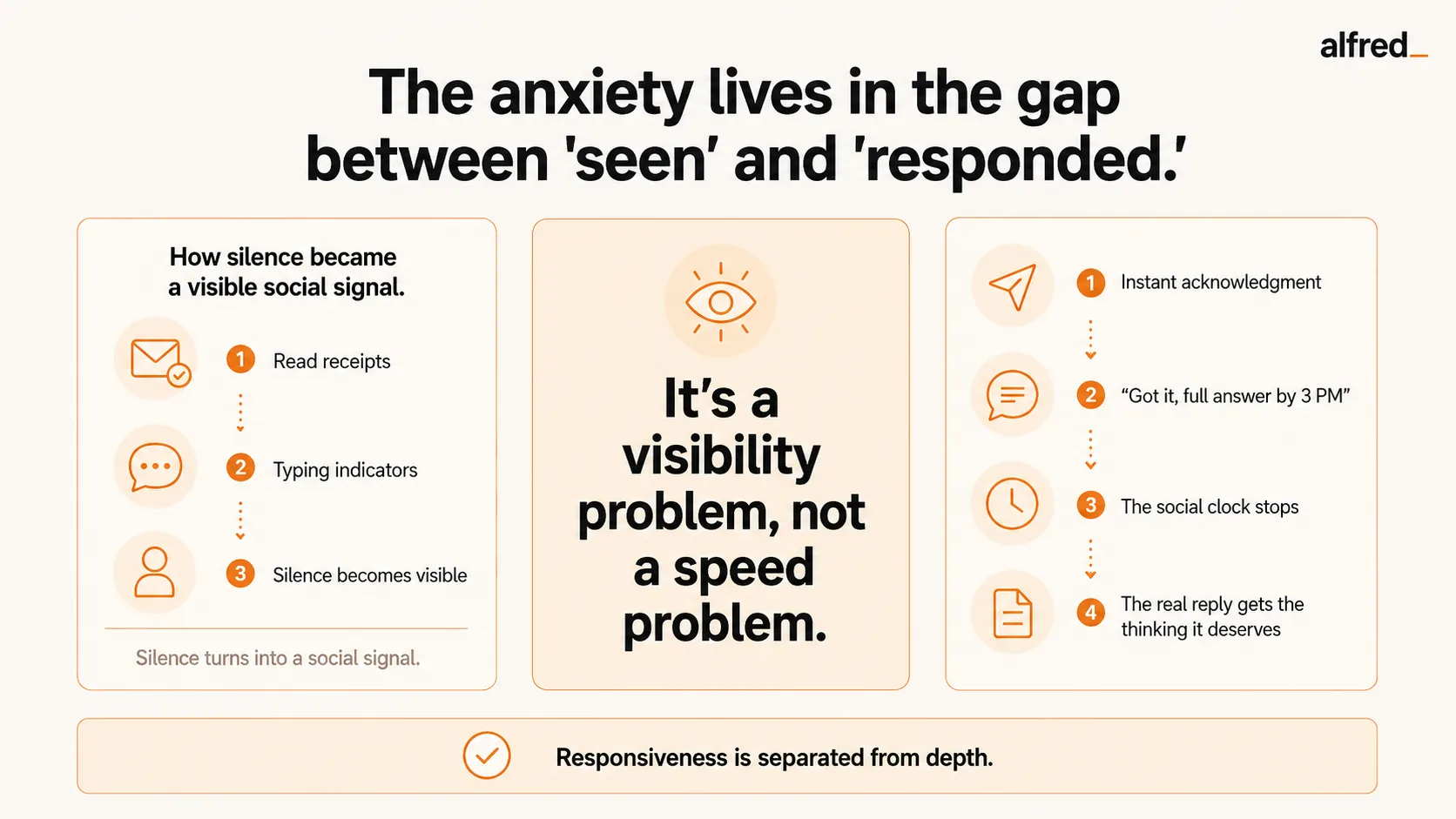
Modern communication tools have systematically eliminated invisible silence:
- Read receipts tell the sender you opened their message
- Typing indicators show when you start and stop composing a reply
- Online status broadcasts whether you’re at your computer
- “Last active” timestamps reveal exactly how long you’ve been away
- Delivery confirmations prove the message reached your device
Each of these features was designed to improve communication. Together, they’ve created a surveillance layer that transforms every moment of non-response into a visible, interpretable choice. When the sender can see that you read their message 11 minutes ago and haven’t responded, your silence becomes a statement. And your brain, wired for social cohesion and threat detection, interprets that statement as dangerous.
Research from the University of Glasgow found that 34% of workers felt stressed by email volume and the obligation to respond quickly, with the expectation of rapid response creating a state of heightened vigilance that interferes with primary task performance. The pressure isn’t just psychological. It’s physiological. Response time anxiety activates the same stress pathways as social rejection because, functionally, it is social rejection, or at least the fear of it.
“The worst is when you see someone typing, then stopping, then typing again. Now I’m monitoring their response to my response while trying to do actual work.”
The Depth Tax
Here’s what response time pressure actually costs you.
Every time you interrupt deep work to send a fast reply, you’re not just losing the 2 minutes it takes to type the response. You’re losing the 23 minutes and 15 seconds it takes to recover your train of thought (Gloria Mark, University of California, Irvine, research on interruption recovery). You’re losing the quality of the thought itself, because cognitive momentum doesn’t pause and resume cleanly.
A study by Mark, Gonzalez, and Harris found that workers who are frequently interrupted experience higher stress, higher frustration, and greater time pressure, not less. Responding quickly doesn’t relieve the pressure. It accelerates it. Because each fast response begets another message, another question, another expectation of speed. The cycle compounds.
The deepest cost is invisible: the work you never produce because you never reach the cognitive depth required to produce it. The strategic insight that requires 90 minutes of uninterrupted thought. The creative connection that forms only when your mind has space to wander. The careful analysis that distinguishes between a good decision and a fast one.
You’re trading all of that for the relief of stopping a social clock.
“I spend my whole day being responsive. Then at 7 PM I try to do the actual thinking work. That’s backwards. That’s insane. But that’s what the culture demands.”
Why “Just Respond Slower” Is Terrible Advice
The obvious answer: just take longer to respond. Set expectations. Tell people you check email twice a day.
This advice comes from people who either (a) have the organizational power to set their own norms, or (b) don’t understand the social cost of visible non-response in a fast-reply culture.
In most organizations, responding slowly is not neutral. It’s penalized. Not formally, but through the accumulated friction of being the person who’s “hard to reach.” The colleague who “doesn’t get back to you.” The team member who’s “probably not on top of things.” These reputational costs are real. They affect project assignments, promotion discussions, and the ambient trust that determines whether people bring opportunities to you or route around you.
You can’t unilaterally change the culture by responding slower. You’ll just be the person who responded slowly inside a culture that values speed.
And the advice to “set expectations”, “I check email at 9, 12, and 5”, works in theory. In practice, it requires you to absorb all the anxiety of not-monitoring during the gaps. If nothing is watching your inbox between 9 AM and noon, then for three hours, things could be arriving, accumulating, becoming urgent, and you have no way to know. The monitoring function in your brain doesn’t shut down because you decided to batch. It keeps running, and now it’s running against silence.
What Actually Works: Separating Speed from Depth
The real fix isn’t being faster or slower. It’s decoupling the signal of responsiveness from the act of deep thinking.
Your boss doesn’t actually need your thoughtful analysis in 4 minutes. They need to know you received the message and are on it. The client doesn’t need the finished deliverable in 15 minutes. They need to know the request didn’t disappear into a void. The colleague doesn’t need an answer right now. They need to know the question landed.
The anxiety lives in the gap between “seen” and “responded.” Close that gap with an acknowledgment, and the social clock stops. Then take the time you actually need to think.
This is what an executive assistant does. Not answer on your behalf, acknowledge on your behalf. “Sarah received your message and will follow up by end of day.” The sender feels heard. You feel unhurried. The work gets the depth it deserves.
SaneBox ($7-$36/month) filters noise, which reduces the total volume you face. But it doesn’t help with the messages that do need responses. You still face the response time clock on everything SaneBox lets through.
Superhuman ($30-$40/month) makes responding faster, keyboard shortcuts, snippets, split inbox. If your goal is to respond to 200 messages in 45 minutes, Superhuman works. But faster responses don’t reduce response time pressure. They teach the people around you that you respond fast, which calibrates their expectations upward. Superhuman makes you faster on the treadmill. It doesn’t let you step off.
Spark and Shortwave offer smart inbox features and AI summaries, but they’re still inbox-first. They require you to open, read, and decide on each message yourself. The response time pressure remains because you are still the bottleneck between receipt and response.
alfred_ takes a different approach. It reads your incoming messages, understands the context, and drafts replies in your voice. For messages that need acknowledgment, it can respond immediately, “Got it, I’ll have the analysis to you by 3 PM”, buying you the time to think without the anxiety of visible silence. For messages that need substantive replies, drafts are waiting for your review when you’re ready. The gap between “seen” and “responded” closes. The social clock stops. And you get your depth back.
The Permission to Think
There’s a moment that people describe when the response time pressure lifts. It’s not dramatic. It’s quiet.
You’re in the middle of a document. A notification appears. Instead of the familiar jolt, who is it, what do they need, how fast do I have to switch. You feel… nothing. Because you know the message was received. You know an acknowledgment went out. You know a draft reply is waiting for when you’re ready to review it. The social clock is not ticking. Nobody is watching your silence grow.
You go back to the sentence you were writing. You finish the thought. The thought is good, better than it would have been if you’d interrupted it. You finish the document. Then you review the drafts, adjust the ones that need your voice, approve the ones that don’t, and move on.
“The mental overhead of ‘I need to respond to that’ is worse than actually responding.”
That overhead disappears when you know it’s handled. Not later. Now. In real time. While you think.
The Real Response Time Metric
The irony of response time culture is that it measures the wrong thing. Speed of reply is not the same as quality of reply. Availability is not the same as value. The person who responds in 2 minutes with “let me check” is not more useful than the person who responds in 2 hours with the answer.
But organizations measure what’s visible. And response time is visible. Quality of thought is not.
alfred_ makes both visible. Fast acknowledgment (which is what the culture actually demands) and deep responses (which is what the work actually requires). You get the social signal of speed and the cognitive space for depth.
The response time pressure was never about how fast you type. It was about the gap between being seen and being heard. Close the gap, and the pressure dissolves.
You don’t need to respond faster. You need the anxiety of not-responding to go away. Those are different problems with different solutions.