


Your phone buzzes. Your chest tightens. A micro-dose of cortisol floods your bloodstream. You reach for the phone.
It is a promotional email from a brand you bought socks from once in 2023.
Your body does not know that yet. Your body responded to the vibration the same way it would have responded to a message from your CEO about the project that is off track. The same adrenaline. The same tightness. The same bracing.
This happens 65 to 80 times a day.
“Every notification feels like a tiny emergency, even when it never is.”
If that pattern sounds familiar, the flinch, the reach, the relief-or-dread. You are not oversensitive. You are not “too attached to your phone.” Your nervous system has been conditioned, over years of intermittent reinforcement, to treat every vibration as a potential threat. And now the conditioning runs on its own, whether the notifications are on or off.
The Pavlovian Loop
In the 1890s, Ivan Pavlov rang a bell before feeding his dogs. After enough repetitions, the dogs salivated at the bell alone, no food necessary. The bell became the trigger. The response became automatic.
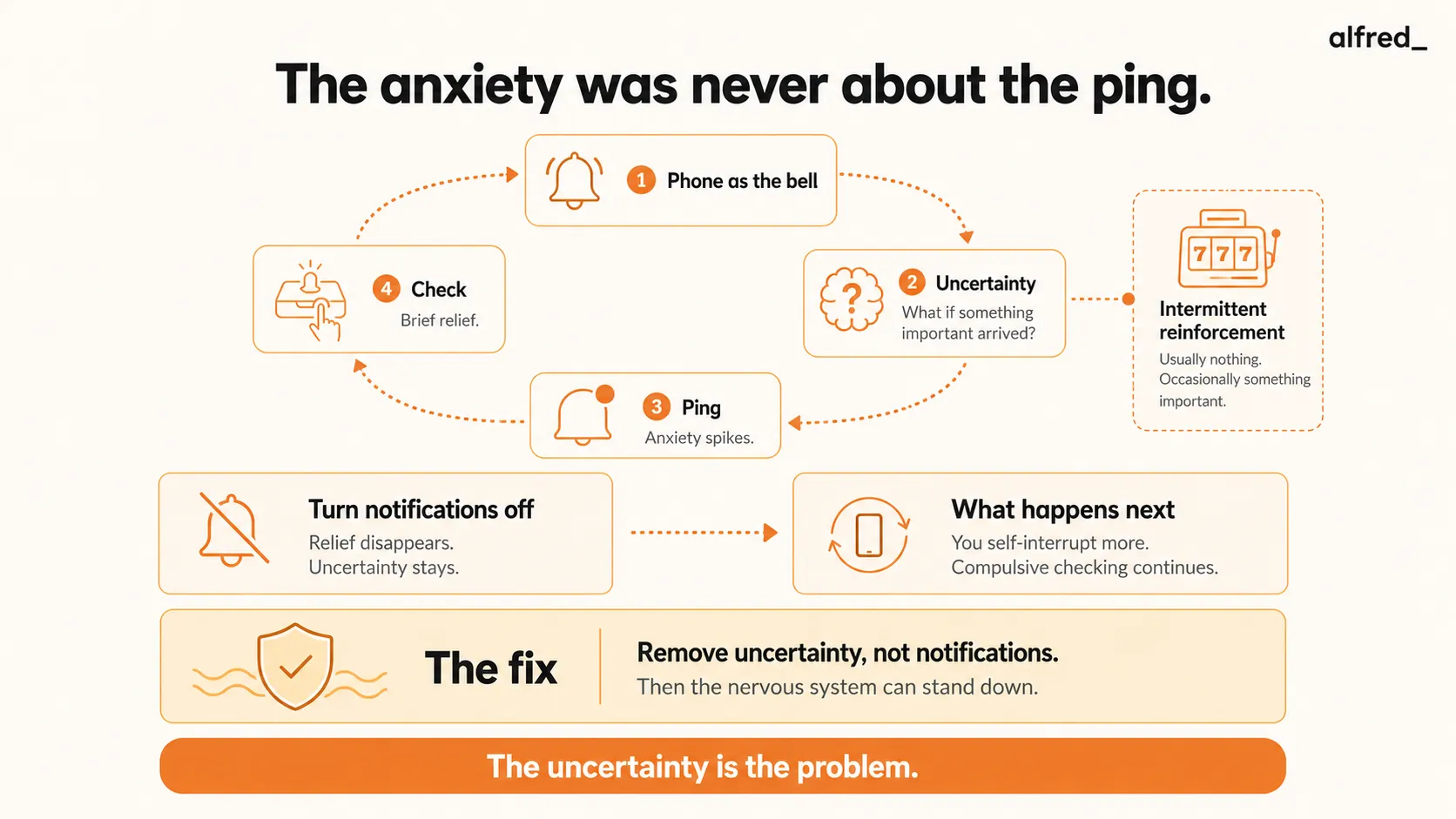
Your phone is the bell.
Every notification might be something important. A client escalation. A meeting change. A request from your boss. Occasionally, it is. That occasional importance, the intermittent reinforcement, is what makes the conditioning so powerful. Slot machines work on the same principle. You do not need to win every time. You just need to win sometimes. The unpredictability is what creates the compulsion.
Research on smartphone notification behavior confirms the mechanism. A study by Duke University found that the average smartphone user receives 65-80 push notifications per day. Each one triggers a micro-decision: check now or risk missing something important? Each decision consumes a small amount of cognitive energy. Each check either resolves the uncertainty (it was just spam) or confirms the threat (it was actually urgent). Both outcomes reinforce the checking behavior, one through relief, the other through validation.
Over months and years, this cycle trains your nervous system to stay in a state of perpetual low-level alert. You are not anxious about a specific notification. You are anxious about the possibility of a notification. The anticipation. The bracing.
That is not a choice. That is conditioning.
Phantom Vibrations: When Your Brain Starts Hallucinating Notifications
You have felt it. Your phone buzzes in your pocket. You pull it out. Nothing. No notification, no missed call, no message. Your phone did not vibrate. Your brain manufactured the sensation.
This is called phantom vibration syndrome, and it is remarkably common. A study by Dr. Michelle Drouin and colleagues found that 89% of undergraduate smartphone users experience phantom vibrations. Research published in Computers in Human Behavior found that phantom vibrations correlate with higher levels of phone dependency and anxiety.
The mechanism: your brain’s threat-detection system has become hyper-tuned to vibration patterns. It operates on the principle that the cost of missing a real threat (missing an important notification) is higher than the cost of a false alarm (checking your phone unnecessarily). So it lowers the detection threshold until it starts generating false positives, perceiving vibrations that did not happen.
“I feel my phone vibrate all the time. It’s in my bag. Or on the counter across the room. Or not even on me. I still feel it.”
Your brain is literally hallucinating notifications. That is how deep the conditioning goes. The notification does not need to exist for the anxiety to fire. The possibility of a notification is sufficient.
Why Turning Off Notifications Is the Cruelest Advice
Every article about digital wellness says the same thing: turn off your notifications. Take back control. The pings are the problem, eliminate the pings.
This advice works for people who do not have notification anxiety.
For people who do, it is a trap.
Here is the paradox nobody talks about. Notifications are simultaneously the cause of the anxiety and the temporary relief from it. The ping triggers the stress response, but the ping also resolves the uncertainty. You hear the notification, you check, and for a brief moment you know: it was nothing. Or it was something, and now you can deal with it. Either way, the uncertainty is momentarily resolved.
When you turn off notifications, you remove both the trigger and the relief. The uncertainty remains, messages are still arriving, you just do not know about them. But now you have no mechanism to resolve the uncertainty without actively checking.
A study by Pielot and Rello had participants go 24 hours without any notifications. The results were telling: participants reported less distraction but significantly more anxiety and FOMO. They checked their phones more often than they did with notifications on. The compulsive manual checking replaced the passive notification, and was worse, because every manual check was a conscious act of giving in to the anxiety.
“I turned off notifications and it somehow got worse, now I compulsively check manually.”
The notifications were at least information. They told you: something happened, here is what it is, now you can decide. Silence tells you nothing. And your brain fills the silence with worst-case scenarios.
This is why the advice is cruel. It sounds rational. It sounds like a boundary. But for someone whose nervous system is conditioned to monitor for threats, removing the monitoring signal does not remove the monitoring behavior. It just makes the monitoring more frantic, more guilt-laden, and more exhausting.
The Cost Nobody Measures
Notification anxiety is not just uncomfortable. It is measurably destructive.
Cognitive cost: Research from Carnegie Mellon University’s Human-Computer Interaction Institute found that notifications cause a measurable decrease in task performance, not just when you check them, but when you resist checking them. The act of deciding not to check consumes the same cognitive resources as actually checking. Your brain pays the attentional cost either way.
Physiological cost: A study by the American Psychological Association found that “constant checkers”, people who continuously monitor their devices, report significantly higher stress levels than those who do not. Separate research found that smartphone notifications trigger cortisol release, even when the notifications are trivial. Over a full day of 65-80 notifications, this amounts to a near-continuous drip of stress hormones.
Social cost: The flinch, the involuntary reach for your phone when it buzzes, happens during conversations, during meals, during moments with your children. Research from the University of Essex found that the mere presence of a phone on the table during a conversation reduces the quality of the interaction, even when the phone never buzzes. The phone represents the possibility of interruption, and that possibility is enough to prevent full engagement.
Sleep cost: Research published in PLOS ONE found that notification frequency is associated with poorer sleep quality. The anticipation of notifications, the awareness that a message could arrive at any time, keeps the brain in a state of readiness that is incompatible with restful sleep. This is why many people check their phone last thing before sleep and first thing upon waking, the monitoring does not pause for unconsciousness. It resumes the moment awareness returns.
“Even when I’m not checking, I’m thinking about what might be in there.”
The cumulative cost of notification anxiety is not a few minutes of distraction per day. It is a continuous degradation of your attention, your relationships, your sleep, and your ability to be fully present in any moment.
The Fix Is Not Fewer Notifications. It Is Less Uncertainty.
Every approach to notification anxiety targets the notifications:
- Turn them off
- Batch them
- Customize them by app
- Use focus modes
- Set Do Not Disturb schedules
None of them target the uncertainty. And the uncertainty is the actual problem.
Here is the distinction. You do not flinch at the ping because of the sound. You flinch because the sound might mean something bad. Or something urgent. Or something you should have handled yesterday. The sound is the trigger. The uncertainty about what it means is the fuel.
If you knew, with certainty. That every genuinely important message was being caught, surfaced, and handled, the ping would lose its power. A notification from a sock company would feel like what it is: irrelevant noise. You would not flinch because there would be nothing to flinch about. The bell would ring and the dog would not salivate, because the bell would no longer be associated with a potential threat.
| Approach | Does It Reduce the Anxiety? |
|---|---|
| Turn off all notifications | No, trades ping anxiety for checking anxiety |
| Notification batching | Partially, creates windows of dread between batches |
| Per-app notification rules | Partially, requires constant rule maintenance as apps change |
| Focus modes | Temporarily, anxiety about what was missed during focus mode |
| Digital wellness apps | Track the behavior but do not address the cause |
| alfred_ | Yes, eliminates the uncertainty that fuels the conditioned response |
Breaking the Loop
alfred_ breaks the Pavlovian loop at the only place it can actually be broken: the uncertainty.
It connects to your email and calendar. It watches your communications continuously. It does not just filter by keyword or sender. It understands context. It knows who matters, what matters, and the difference between “urgent” and “feels urgent.”
When something genuinely needs your attention, alfred_ surfaces it with context, who sent it, what it is about, why it matters, and a drafted reply if one is needed. Everything else is handled, archived, or held for later review.
The shift is subtle but profound. Your phone still receives notifications. But the notifications stop being a lottery ticket that might contain a threat. They become background noise, because you know that the actual threats are being watched for. You stop bracing because there is nothing to brace for. The monitoring is handled.
“The mental overhead of ‘I need to respond to that’ is worse than actually responding.”
alfred_ removes the overhead. Not by eliminating messages, but by eliminating the uncertainty about which ones matter. Your nervous system gets what it needs to stand down: the certainty that nothing important is being missed.
The phantom vibrations fade. Not immediately, conditioning takes time to unwind. But when the reinforcement stops, when the bell stops predicting the food, the salivation stops. When notifications stop being unpredictable threats and become known quantities, the flinch fades.
alfred_ does not change your notification settings. It does not block apps or enforce digital wellness rules. It changes the relationship between you and your notifications by ensuring that the thing you are afraid of, missing something important, is no longer possible.
The ping is still there. The anxiety is not. Because the anxiety was never about the ping.