

“I need a vacation from my vacation.”
You have heard it. You have said it. You have felt it so deeply that you stopped bothering to take the vacation in the first place.
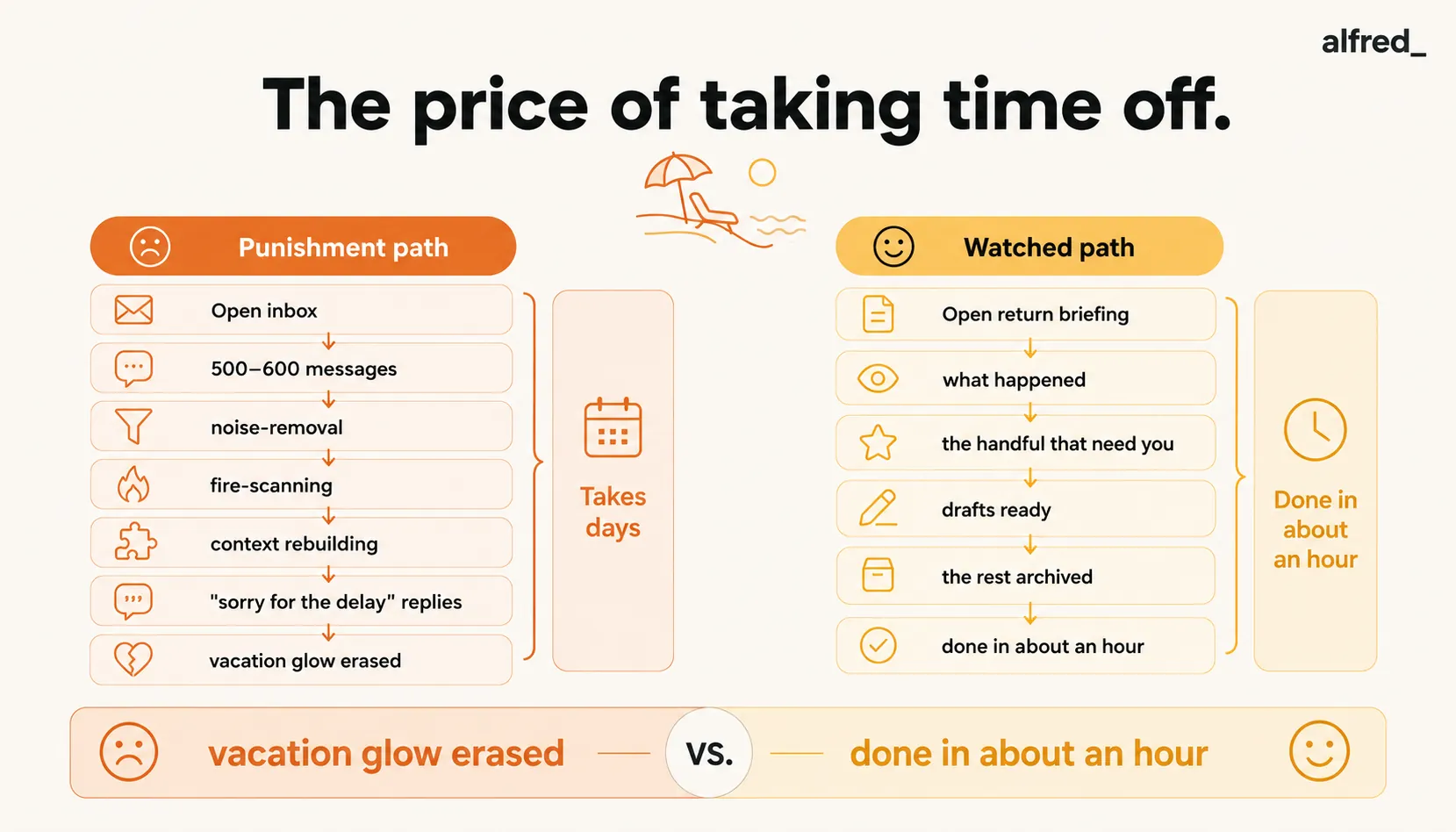
Here is the scene. You have been gone a week. Maybe it was a real vacation, beach, mountains, somewhere without reliable Wi-Fi. Maybe it was a conference. Maybe you were sick. The reason does not matter. What matters is that you were away from your inbox for five, seven, ten days.
You open your laptop. The email loads. The count appears.
512 unread.
Your body does something, a contraction somewhere in your chest. Not pain. Something worse: resignation. You know what the next 48 hours look like. Scrolling. Scanning. Triaging. Rebuilding context on 50 different threads that moved without you. Responding to things that needed responses four days ago with the weak preamble of “Sorry for the delay, just getting back from…”
The vacation glow, the thing that was supposed to last. It evaporates in the time it takes your inbox to load.
The Punishment for Taking Time Off
The math is pitiless.
The average knowledge worker receives 121 emails per day (Radicati Group). Over different periods away, the accumulation looks like this:
| Time Away | Estimated Emails | Catch-Up at 2 min/email | Catch-Up at 3 min/email |
|---|---|---|---|
| Sick day (1 day) | ~120 | 4 hours | 6 hours |
| Long weekend (3 days) | ~360 | 12 hours | 18 hours |
| One week (5 days) | ~600 | 20 hours | 30 hours |
| Conference (3–4 days) | ~400–500 | 14–17 hours | 20–25 hours |
| Two weeks (10 days) | ~1,200 | 40 hours | 60 hours |
Two minutes per email is optimistic. It assumes you scan, decide, and act, or archive, in 120 seconds. For emails that need thoughtful responses, add 5-10 minutes. For emails that reference threads you missed, add another 5 minutes of scrolling to reconstruct context. For emails where the issue escalated while you were away and has since been partially resolved by someone else, add 15 minutes of piecing together what happened.
A one-week vacation creates 2.5 to nearly 4 days of catch-up. The vacation was supposed to recharge you. Instead, half the benefit is immediately consumed by the return.
And this is why people do not take time off.
55% of Americans do not use all their paid time off (U.S. Travel Association). 43% cite workload concerns as a reason for not taking vacation. 768 million vacation days went unused in 2018 alone. Americans are not workaholics by nature. They are rational actors who have calculated the cost of time off and concluded that the inbox penalty makes it not worth it.
That calculation is destroying them. Research from the American Psychological Association confirms that vacation time improves health, reduces burnout, and restores cognitive function, but only if the return does not create a stress event that erases the benefit.
The inbox is the stress event. Every time.
The Anxiety Starts Before You Leave
The inbox penalty does not begin when you return. It begins before you go.
“I spend my last day before vacation pre-answering emails that haven’t been sent yet.”
If you have ever spent the day before PTO in a frenzy, sending pre-emptive updates, answering questions nobody asked, writing detailed handoff documents that nobody will read. You know this pattern. You are trying to prevent the pile. You are trying to address future problems before they become problems. You are trying to make the inbox smaller before it starts growing.
It does not work. The emails come anyway. Your pre-emptive work adds to the email volume because every message you send generates replies. The handoff document sits unread in someone’s inbox, contributing to their pile.
Then the vacation itself. 49% of workers check email on vacation. Not because they are asked to. Because the not-knowing is unbearable.
You are at dinner. A nice dinner. The kind of dinner the vacation was supposed to enable. Your phone is in your pocket. You are thinking about email. Not a specific email, just email. The pile. The growing, invisible pile.
“I can’t be fully present anywhere because part of my brain is always half-monitoring what I might be missing.”
You excuse yourself to the bathroom. You check. 47 new since this morning. You scan the subjects. Nothing urgent. But that one from your boss, “Re: Q3 Planning”, what does that mean? You could open it. You could see. But then you would need to respond, and you are at dinner, and you are on vacation, and you told yourself you would not do this.
You do not open it. You return to dinner. You are no longer present. The mental load of “what did my boss want about Q3 planning?” will accompany you through dessert, through the walk home, and to bed.
Research on psychological detachment from work, the ability to mentally disconnect during off-hours, consistently finds that detachment is the single strongest predictor of vacation benefit. Workers who fully detach show the most recovery. Workers who partially detach, checking occasionally, worrying intermittently, show almost no benefit over workers who did not take vacation at all.
The inbox makes detachment impossible. Not because of employer demands. Because of the uncertainty.
The Wall You Come Back To
You are back. Day one.
The 512 unread messages are not created equal, but they are presented equally, a flat, undifferentiated wall of sender names and subject lines. Some are noise. Some are critical. Some were critical four days ago and are now either resolved or full-blown problems. You cannot tell which is which without opening each one.
The triage process goes like this:
Pass 1: Noise removal (30-45 minutes). Archive newsletters, automated notifications, marketing emails, CC threads that clearly do not involve you. This gets the count from 512 to maybe 280. It feels productive. It is not. You have not read a single important email yet.
Pass 2: Scanning for fires (45-60 minutes). Scroll through the remaining 280 looking for red flags. Emails from your boss. Emails from major clients. Subject lines with words like “urgent,” “deadline,” “issue,” “escalation.” You open the most alarming ones and read them quickly, pulse slightly elevated, building a mental model of what happened while you were gone.
Pass 3: Context rebuilding (2-4 hours). The fires you identified in Pass 2 do not exist in isolation. The client email about the delayed shipment connects to a vendor thread you missed, which connects to a pricing conversation that happened Thursday, which references a spreadsheet someone attached to an email you have not found yet. You are not processing email. You are doing archaeology.
Pass 4: Responding (ongoing, days). By the time you have enough context to respond meaningfully, it is Wednesday. Three days after your return. The responses go out with “Apologies for the delay” and “Just seeing this now”, phrases that feel increasingly hollow the more you use them. Some threads have moved past the point where your input matters. Some threads needed your input days ago and the outcome was worse without it.
The vacation was five days. The recovery is five days. Net benefit: questionable.
Why Out-of-Office Replies Are Performance Art
You set an out-of-office reply. It is polite. It says you are away. It says who to contact in your absence. It says you will respond upon your return.
Here is what actually happens:
- Most people do not read it. They send the email and move on. Your auto-reply arrives in their inbox and is archived or ignored.
- The people who do read it email you anyway. They figure you will see it when you get back. The email still arrives. The pile still grows.
- Nobody contacts the person you listed. Your alternate contact has their own inbox, their own priorities, and no context on your projects. Redirecting to them is a polite fiction.
- The replies to your OOO create more email. People respond to your auto-reply with “Thanks, no rush” or “Will follow up when you’re back”, adding messages to the pile.
The out-of-office reply does not prevent the backlog. It does not triage urgency. It does not draft responses. It does not separate the 40 messages that matter from the 460 that do not. It is a courtesy, and courtesies do not solve structural problems.
What Coming Back Looks Like When Someone Was Watching
Imagine a different return.
You open your laptop. Monday morning after a week away. You open alfred_’s briefing instead of your inbox.
While you were away (Summary):
- 583 emails received over 7 days
- 12 require your attention
- 4 have draft replies ready
- 1 was time-sensitive and was flagged to your alternate contact on Day 3
- 571 have been categorized and archived (newsletters, automated notifications, CC threads, resolved discussions)
Needs your attention:
- Client at Henderson Corp replied about Q3 timeline, pushing to the 22nd. Context from prior 4 messages included. Draft reply ready.
- Boss asked about headcount for Q4 planning. Thread context included. Draft reply ready.
- New inbound lead via referral from Dave Chen. Context on the referral relationship included. Draft reply ready.
- Vendor invoice discrepancy flagged by accounting. Original invoice and contract terms pulled. Draft reply ready. 5-12. Lower-priority items with summaries and context. No drafts needed, quick responses.
Resolved without you (8 items):
- Budget discussion finalized. Final numbers attached.
- Team meeting rescheduled to Thursday. Calendar updated.
- 6 other threads that were resolved by other participants.
You review the 12 items. You edit and send the 4 draft replies. You dash off quick responses to the other 8. Total time: one hour.
It is 9:15 AM. Your first day back has started. Not your first day of catch-up. Your first actual day of work. The vacation benefit is intact. The glow persists. You are rested and you are current.
alfred_ did not do anything magical. It read the emails. It understood context. It made judgment calls about urgency. It drafted responses in your voice. It separated signal from noise. It did what a great human executive assistant would do, the kind that costs $60,000-$120,000 a year, for a tiny fraction of that.
The Vacation You Actually Take
Here is the real transformation, and it is not about Monday morning.
It is about Wednesday night of the vacation. You are at dinner. Your phone is in the hotel room. You are present. Fully present. Not because you are exercising iron discipline. Because there is nothing to worry about. alfred_ flagged the one time-sensitive item on Day 3 and routed it to your colleague. Everything else is being triaged. Your inbox is not a growing pile of unknown problems. It is a managed queue.
You do not check. Not because you decided not to. Because the compulsion is gone. The compulsion was driven by uncertainty, by the growing distance between your last view of the inbox and the current moment, by the expanding gap of not-knowing. That gap does not exist anymore. alfred_ closed it.
89% of people feel refreshed after PTO. But nearly 60% return to a noticeably more stressful workload. The refreshment and the stress exist in the same moment, the vacation was good, and the return erased it.
alfred_ breaks that equation. The vacation is good. The return is manageable. The refreshment persists because the stress event never materializes.
“I don’t need zero inbox. I need to not feel like I’m always behind.”
You do not need zero inbox after vacation. You need to not face 500 undifferentiated messages alone. You need the catch-up to take an hour, not a week. You need to stop being punished for taking the time off you earned.
The inbox penalty is real. It is why people skip vacations, work through sick days, and cut conferences short. It is a structural problem, not a discipline problem, not an organizational problem, not a you problem.
The vacations you have been skipping are worth immeasurably more than alfred_ costs.