

Your daughter is telling you about her day at school. She’s excited. Something happened at recess, a new friend, a game she won, a funny thing the teacher said. She’s looking at you. Talking to you.
And you’re nodding. Saying “wow” and “that’s great” in the right places. But you’re not there. Not fully. Because somewhere in the back of your mind, a thread is running: Did the client reply to the proposal? What did Sarah mean by “let’s discuss”? Is there something sitting in my inbox right now that I should have responded to two hours ago?
You’re physically at the dinner table. Mentally, you’re in your inbox.
“My wife told me I’m always somewhere else. She’s right. Even when I’m sitting right next to her, part of me is monitoring.”
That quote could belong to anyone. A founder. A VP. A project manager. A consultant. The job title doesn’t matter. The feeling is universal: you can’t be fully present because part of your brain is always half-monitoring what you might be missing.
The Cost of Half-Attention
This isn’t about checking your phone during dinner, though you probably do that too. This is about the background process that runs even when your phone is in the other room. The low-grade cognitive hum that never fully stops.
Research makes this uncomfortably concrete.
A 2017 study by Ward, Duke, Gneezy, and Bos at the University of Texas at Austin tested what happens to cognitive performance when a smartphone is merely present, not being used, not buzzing, just sitting face-down on a desk or in a pocket. The results were stark: participants with their phone in the same room performed significantly worse on cognitive tasks than those whose phone was in another room. The mere proximity of the device, and the connection to work it represents, consumed cognitive resources even when participants were not aware of any distraction.
Your phone doesn’t need to ring. It just needs to exist within reach for part of your brain to stay allocated to monitoring it.
A separate study by Kushlev, Proulx, and Dunn at the University of British Columbia found that participants randomly assigned to keep their phone notifications turned on and their phone within reach experienced more inattention and hyperactivity symptoms throughout the week, compared to when alerts were off and phones were kept away. The monitoring function, the background scan for what might need your attention, runs continuously.
This is what your family experiences. Not you on your phone. You near your phone. You at the table but not at the table. You making eye contact but not really seeing them. You hearing the words but not processing them because a portion of your working memory is perpetually allocated elsewhere.
“I can’t be fully present anywhere because part of my brain is always half-monitoring what I might be missing.”
Why “Just Put Your Phone Away” Doesn’t Work
You’ve tried. Of course you’ve tried.
You’ve left your phone in the car. You’ve put it in a drawer. You’ve turned it off completely. And maybe for the first twenty minutes, it helped. But then the anxiety started. Not phone anxiety. Not-knowing anxiety. What if something came in? What if the client responded to the urgent thread? What if there’s a fire and no one can reach you?
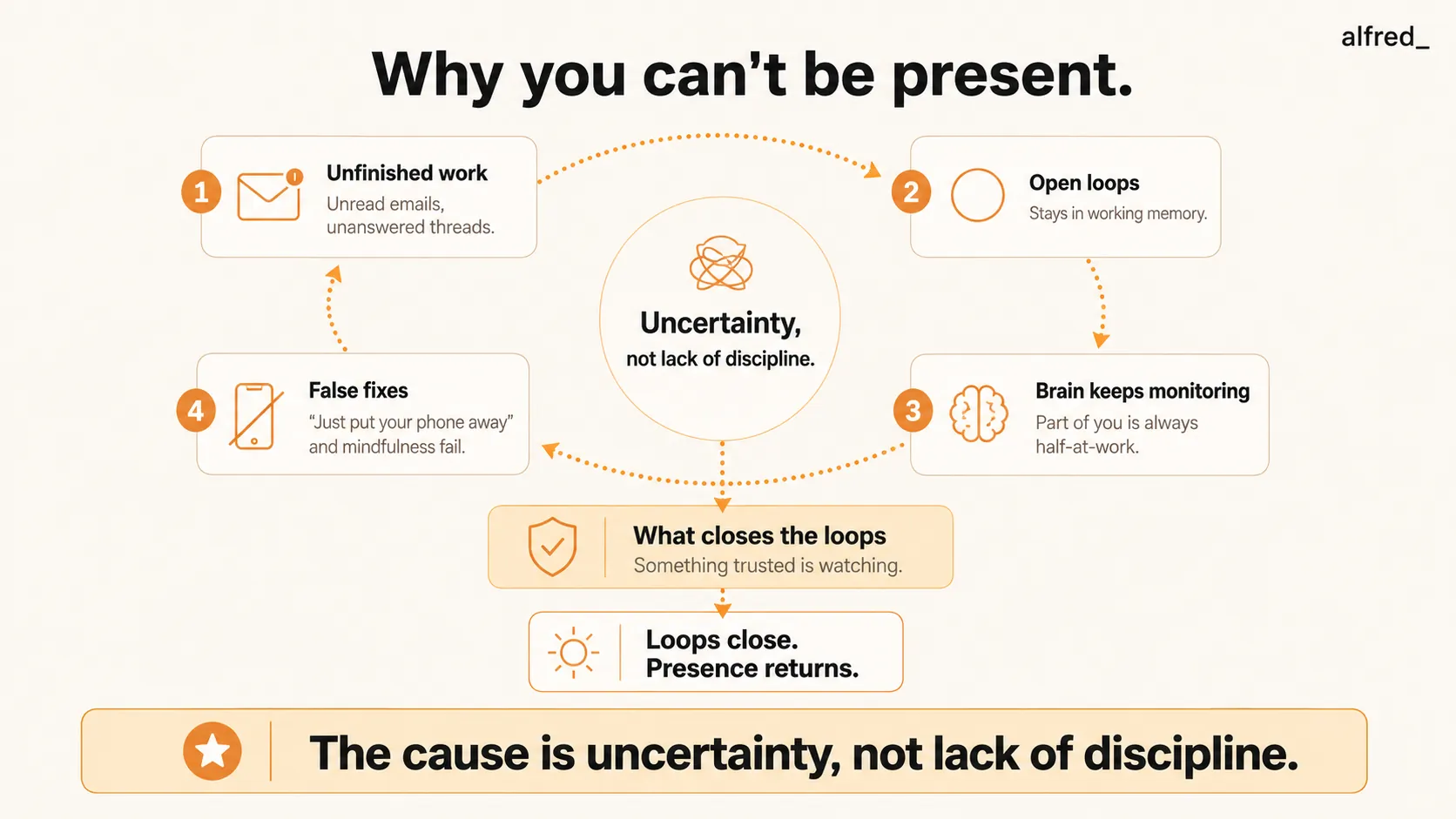
The phone is not the problem. The phone is a symptom. The problem is the open loops.
Psychologist Bluma Zeigarnik documented this in the 1920s. Her research found that unfinished tasks occupy active working memory in a way that completed tasks do not. Your brain treats unresolved commitments, unanswered emails, pending decisions, uncertain outcomes, as open loops that require continuous monitoring. This is the Zeigarnik Effect, and it explains why you can’t stop thinking about work: your brain literally cannot release the threads until they’re resolved or captured in a system you trust.
Every unanswered email is an open loop. Every “I’ll deal with that tomorrow” is an open loop. Every message you saw but didn’t respond to is an open loop. By the time you sit down for dinner, you’re carrying dozens of them. Your brain is tracking all of them simultaneously, like a juggler who can’t put the balls down.
And no amount of mindfulness, willpower, or phone-in-a-drawer rituals will close those loops. They’re structural. They require a structural fix.
The Guilt Spiral
Here’s the cruelest part: you know you’re doing it. You can feel yourself drifting during conversations. You catch yourself mentally composing email replies while your partner is talking. You see the look on your kid’s face when they realize you weren’t listening. And then the guilt hits.
“I feel guilty when I’m with my family because I’m thinking about work. Then I feel guilty at work because I wasn’t present with my family. I’m never fully anywhere.”
Research from the American Psychological Association consistently finds that work-family conflict is one of the strongest predictors of reduced life satisfaction, relationship strain, and burnout. Research published in the Journal of Occupational Health Psychology has found that psychological detachment from work, the ability to mentally disconnect during off-hours, is a critical factor in recovery and well-being. People who can’t detach show higher exhaustion, lower engagement, and worse relationship satisfaction.
But here’s the thing the researchers also found: detachment isn’t just a choice. It’s a function of job demands and recovery conditions. People with high email volume, ambiguous expectations, and no system for capturing unresolved work are structurally unable to detach. Telling them to “be more present” is like telling someone standing in a river to be drier.
The guilt is real. But it’s not a moral failing. It’s the natural consequence of a brain that has no way to confirm that everything is handled.
What Mindfulness Apps and Boundary Advice Get Wrong
The wellness industry has answers for you. Meditation apps. Digital detox challenges. “Set boundaries and stick to them.” Screen time limits. Gratitude journaling.
These are not bad things. But they share a fundamental misconception: they assume the problem is behavioral. That you are choosing to be distracted. That with enough discipline, you could simply decide to be present and it would work.
For some people, that’s true. If your presence problem is a habit, mindless scrolling, reflexive checking, boredom-driven phone use, then behavioral interventions work fine.
But if your presence problem is uncertainty-driven, if the reason you can’t stop thinking about work is that you genuinely don’t know whether something important is sitting in your inbox right now, then behavioral interventions are treating the wrong layer. You can’t meditate away an open loop. You can’t journal away the fact that you don’t know whether the contract fell through while you were at your kid’s soccer game.
“I turned off notifications and it somehow got worse, now I compulsively check manually.”
This is the paradox that drives people toward deeper frustration. The strategies that should work make things worse because they remove the trigger without removing the cause. The cause is uncertainty. The solution is certainty.
What Actually Fixes This
The open loops close when you have a system that provides certainty. Not a system that sorts your email into folders. Not a system that makes processing faster. A system that tells you, with confidence, that nothing important has slipped.
This is the difference between sorting and judgment. Between automation and an assistant.
SaneBox ($7-$36/month) sorts your email by sender reputation. It reduces noise, which is genuinely helpful. But it doesn’t read your messages. It doesn’t know that the email from your colleague contains a time-sensitive request buried in the third paragraph. It sorts. Sorting doesn’t close open loops because sorting doesn’t provide certainty about what matters.
Superhuman ($30-$40/month) makes email faster. Split Inbox separates humans from machines. Keyboard shortcuts let you fly through messages. But speed doesn’t help you when you’re at your daughter’s recital and the question isn’t “how fast can I process” but “is there something I’m missing right now?” Superhuman works at the desk. It doesn’t help when you leave the desk.
Notion and Todoist help you capture tasks, which can partially close loops by externalizing them from working memory. But they require you to manually identify, extract, and log every commitment from every email, which is its own cognitive burden. And they don’t watch your inbox after you’ve captured what you know about. New messages arrive. New loops open. The cycle continues.
alfred_ takes a fundamentally different approach. It connects to your email and calendar and works continuously, reading your messages, understanding context, triaging by genuine urgency. When you leave work, alfred_ keeps watching. If something truly urgent arrives, it surfaces. Draft replies are prepared in your voice. The noise is categorized. When you sit down for dinner, you sit down knowing: there is nothing buried. Nothing has slipped. If something matters, it will find me.
The open loops close. Not because you resolved every email. Because a system you trust is holding them for you.
The Moment You Come Back
People describe it in almost identical terms. Not as a productivity improvement. As a physical sensation.
The first evening where you sit at the table and realize, ten minutes in. That you haven’t thought about work once. Your kid is talking and you’re actually hearing the words. Your partner says something funny and you laugh fully, not the distracted half-laugh you’ve been doing for months. The background hum is gone. Not suppressed. Gone.
“I didn’t realize how much noise was in my head until it stopped.”
This is what happens when the monitoring function shuts down. When your brain receives the signal that it’s safe to stop scanning. When the open loops are held by a system that actually watches, not a to-do list that sits there waiting for you to remember to check it.
You don’t need to be more disciplined. You don’t need another app that helps you organize your guilt. You need the uncertainty to end.
The Math of Presence
Consider what half-attention actually costs over time.
If you spend 3 hours per evening with your family but your cognitive presence is at 60%, the remaining 40% allocated to background work monitoring, you’re losing 1.2 hours of genuine connection per day. That’s 8.4 hours per week. 438 hours per year of presence you’ll never get back.
Your kid’s childhood is happening in those hours. Your partner is sitting across the table in those hours. And you’re there. But not really.
alfred_ costs less than a dollar a day. Less than the coffee you’re drinking while scrolling your inbox at 6:45 AM before anyone else wakes up, the quiet check you do so you can “start the day ready,” which is really just the monitoring function demanding its first update.
The question isn’t whether you can afford an AI assistant. It’s whether you can afford to keep being half-present for the people who matter most.