


Most to-do lists fail before you do a single task on them. You write down twelve things, none of them sized, and by mid-afternoon the list has quietly become a record of everything you did not get to. The problem is rarely discipline. It is that the list never had a shape an actual day could hold. The 1-3-5 Rule fixes that by giving the day a hard, effort-sized ceiling before you start. Here is the method, the research behind why it works, and the two places it breaks down.
Where It Came From
The 1-3-5 Rule was created by Alex Cavoulacos, co-founder and president of The Muse, in an article published on The Muse that was subsequently republished in Fast Company in May 2013. Cavoulacos later formalized the method in The New Rules of Work (Crown Business, 2017), co-authored with Kathryn Minshew.
Unlike the Eisenhower Matrix or GTD, frameworks built by executives and consultants with industrial-era problems, the 1-3-5 Rule emerged from a digital-media startup founder trying to manage her own workday. That origin matters: the method was designed for people with real inboxes, real meetings, and genuinely unpredictable days, not for idealized conditions.
The insight was simple. Cavoulacos noticed that her most productive days shared a common structure: one substantial piece of work got finished, a handful of mid-size tasks got cleared, and several smaller obligations got handled. She reverse-engineered that pattern into a planning constraint rather than leaving it to chance.
The Exact Constraint
Each day, you plan to accomplish exactly:
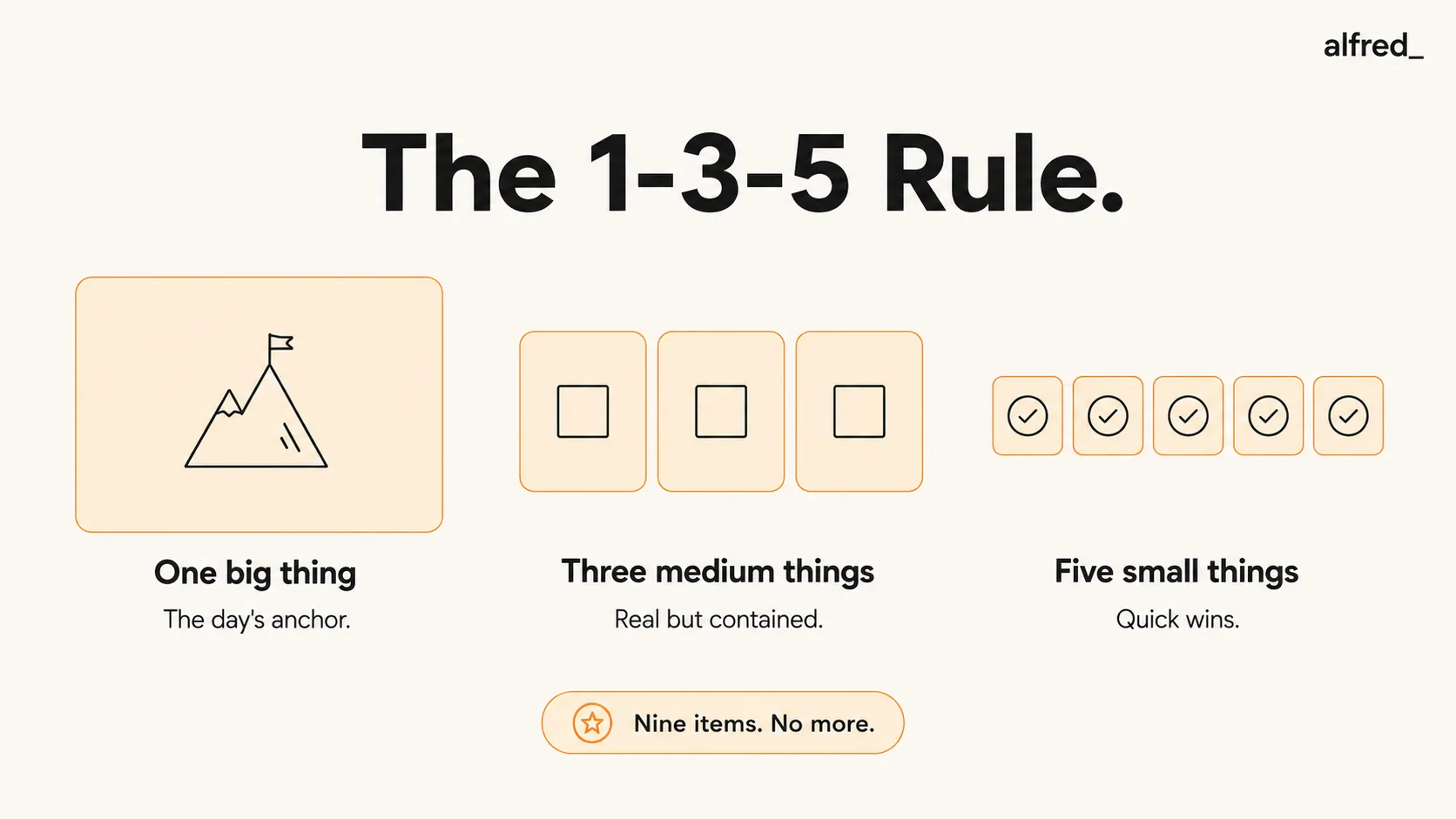
1. Big thing
High-effort, high-impact. The thing that, if completed, makes the day feel genuinely productive. Examples: finishing a proposal draft, completing a design review, shipping a feature.
3. Medium things
Moderate effort: tasks that take real attention but not most of the day. Examples: preparing for a meeting, writing a memo, reviewing a document, responding to a complex thread.
5. Small things
Low-effort, quick to execute. Examples: scheduling a call, filing a document, sending a follow-up, approving a request, paying an invoice.
Total: 9 items maximum. The structure requires you to categorize tasks by effort before you assign them to the day. That is where the method’s real value lies.
9 items
the maximum daily list under the 1-3-5 Rule, organized as 1 big, 3 medium, and 5 small: a hard ceiling that forces planning honesty
Alex Cavoulacos, The New Rules of Work, Crown Business, 2017Why the Effort-Sizing Constraint Is the Mechanism
Most daily task lists fail not at the capture stage but at the planning stage. People add tasks without thinking about how long they will take, which produces a list that looks manageable but is structurally impossible to complete in a single day. The resulting failure feels personal, like a discipline problem, when it is actually a planning problem.
The 1-3-5 Rule solves this through forced categorization. Before a task can go on your list, you have to decide: is this a big thing, a medium thing, or a small thing? That decision surfaces the effort estimation problem before execution, when you still have time to adjust.
Two mechanisms from behavioral research explain why this works:
1. The planning fallacy
Kahneman and Tversky’s 1979 research on planning fallacy showed that people systematically underestimate how long tasks will take while simultaneously overestimating how much they can accomplish in a given period. An unlimited to-do list exploits this bias. You can add twenty items without any internal alarm going off, because there is no structural feedback that the list is unrealistic.
The 1-3-5 structure creates that feedback. Once you have assigned your one big thing and three medium things, adding a second big thing requires removing something, or acknowledging that your plan is impossible. The constraint makes the trade-off visible.
2. Decision paralysis at execution
An unlimited list presents a decision problem every time you look at it: where to start, what to do next, whether to do the hard thing or the easy thing. Research on decision fatigue shows that the quality of decisions degrades as the number of prior decisions made increases. An unlimited list pushes that decision load into the workday itself, when cognitive resources are already being spent on actual work.
The 1-3-5 structure moves the planning decision to the start of the day (or the evening before), when the list is being built. During execution, the only question is which category you are working in, and the answer is usually “start with the big thing.”
How to Build the List in Practice
The method works best when applied at the beginning of the workday or the evening before. The practical steps:
1. Start with the big thing
Ask: what one piece of work, if completed today, would make the day genuinely count? This is typically the most important and most avoided item, the one with real consequences if it doesn’t get done. Write it down first.
2. Choose three medium things
These should be genuinely medium, not three more big things squeezed into the medium slot. If you can’t decide between four candidates, ask which three would cause the most friction if left undone.
3. Fill in five small things
These are the administrative and logistical obligations that accumulate. Clear the ones with the most downstream consequences: the scheduling confirmations, approvals, and follow-ups others are waiting on.
4. Resist adding more
Everything else goes on a separate running list or backlog, not on today’s 1-3-5. The ceiling is the point. If something genuinely urgent arrives mid-day, it can displace an item from the existing list, but the structure doesn’t expand to accommodate it.
How It Relates to Other Systems
The 1-3-5 Rule did not emerge in a vacuum. It shares structural DNA with several older methods and can be meaningfully compared to them.
The Ivy Lee Method
Both the Ivy Lee Method and the 1-3-5 Rule enforce a daily cap and require prioritization before execution. The Ivy Lee Method uses six tasks ranked by priority without distinguishing effort size; the 1-3-5 Rule uses nine tasks organized by effort without requiring a strict sequential ranking. The methods are compatible. You can apply the Ivy Lee sequencing logic (work down in order) within the 1-3-5 structure.
GTD (Getting Things Done)
GTD and the 1-3-5 Rule solve different problems. GTD is a full capture-and-review system designed to eliminate psychic overhead from uncaptured commitments. The 1-3-5 Rule is a daily execution filter. They are highly compatible: use GTD to capture, process, and organize everything; use the 1-3-5 Rule each morning to select today’s nine items from your GTD project and next-action lists.
Cavoulacos acknowledged this pairing in The New Rules of Work: the 1-3-5 Rule is not designed to be a comprehensive task management system. It is a daily planning ritual that works on top of whatever capture system you use.
The Eat the Frog Method
Eat the Frog prescribes starting the day with your most avoided, most important task. This maps cleanly onto the 1-3-5 Rule’s big thing: under either framework, the highest-leverage item gets your first attention. The 1-3-5 Rule adds structure around what happens after the frog is eaten. The three medium and five small items give the rest of the day shape rather than leaving it to ad-hoc prioritization.
1979
Kahneman and Tversky's research on the planning fallacy, the systematic tendency to underestimate task duration, which the 1-3-5 Rule's effort-sizing constraint directly addresses
Kahneman, D. & Tversky, A. (1979). Intuitive prediction: Biases and corrective proceduresWhere the Method Breaks Down
The 1-3-5 Rule has two structural failure modes that its advocates rarely address directly.
1. The categories can be gamed
The method’s constraint only works if you are honest about effort sizing at the planning stage. If you consistently label medium-effort tasks as “small” to fit more into the day, you have reconstructed an unlimited list with extra steps. The method requires genuine self-assessment about what each item actually takes, and most people, most of the time, are optimistic in a way that distorts this.
The practical fix is to ask at the categorization stage: “When have I done something like this before, and how long did it actually take?” Historical anchoring corrects for planning optimism better than abstract estimation.
2. It is not a capture system
The 1-3-5 Rule tells you how to structure the day’s work; it has no mechanism for ensuring that the right things make it onto the list in the first place. Without a companion capture system, such as a weekly review, a backlog, or a project list, important work that lacks an immediate deadline will simply fail to appear in the daily nine. Strategic, long-horizon work is systematically underrepresented in any pure execution ritual.
This is the same limitation as the Ivy Lee Method, and the solution is the same: use the 1-3-5 Rule as an execution layer on top of a broader system that ensures important non-urgent work stays visible.
Where the Right Nine Come From
The 1-3-5 Rule assumes you already know which nine items matter today. That assumption is where most days actually go wrong. The big thing gets crowded out by whatever email shouted loudest, and the important-but-quiet work never surfaces to be sized in the first place. The method has no answer for this, by design. It is an execution filter, not a capture system.
This is the part alfred_ handles. It reads your inbox, calendar, and the threads you are on, then surfaces what genuinely needs you today: the reply someone is waiting on, the commitment you made and have not closed, the deadline moving toward you. Instead of starting your 1-3-5 from a blank page and hoping you remembered the real priorities, you start from a short, honest list of what is actually outstanding. You still decide the one big thing. alfred_ just makes sure the candidates in front of you are the ones that count, not the ones that happened to be loud.
Who It Works Best For
The 1-3-5 Rule is best suited to people whose daily work is genuinely heterogeneous, meaning they have a mix of deep-work tasks, coordination obligations, and administrative overhead in any given day. Knowledge workers, managers, founders, and individual contributors with varied responsibilities tend to find the structure fits naturally.
It is less well-suited to highly specialized roles where almost all work belongs to a single category. A software engineer doing focused feature development may find that most of their day’s tasks are “big things,” making the 1-3-5 structure awkward. In those contexts, simpler systems, such as a single daily priority or a time-blocked schedule, may fit better.
The method also tends to work better for people who can exercise meaningful control over their daily agenda. Roles defined by reactive work, such as customer support, operations, or crisis management, may find the pre-planned structure collapses regularly, since the day’s actual shape is driven by external inputs rather than internal planning.
9
total tasks per day under the 1-3-5 Rule, a constraint calibrated to what a real workday can hold, not what an unlimited list can capture
Alex Cavoulacos, The New Rules of Work, Crown Business, 2017