


Generation One: Pareto’s Observation
Vilfredo Pareto (1848–1923) was an Italian economist, sociologist, and engineer who made his foundational observation while studying Italian land ownership records in the early 1900s. His finding: approximately 20% of Italy’s population owned approximately 80% of the land. He then checked other European countries and found similar distributions.
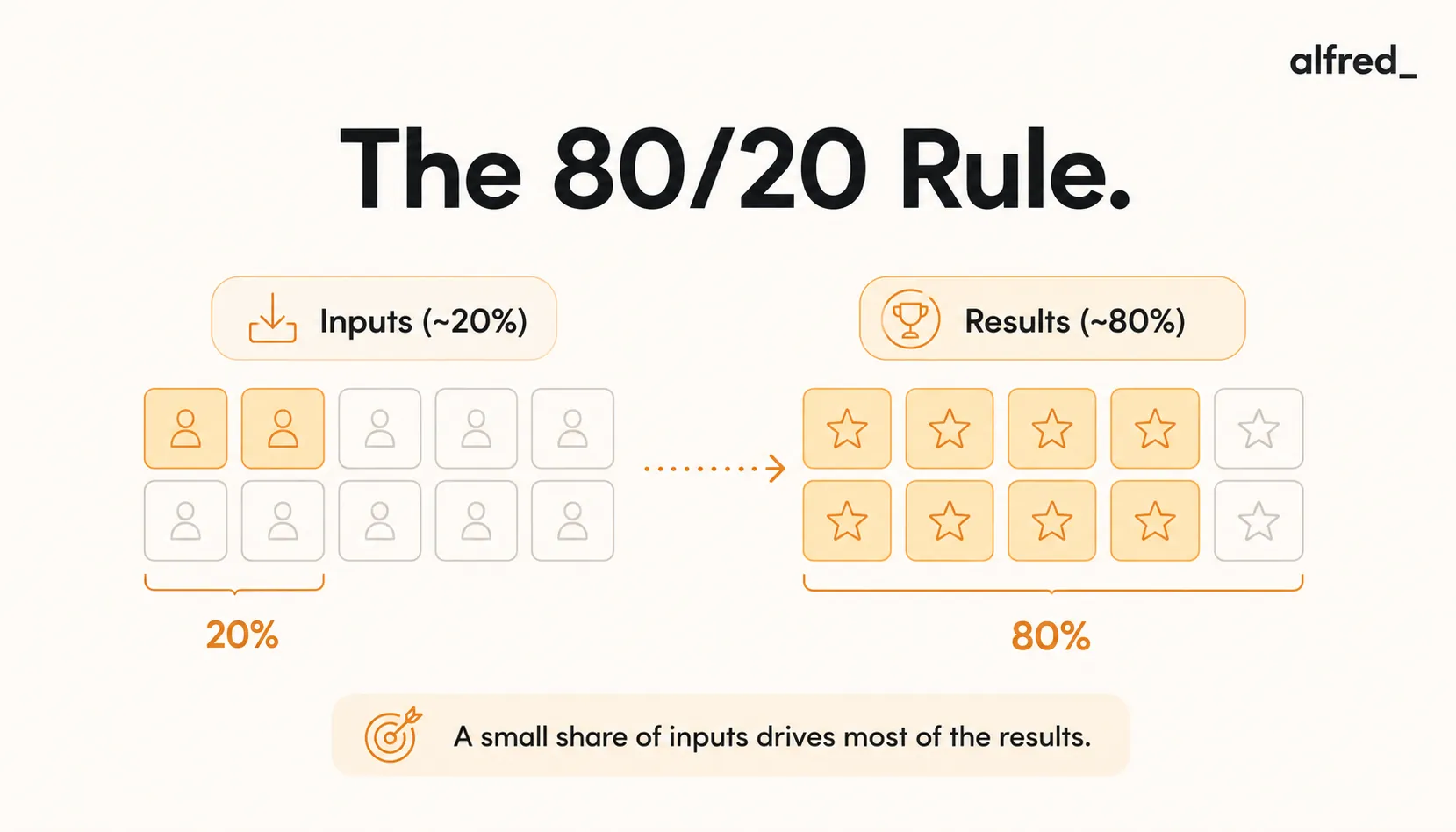
This is the empirical core of the 80/20 rule: a specific, documented distributional observation from land ownership data. It was an economic finding, not a productivity prescription, and Pareto did not propose doing anything in particular about it.
The garden story (that Pareto noticed 20% of his peapods produced 80% of his peas) has circulated widely and functions as the origin myth of the principle. It is likely apocryphal. Most productivity writers repeat it; few trace it to a primary source. The land records observation is the documented one.
1848–1923
Vilfredo Pareto's lifespan. The Italian economist whose land ownership research provided the original 80/20 observation.
Pareto, Cours d'économie politique (1896)Generation Two: Juran’s Business Application
Joseph M. Juran was an American quality management consultant who became one of the founders of the quality movement in the 1940s and 1950s. He coined the phrase that gave the principle its memorable form: “the vital few and the trivial many.”
Juran’s application was to quality defects. He observed that in manufacturing and service processes, roughly 20% of defect types accounted for roughly 80% of total defect volume. If you identified and fixed those 20% of defect types, you resolved the majority of the quality problem.
This is the first prescriptive application of the Pareto distribution. Juran used it to prioritize where to focus quality improvement efforts. Don’t fix every defect type equally. Find the vital few that cause most of the damage and fix those first.
Juran coined “the vital few and the trivial many,” his name for the Pareto distribution applied to business. Fix the vital few defect types, and you solve the majority of the quality problem.
Joseph M. Juran, quality management consultant, 1940s–1950s
Juran named the distribution after Pareto, which is why it’s called the Pareto Principle rather than the Juran Principle. The application to business is Juran’s. The distribution is Pareto’s. The conflation of the two is nearly universal.
1940s–50s
When Joseph Juran applied Pareto's distribution to business quality management, coining 'the vital few and the trivial many'
Juran, Quality Control Handbook (1951)Generation Three: Koch’s Productivity Prescription
Richard Koch is the British businessman and author who extended the Pareto distribution to personal productivity in The 80/20 Principle (1997) and more directly in The 80/20 Individual (2003). Koch’s argument was radical and stated in explicit terms:
“Taken literally, for example, 80 percent of what you achieve in your job comes from 20 percent of the time spent. Thus for all practical purposes, four fifths of the effort, a dominant part of it, is largely irrelevant.”
Richard Koch, The 80/20 Principle (1997)
Koch’s prescription followed directly: identify the top 20% of your activities (the work that produces the highest-leverage outputs) and ruthlessly reallocate time toward those. Everything else should be eliminated, delegated, or minimized to the extent possible.
This is a significant leap from both Pareto and Juran. Pareto described a distributional observation. Juran applied it to defect prioritization. Koch applied it to personal time allocation, a much harder and more subjective domain. The argument is compelling precisely because it is radical: if 80% of your results come from 20% of your time, then four-fifths of your effort is waste.
The Research Gap
The 80/20 principle is a descriptive observation, not a universal law. The actual ratio varies significantly across domains. Sometimes the distribution is 70/30. Sometimes 90/10. Sometimes 60/40. The specific numbers are not fixed.
More critically, the prescriptive leap (“therefore only do your top 20% of tasks”) is a heuristic, not a scientifically validated productivity intervention. Koch’s argument is compelling and has face validity, but it has not been rigorously tested as a productivity protocol in the way that, say, the Pomodoro Technique’s interval lengths have been studied.
The honest assessment: the 80/20 principle has strong descriptive support (distributions like this do appear in many domains), weak prescriptive support (the “therefore do less” conclusion has not been validated in controlled studies), and high practical utility as a forcing function to think about where your highest-leverage activities actually are.
The Identification Problem
The failure mode of the 80/20 principle is not that the distribution doesn’t exist (it probably does in most knowledge work). The failure mode is that most knowledge workers cannot reliably identify which 20% of their activities produces 80% of their results.
The activities that feel most productive (email, meetings, coordination, responding to requests) are often the ones that generate the least leverage. They’re high-frequency and high-visibility, which creates the cognitive illusion of productivity.
The activities that generate the most leverage (building relationships, deep thinking, reading, strategic planning, skill development) are diffuse, hard to attribute, and often impossible to connect to specific outcomes. You rarely know that the lunch conversation with a particular person was in your top 20% until years later.
The 80/20 principle is more useful as a diagnostic question than as an execution framework. The question “which 20% of my work produces 80% of my results?” is valuable even when the answer is uncertain, because it forces a confrontation with where time is actually going versus where it should go.
Koch acknowledges this: the identification requires honest and often uncomfortable reflection. Most people resist it because the conclusion (that a large fraction of their current activity is largely irrelevant) is threatening to their professional identity.
How to Actually Use It
Given the identification problem and the research gap, what is the 80/20 principle actually good for in practice?
1. As a diagnostic question, not a prescription
Ask weekly: “If I could only do 20% of what’s on my plate this week, which 20% would produce the most valuable outcomes?” You don’t have to literally do only that 20%, but the question surfaces what actually matters versus what just feels urgent.
2. As a delegation framework
The principle is most actionable when applied to tasks you can delegate or eliminate. If a task is likely in the bottom 80%, the question becomes: can someone else do this? Can it be automated? Can it be dropped? Koch’s prescription is most achievable in the activities you have control over.
3. As a calendar audit tool
Look at last week’s calendar. Which meetings, tasks, and commitments produced tangible progress toward your most important goals? Which generated activity without output? The audit is a rough approximation of the distribution, and it is usually revealing.
80% of results from 20% of effort
Richard Koch's core claim in The 80/20 Principle (1997): the prescriptive application of Pareto's distribution to personal time allocation
Richard Koch, The 80/20 Principle (Nicholas Brealey, 1997)