

Your calendar is a wall of back-to-back blocks, you end each day exhausted with nothing of your own work done, and the obvious conclusion is that you have too many meetings. That is true but not useful, because “too many meetings” is actually two different problems wearing one disguise: meetings that should not exist at all, and meetings that exist only because information is not reaching people any other way. They look identical on the calendar and require opposite fixes. Here is how to tell them apart and address each.
Drucker’s Diagnosis: Excessive Meetings Are an Organizational Symptom
Peter Drucker’s most important observation about meetings wasn’t about how to run them better. It was about what their excessive presence reveals. “Meetings are by definition a concession to deficient organization,” Drucker wrote. “If executives spend more than a small fraction of their time in meetings, it is a sure sign of malorganization.”
“If executives spend more than a small fraction of their time in meetings, it is a sure sign of malorganization.”, Peter Drucker, The Effective Executive
Drucker identified four organizational time wasters that manifest as excessive meetings. Two are particularly common: malorganization (where structural problems force people to meet in order to get clarity they can’t get any other way) and malfunction in information, where people can’t access what they need without asking someone directly.
The diagnostic question this implies: for every meeting on your calendar, what organizational failure does it compensate for? Answer that question honestly and you’ll find that a meaningful fraction of your recurring meetings aren’t meeting problems. They’re system problems wearing meeting clothes.
23 hrs
average executive time spent in meetings per week, with over half rated as unproductive
Harvard Business ReviewThe Two Types of Meeting Overload
Meeting overload comes from two structurally different sources, and they require two structurally different fixes:
Type 1: Meetings That Compensate for Missing Information Systems
These meetings exist because information isn’t reaching people any other way: weekly status updates because there’s no shared project tracker, Monday morning check-ins because nobody knows what others are working on, recurring briefings because the decision-maker can’t access the data without asking. The fix is the information system, not the meeting. Create the shared doc, the dashboard, the async update process, then cancel the meeting.
Type 2: Meetings That Compensate for Missing Decision Authority
These meetings exist because nobody is empowered to decide without a committee: cross-functional approval meetings, escalation chains, review cycles that require six people to sign off on what one person could decide. The fix is authority clarity, not meeting efficiency. Define who can decide what, and the committee meetings dissolve.
Andy Grove distinguished between process-oriented meetings (regularly scheduled, proactive, prevent problems) and mission-oriented meetings (ad hoc, reactive, compensate for failed processes). Grove’s principle: “Ideally, a manager should never have to call an ad hoc, mission-oriented meeting, because if all runs smoothly, everything is taken care of in regularly scheduled, process-oriented meetings.”
The presence of many mission-oriented meetings is the signal. The fix is improving the process-oriented meetings, not accepting the fire-fighting as inevitable.
Collins’s Stop-Doing List for Your Calendar
Jim Collins, in Good to Great, argued that the discipline of the stop-doing list is equal to, and often more important than, the to-do list. “The presence of an ever-expanding to-do list without a robust stop-doing list is a lack of discipline.” Replace “to-do list” with “calendar” and the principle applies exactly.
“The presence of an ever-expanding to-do list without a robust stop-doing list is a lack of discipline.”, Jim Collins, Good to Great
The quarterly calendar audit: for every recurring meeting, ask Collins’s test question: “If we were starting from scratch today, would we schedule this meeting?” Not “Is this meeting useful?” (that bar is too low). Not “Would someone be annoyed if we canceled it?” (that’s the wrong consideration). “Starting from scratch, knowing what we know now, would we choose to put this on the calendar?”
Collins also said: “Good is the enemy of great.” Every “good enough” recurring meeting that you keep because it’s fine takes a calendar slot that could belong to deep work, a strategic conversation, or nothing at all. The meeting doesn’t have to be useless to deserve cancellation. It has to fail the scratch test.
Lencioni’s Structure Fix: More Meeting Types, Fewer Meetings
Patrick Lencioni’s counterintuitive finding: most organizations don’t suffer from too many meeting types. They suffer from too few. When strategic discussions get jammed into tactical meetings, and tactical updates get jammed into one-on-ones, every meeting becomes overlong, unfocused, and inconclusive.
Implementing Lencioni’s four distinct meeting types (Daily Check-In, Weekly Tactical, Monthly Strategic, Quarterly Off-Site) often reduces total meeting time even though it introduces more meeting categories. Here’s why: each meeting is dramatically shorter because it has a defined scope. A 10-minute daily standing meeting prevents four 30-minute ad hoc check-ins. A 90-minute weekly tactical prevents a dozen informal interruptions and status requests throughout the week.
The weekly tactical’s lightning round is particularly powerful for meeting overload: each person states their top priorities in one minute. The agenda is set from what the lightning round reveals, not from a pre-set list. This means the meeting is always addressing the actual live obstacles, not the ones someone anticipated last week when they wrote the agenda.
Graham’s Office Hours Principle Applied to Meeting Overload
Paul Graham’s insight about the maker’s schedule and the manager’s schedule applies to meeting overload in a specific and practical way. Graham noted: “When you’re operating on the maker’s schedule, meetings are a disaster. A single meeting can blow a whole afternoon, by breaking it into two pieces each too small to do anything hard in.”
“If I know the afternoon is going to be broken up, I’m slightly less likely to start something ambitious in the morning.”, Paul Graham, Maker’s Schedule, Manager’s Schedule
The anticipatory cost is real: a meeting at 2pm doesn’t just consume the hour from 2-3pm. It degrades the two hours before it as well, because the approaching meeting creates a cognitive ceiling on the depth of work possible. This means that scattered meetings across the day produce a total productivity cost far larger than their combined duration.
Graham’s solution, office hours, is simple: cluster all meetings at one end of the day. All meetings in the afternoon, protect mornings completely. This doesn’t require reducing the total number of meetings; it requires changing when they happen. The compound effect: reclaimed mornings across five days produces up to 10 hours of deep work per week without canceling a single meeting.
Newport: Meeting Overload as an Attention Problem, Not a Time Problem
Cal Newport’s research on attention residue adds another dimension to the cost of scattered meetings. Each meeting leaves cognitive residue, a portion of attention that remains on the meeting’s unresolved questions rather than moving fully to the next task. The cost isn’t just the time in the meeting; it’s the degraded cognitive performance in the hours surrounding it.
Newport’s process-centric fix for meeting overload: identify which meetings exist purely to share information. For each one, ask what written alternative would serve the same function. Jeff Bezos’s principle applies here: written communication forces clarity. A well-written async update replaces a meeting and produces better-organized information in the process.
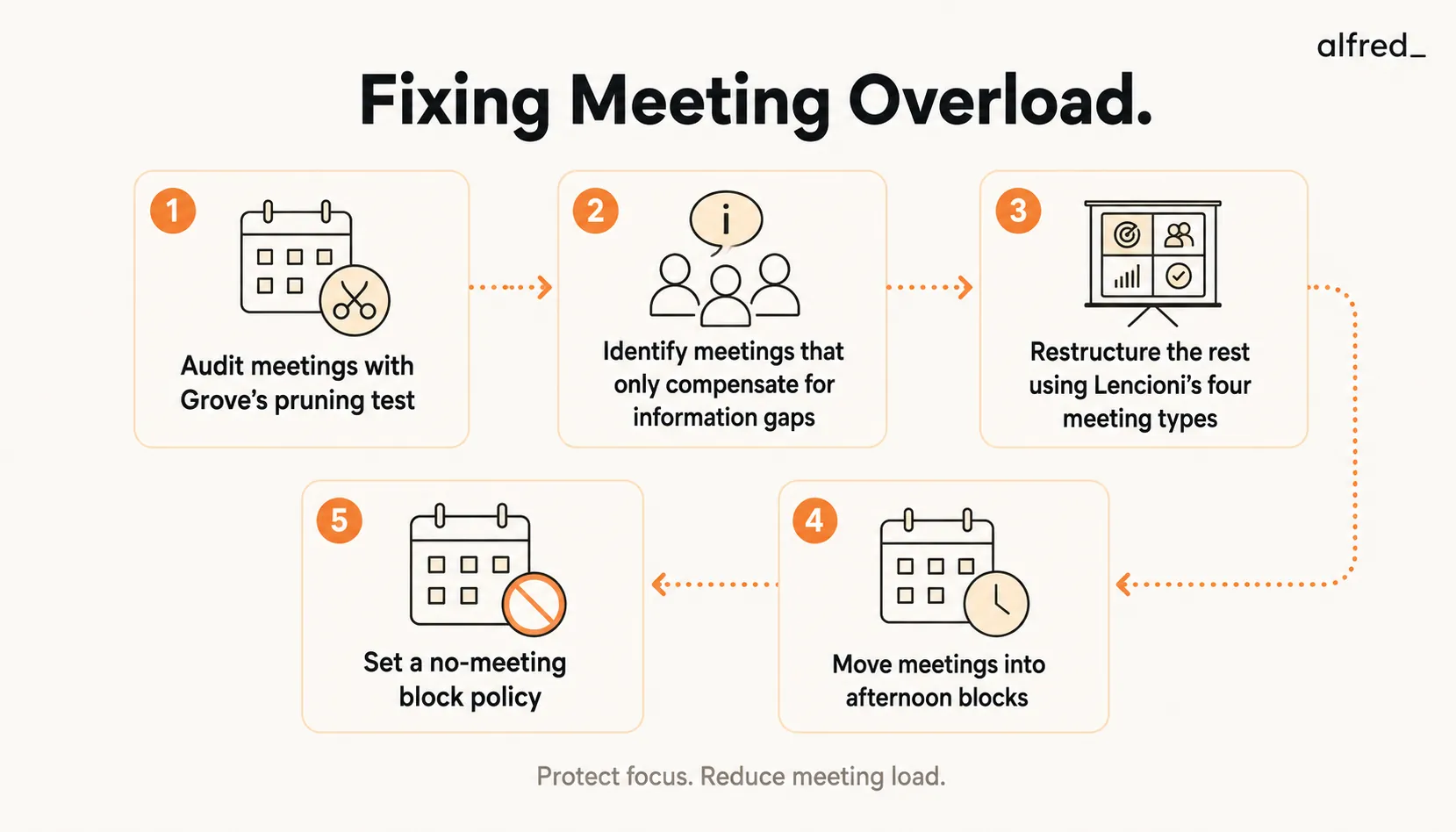
Step-by-Step: Reduce Meeting Overload
1. Conduct a Meeting Audit Using Grove’s Pruning Test
List every recurring meeting on your calendar. For each one, apply Grove’s test: “What would happen if this meeting didn’t exist?” If the answer is “nothing,” cancel it. If the answer is “we’d send an email,” cancel it and send the email. If the answer is “a decision-making forum we need would disappear,” keep it and move to step 2.
2. Identify Meetings That Compensate for Information Gaps
For each surviving meeting, ask: does this exist because information isn’t reaching people any other way? If yes, create the async alternative first. Build the shared project tracker, the weekly written update, the dashboard that surfaces what the meeting was surfacing. Then cancel the meeting. Do this before restructuring, not after.
3. Restructure Remaining Meetings Using Lencioni’s Four Types
Map each surviving meeting onto one of Lencioni’s four categories: Daily Check-In, Weekly Tactical, Monthly Strategic, Quarterly Off-Site. Meetings that don’t fit any category are probably confused hybrids; split them or eliminate them. Meetings that belong in the same category but are currently separate can often be merged.
4. Move All Meetings to Afternoon Blocks
Apply Graham’s office hours principle: consolidate all meetings into afternoon blocks. This doesn’t require fewer meetings, just different timing. Block your calendar mornings as “no meetings” and push all recurring meetings to post-noon slots. The morning deep work you recover compounds: five protected mornings per week multiplied by your team size multiplied by 50 work weeks.
5. Establish and Communicate a No-Meeting Block Policy
Block at least one meeting-free period per day on your shared calendar. Communicate this to your team as a norm, not just a personal preference. When the team understands that morning blocks are sacred, they stop scheduling into them. This is a team-level cultural change, not just a personal calendar management tactic.
Before and After: What Meeting Reduction Actually Looks Like
Before: 23 Hours of Meetings Per Week
- Scattered meetings throughout the day: 9am, 11am, 1pm, 3pm, 4:30pm
- Context switching constantly, never more than 90 minutes of unbroken time
- Deep work relegated to evenings and weekends
- Feeling perpetually busy but rarely accomplishing anything important
After: 12 Hours of Structured Meetings Per Week
- All meetings after 1pm, mornings fully protected
- Lencioni structure: 10-min daily standup, 60-min weekly tactical, monthly strategic
- 4 hours of deep work every morning before the first meeting
- Information needs met by async updates, no status meetings