

Think about the last genuinely good meeting you were in. It probably ended early, reached a clear decision, and left everyone knowing what happens next. Now think about how rare that was. Most meetings are boring and inconclusive, and the reason is not that people are bad at meetings. It is that nobody designed them: no clear type, no decision to make, no owner of the outcome. A meeting is a tool, and an undesigned tool produces undesigned results. Here is how to design meetings that actually decide things, using the frameworks of Lencioni, Bezos, and Grove.
Drucker’s Uncomfortable Truth About Meetings
Peter Drucker wrote what remains the most honest thing anyone has said about meetings: “Meetings are by definition a concession to deficient organization. For one either meets or one works. One cannot do both at the same time.”
“Meetings are by definition a concession to deficient organization. For one either meets or one works. One cannot do both at the same time.”, Peter Drucker, The Effective Executive
Drucker identified four organizational time wasters that generate excessive meetings. Two are particularly relevant: malorganization (excessive meetings are a symptom of structural problems, meaning people can’t get clarity any other way) and malfunction in information (people meet because they don’t have access to what they need without asking someone).
The implication is uncomfortable: some meetings shouldn’t be made more efficient. They should be eliminated, and the organizational failure they compensate for should be fixed instead. If your team holds a weekly update meeting because people otherwise don’t know what others are working on, the solution is a shared project management system, not a shorter update meeting.
23 hrs
average executive time in meetings per week, up from fewer than 10 hours in the 1960s
Harvard Business ReviewLencioni’s Four Meeting Types: The Framework Most Organizations Ignore
Patrick Lencioni’s Death by Meeting argues that most organizations don’t have too many meetings. They have too many structurally confused meetings. When strategic topics get jammed into tactical meetings and administrative updates get jammed into decision meetings, every meeting becomes shapeless and nothing gets resolved.
Lencioni’s solution is not fewer meetings. It’s four distinct meeting types, each with its own purpose, duration, and rules:
1. Daily Check-In (5-10 minutes, standing)
Administrative alignment only. Each person states their top three priorities for the day. Standing, no chairs. No problem-solving. No status updates on projects. If an issue surfaces that requires discussion, schedule it in the weekly tactical, then move on. The daily check-in exists to prevent the wrong things from consuming the wrong people’s days.
2. Weekly Tactical (45-90 minutes)
Begin with a lightning round: each person gives their top two to three priorities for the week in one minute or less. Then, critically, set the agenda based on what surfaced in the lightning round, not from a pre-set list. The lightning round reveals where the real obstacles are. A pre-set agenda obscures them. The weekly tactical handles tactical obstacles and near-term decisions. Strategic topics get deferred.
3. Monthly Strategic (2-4 hours)
One or two topics maximum. Real conflict required. This is where you explore uncomfortable options, surface hidden disagreements, and make decisions that shape the organization for months. Lencioni is specific: if there is no conflict in a monthly strategic meeting, something is wrong. Either the topic isn’t strategic enough, or people are holding back. The facilitator’s job is to surface both.
4. Quarterly Off-Site (1-2 days)
Comprehensive review of strategy, team dynamics, and culture. Away from the office, physically removed from operational context. Includes unstructured time. This is where the team reconnects with the big picture it has been too busy executing to examine.
“Meetings are boring because they lack drama. Leaders do not look for legitimate reasons to provoke relevant, constructive, ideological conflict that keeps people engaged.”, Patrick Lencioni, Death by Meeting
The Bezos Running Rules
Jeff Bezos banned PowerPoint at Amazon and replaced it with a requirement for written six-page narrative memos. At the start of every substantive meeting, attendees read the memo silently for 30 minutes. Discussion begins only after everyone has read.
The rationale is structural: “You can hide a lot of sloppy thinking behind bullet points.” A bullet point can assert without supporting. A sentence must connect to a following sentence. Narrative structure forces the author to reason, and forces the reader to evaluate that reasoning rather than fill in gaps with their own assumptions.
“There is no way to write a six-page narratively structured memo and not have clear thinking.”, Jeff Bezos
Bezos also introduced the two-pizza rule for meeting size: if a meeting requires more food than two pizzas to feed, it has too many people. Beyond five to eight attendees, meetings transform from decision-making sessions into performances. People speak to appear informed rather than to resolve the question at hand. The fix: remove one person at a time until the meeting would break. The last person you couldn’t remove is the minimum viable attendee list.
Grove’s Preparation Principle
Andy Grove identified arriving unprepared to a meeting as a high-leverage negative act. It wastes every attendee’s time while simultaneously depriving them of whatever they would have done instead. Grove called this negative leverage: one person’s failure producing costs multiplied across everyone in the room.
The preparation standard Grove applied: every meeting should have a defined purpose, an agenda, an expected output, and a pre-read if necessary. Not as bureaucracy, but as respect for everyone’s time and alternative uses of it.
Apply Grove’s pruning test to every meeting invite you send: “What would happen if the people I am inviting did not attend this meeting at all?” If the honest answer is “they would be informed by email,” send the email. If the answer is “they would miss a decision they need to make,” you have a real meeting.
Mining for Conflict: The Facilitator’s Most Important Skill
Lencioni’s most counterintuitive insight: most meetings fail not because they have too much conflict but because they have too little. People hold back to avoid awkwardness, keep the peace, or protect relationships. The real conversation happens in the hallway afterward.
The facilitator’s job in a monthly strategic meeting is to surface the hallway conversation inside the meeting room. Lencioni’s technique, “mining for conflict,” requires asking directly: “What is the one thing we are not saying that we should be saying?”
This question does two things simultaneously: it names the pattern (something is being withheld) and it creates explicit permission to say it. Most people know what the unspoken thing is. They’re waiting for someone to open the door. The facilitator opens the door.
The question: “What is the one thing we are not saying that we should be saying?”, Lencioni’s mining for conflict technique
Step-by-Step: Run a Meeting That People Actually Value
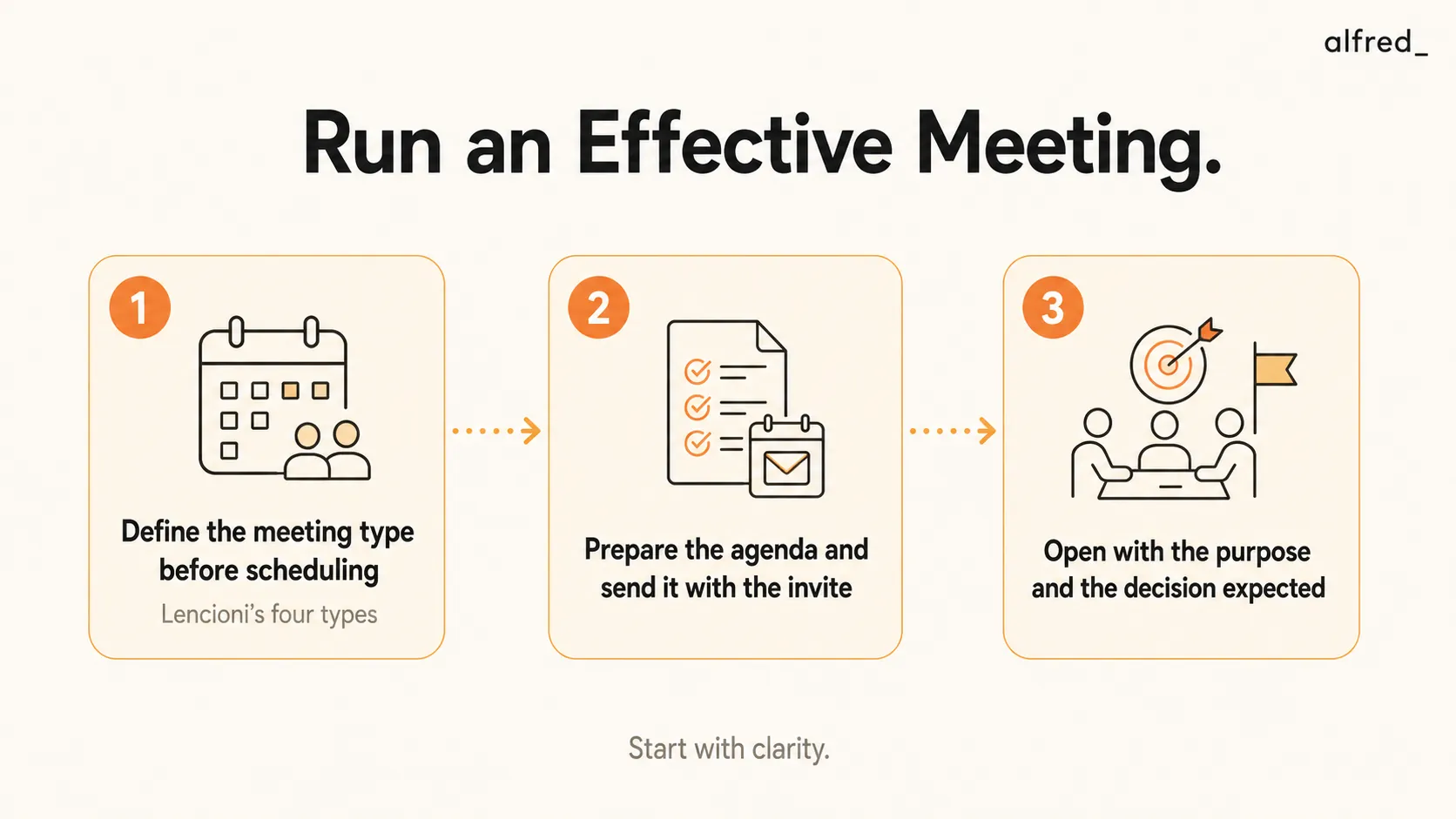
1. Define the Meeting Type Before Scheduling
Before creating the calendar invite, decide: is this a daily check-in, weekly tactical, monthly strategic, or quarterly off-site? The answer determines the duration, the attendee list, the format, and the facilitator’s role. A meeting without a type is a meeting without a structure, and a meeting without a structure produces nothing.
2. Prepare the Agenda and Send It With the Invite
Include the expected output explicitly: “By end of this meeting, we will have decided X.” This shapes attendee preparation, the facilitator’s job during the meeting, and the note-taker’s job after. If you can’t state the expected output in one sentence, the meeting isn’t ready to be scheduled.
3. Open With the Purpose and Expected Decision
The first words spoken in the meeting should be the purpose statement and the expected decision. Not “Thanks for coming.” Not “Let me give some background on how we got here.” The purpose, then the decision required. This sets the filter for everything that follows. Discussion that doesn’t contribute to that decision doesn’t belong in this meeting.
4. At Strategic Meetings: Actively Mine for Conflict
If the discussion in a monthly strategic meeting is artificially smooth (everyone nodding, no tension), call it directly. Ask “What is the one thing we are not saying that we should be saying?” Then stay quiet. The silence is productive. It creates the space for someone to say the actual thing.
Conflict in a strategic meeting is not a problem to manage. It’s the mechanism by which good decisions get made. Artificial consensus produces decisions that get relitigated in hallways.
5. Close With Explicit Next Steps Read Aloud
Reserve the last five minutes of every meeting for the close. Someone reads the action items, owners, and deadlines out loud. Every attendee confirms their commitments before leaving the room. This is not optional. It’s the mechanism that converts meeting discussion into organizational action.
What to Do With Recurring Meetings
Jim Collins, in Good to Great, introduced the stop-doing list as a discipline equal in importance to the to-do list. The principle applies directly to your recurring meetings. Every quarter, apply Collins’s question to each recurring meeting on your calendar: “If we were starting from scratch today, would we schedule this meeting?”
“The presence of an ever-expanding to-do list without a robust stop-doing list is a lack of discipline.”, Jim Collins, Good to Great
Then apply Grove’s pruning test: “What would happen if this meeting didn’t exist?” If the answer is “we would email the status update,” cancel the meeting and send the email. If the answer is “we would lose the only structured forum for this team to make decisions together,” keep it, but redesign it using Lencioni’s types.
Collins also noted that good is the enemy of great. Every “good enough” recurring meeting crowds out the time and attention that a genuinely important meeting needs. The quarterly calendar audit is the mechanism that keeps the good from accumulating at the expense of the great.
How alfred_ Supports Meeting Effectiveness
The administrative overhead around meetings (scheduling, follow-up emails, action item tracking) is one of the most significant costs of meeting culture. alfred_ handles the before and after so you can focus on the during.
Before meetings, alfred_’s Daily Brief surfaces any relevant email threads, outstanding action items from prior meetings, or context you need to prepare. After meetings, alfred_ drafts the follow-up email with key points and action items. This is the critical step that most professionals skip because something else pulls their attention before they send it.