

31 hrs/mo – The average professional spends 31 hours per month in meetings they consider unproductive. That’s nearly four full working days spent in rooms – physical or virtual – where nothing is decided, no progress is made, and the only outcome is another meeting. (Atlassian)
Here’s what 31 wasted hours per month actually costs you. At a $75/hour fully-loaded rate, that’s $2,325/month in salary spent sitting in meetings that shouldn’t exist. For a team of 10, that’s $23,250/month. $279,000/year. Burned.
But the financial cost isn’t even the worst part. The worst part is what those meetings displace. Every unnecessary 30-minute meeting doesn’t just cost 30 minutes. It fragments your day into two smaller blocks, both too short for deep work. A calendar with six meetings doesn’t leave six hours of work time. It leaves six 30-to-45-minute gaps, most of which get wasted on email and context-switching.
Saying no to meetings is not rude. It’s necessary. But most people don’t do it because they lack the language.
Here’s the language.
How do you decline a meeting professionally?
- Respond within 24 hours – silence isn’t a polite no, it’s a confusing no
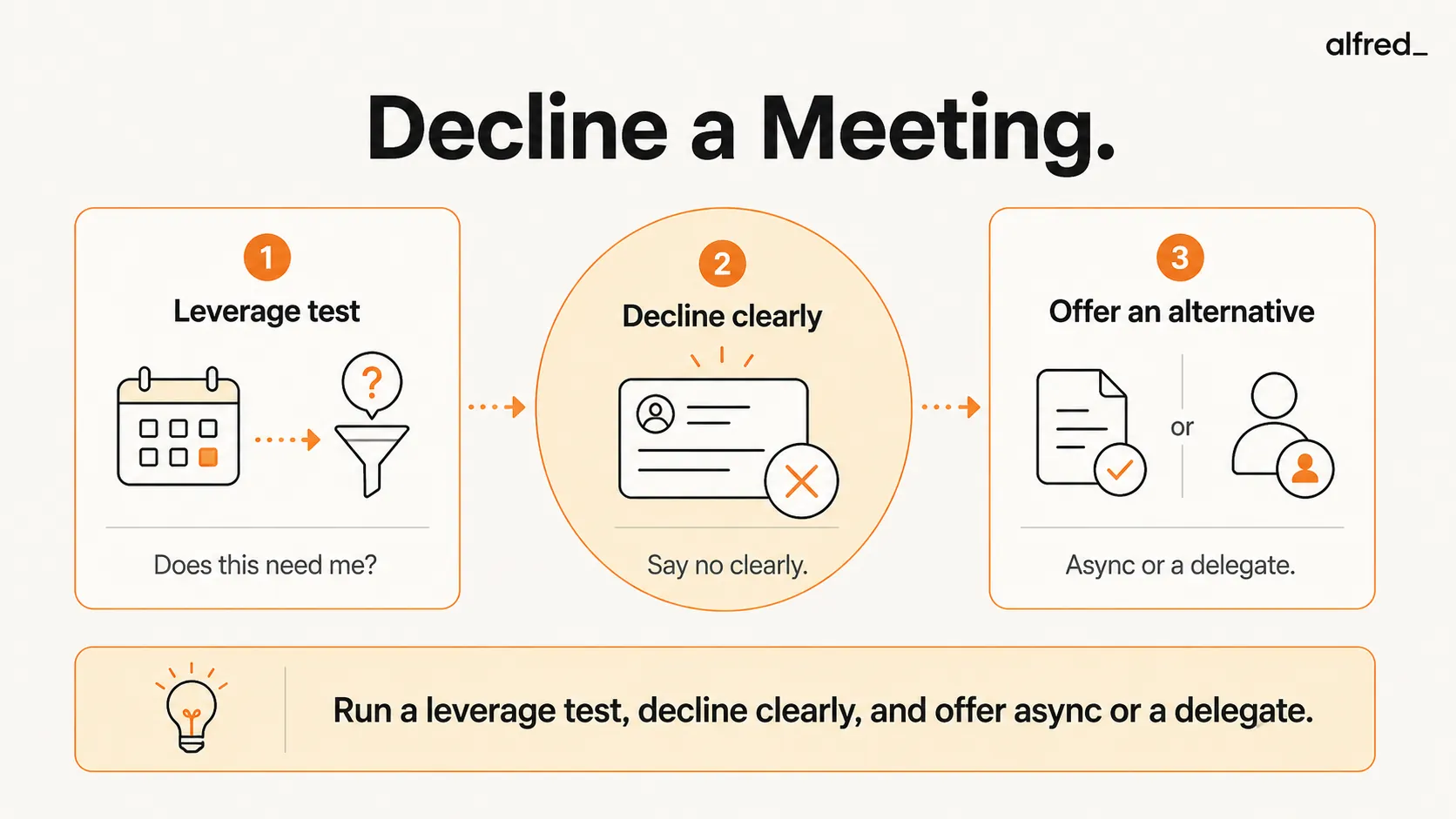
- Give a brief, honest reason – ‘I have a conflict’ or ‘I don’t think I’m the right person for this’
- Suggest an alternative – async update, delegate, shorter meeting, or different time
- Use templates until declining feels natural – scripts remove the emotional friction
When to Decline a Meeting
Not every meeting deserves your time. Before you accept, run it through these four questions.
Is there an agenda? If nobody can articulate what the meeting is about in advance, the meeting is a brainstorm disguised as a decision. These waste everyone’s time. Respond with: “Happy to join – can you share an agenda so I can prepare?”
If they can’t produce one, you have your answer.
Am I a contributor or an audience member? Some meetings require your input. Others just want your presence. If you’ll sit silently for 45 minutes while other people discuss things you’re not involved in, you’re an audience member. Ask for the notes afterward instead.
Could this be an email or a Slack message? The classic question, but people don’t ask it often enough. Status updates, FYI announcements, and one-directional information sharing do not require synchronous time. Push back gently: “Would you be open to sharing this as a written update instead?”
Does this meeting have a decision to make? Meetings without a decision to make are discussions. Discussions are fine – in moderation. But if you have three discussions on your calendar and zero decision-making meetings, your calendar is optimized for talking, not doing.
Scripts for Every Situation
The Direct Decline
Thanks for the invite. I’m going to pass on this one – I don’t think I’d add enough value to justify taking a seat. Happy to review the notes afterward and weigh in async if helpful.
When to use it: When you’re genuinely not the right person for this meeting and your absence won’t affect the outcome.
The Delegation
Thanks for including me. [Colleague name] is closer to this project than I am right now – would it work to have them attend instead? They can loop me in on anything that needs my input.
When to use it: When someone on your team is better positioned for this conversation.
The Async Alternative
I’d love to stay in the loop on this. Would you be open to sharing a written summary instead of meeting? I can respond with my input by end of day. That way we both save 30 minutes.
When to use it: When the meeting is primarily informational and doesn’t require real-time discussion.
The Reschedule
This conflicts with a block I’ve set aside for [deep work / client deliverable / heads-down time]. Could we find a different slot? I’m open on [specific days/times].
When to use it: When you want to attend but the timing kills a focus block you’re protecting.
The Scope Reduction
Could we trim this to 15 minutes? I think we can cover [specific topic] quickly without needing the full hour. If we need more time, we can always extend.
When to use it: When the meeting is necessary but the time allocated is excessive. Most 60-minute meetings can be 25-minute meetings with a tight agenda.
The Recurring Meeting Audit
I’ve been reviewing my recurring commitments. Can we try skipping this meeting for the next two weeks and see if anything breaks? If it does, we’ll reinstate it. If nothing changes, we’ve both freed up an hour per week.
When to use it: For recurring meetings that may have outlived their usefulness. This is the single highest-leverage move you can make for your calendar.
“Every meeting you attend is a meeting you chose over deep work. Make that choice deliberately, not by default.”
The Recurring Meeting Problem
Recurring meetings are the silent killers of calendars. Someone sets up a weekly sync six months ago. The original purpose – coordinating a product launch – has been fulfilled. But the meeting persists. Every week, four people show up, make small talk, share updates that could be Slack messages, and leave. Nobody cancels it because nobody wants to be the person who cancels it.
Be that person.
Start with a simple audit. Open your calendar and list every recurring meeting. For each one, answer: “If this meeting disappeared tomorrow, what would break?” If the answer is “nothing” or “I’d figure it out,” that meeting is a candidate for elimination or reduction.
The two-week test from the script above is powerful because it’s low-risk. You’re not canceling the meeting permanently. You’re running an experiment. Most experiments prove the meeting was unnecessary. The few that don’t get reinstated with a clear justification.
Building a Calendar Culture
Declining meetings is harder when you’re the only person doing it. It gets easier when your team adopts shared principles.
Default to 25 minutes instead of 30. Calendar tools default to 30 or 60 minutes because those are round numbers, not because they’re the right amount of time. Changing the default to 25 minutes gives everyone a 5-minute buffer and forces tighter agendas.
Require agendas for meetings over 15 minutes. Not as a power move – as a norm. “We’ve started requiring agendas for meetings longer than 15 minutes. Can you send one over before we meet?” This kills the worst meetings before they happen.
Designate no-meeting blocks. If your team agrees that Tuesday and Thursday mornings are meeting-free, defending that time becomes collective instead of individual. One person saying “I don’t take meetings Tuesday morning” sounds difficult. A team saying it sounds like a policy.
Make async the default. The question should shift from “should we have a meeting?” to “does this require a meeting, or can we handle it async?” When async is the default, meetings become intentional rather than habitual.
Using AI to Guard Your Calendar
The meeting problem is partly cultural and partly mechanical. Even when you know which meetings to decline, the act of responding to each invitation takes time and emotional energy. You have to evaluate, decide, compose a response, and send it – for every single invite.
Tools like alfred_ can help with the mechanical side. alfred_ reviews your incoming calendar invitations alongside your email and surfaces them in your morning brief with context – who sent it, what it’s about, whether it conflicts with focus time you’ve blocked. When you decide to decline, having pre-drafted responses ready saves the emotional labor of composing a polite no from scratch.
But the cultural side is on you. No tool can decide which meetings matter and which don’t. That requires judgment, boundaries, and the willingness to say “no” even when it’s uncomfortable.
The one-meeting rule: Before accepting any meeting invitation, ask yourself: “If I could only attend one meeting today, would it be this one?” If the answer is no, decline it or delegate it. This simple filter eliminates 30-40% of meetings immediately.




