

Most morning-routine advice is a list of habits: cold plunge, journal, gratitude, lemon water. For an executive, that misses the point entirely. The question is not which habits you stack but what order you do things in, because the first two hours decide whether the day is yours or everyone else’s. Open email first and you have started the day on other people’s agendas. Open your calendar first and you have started on theirs. The real lever is architecture: a deliberate sequence that puts your highest-leverage work in your highest-capacity window before the world gets a vote. Here is how to build it.
Why Morning Is the Highest-Leverage Time
Peter Drucker’s diagnosis of executive effectiveness begins with time, not tasks: “Effective executives do not start with their tasks. They start with their time.” What this means in practice: starting your day by opening your calendar is starting with other people’s priorities. Starting your day by opening your email is starting with other people’s requests. Neither is starting with your work.
“Effective executives do not start with their tasks. They start with their time.” - Peter Drucker, The Effective Executive
Cal Newport’s rhythmic philosophy of deep work makes the morning case differently: scheduling deep work at the same time every morning removes the daily decision of when to go deep. It becomes automatic, like an appointment that can’t be moved because it’s always been there. The alternative, deciding each day when deep work will happen, means it gets crowded out by the first urgent thing that arrives.
Paul Graham’s maker’s schedule observation adds the third dimension: “If I know the afternoon is going to be broken up, I’m slightly less likely to start something ambitious in the morning.” The anticipatory cost of a meeting degrades the hours before it. Protecting mornings from meetings doesn’t just protect the morning. It eliminates the anticipatory drag that the meeting would have cast backward across the entire pre-meeting window.
Circadian-rhythm research is consistent on one point: for demanding cognitive work, performance tends to peak in the morning hours before the post-lunch dip. The exact window shifts with chronotype, but for most people the morning is the highest-capacity stretch of the day, which is exactly why it should hold your highest-leverage work.
The Grove Leverage Test for Morning Work
Andy Grove organized his management philosophy around leverage: the ratio of output produced to time invested. High-leverage activities are those where one action affects many people or affects someone for a long period. Grove’s implicit recommendation for how to structure your day follows directly: put the highest-leverage activities first, when cognitive resources are at their peak.
For most executives, the highest-leverage activities are the ones that require the most cognitive capacity: strategic thinking, important writing, complex problem-solving, key decisions that will shape how others work for weeks or months. These belong in the morning, not the afternoon. The afternoon is for meetings, communication, and tasks that require presence and responsiveness rather than sustained concentration.
Apply Grove’s leverage test to your current morning schedule: what do you actually do in the first two hours of your day? If the honest answer is “check email and attend meetings,” you are spending your highest-leverage hours on your lowest-leverage activities.
Collins’s 20 Mile March Applied to Morning Work
Jim Collins’s 20 Mile March is one of the most useful concepts from Great by Choice: in turbulent conditions, the best performers march a consistent distance every day, not too little on bad days and not too much on good ones. “The march imposes order amidst disorder, discipline amidst chaos, and consistency amidst uncertainty.”
“The march imposes order amidst disorder, discipline amidst chaos, and consistency amidst uncertainty.” - Jim Collins, Great by Choice
Applied to morning deep work: define your daily performance floor, the minimum deep work output you will produce every morning, regardless of conditions. Not a goal, which implies you might miss it. A floor, which means you always clear it. Ninety minutes of deep work every morning is a reasonable floor for most executives. Some days you’ll exceed it. But you never fall below it.
The ceiling matters equally. On high-energy days, don’t let morning deep work expand indefinitely into meeting time. You have meetings for a reason: they’re where management happens. The discipline of the 20 Mile March works in both directions.
Collins’s flywheel concept applies to the cumulative effect: each consistent deep work morning builds momentum. The quality of your thinking improves. The quantity of meaningful output compounds. The flywheel, once moving, generates its own momentum.
Allen’s Morning Processing Ritual
David Allen’s Getting Things Done methodology includes a daily review practice that belongs at the start of the workday, before deep work, not after. The morning review is not planning: it’s a brief scan to confirm you’re working on the right thing right now.
Allen’s insight: “Your mind is for having ideas, not holding them.” Every uncaptured task, unreviewed commitment, or unprocessed email represents an open loop that the brain will attempt to hold in working memory, at the cost of cognitive resources that should be available for deep work. A 10-minute morning review empties that RAM.
The morning review sequence: scan your project list (what’s active?), check today’s calendar (what’s fixed?), confirm your top priority for the morning (what is the most important thing to produce today?). Then close all other windows and start. This takes 10 minutes. It transforms the subsequent 90 minutes from reactive drift to intentional execution.
The morning is also not the time to process email in full. That’s a separate window. The morning review is reconnaissance, not response. Read what arrived overnight; clarify the next action for anything that needs one; close the inbox and begin deep work. The response happens at your designated email processing window, not as a morning warm-up routine.
“Your mind is for having ideas, not holding them.” - David Allen, Getting Things Done
The alfred_ Morning Brief
The gap between Allen’s morning review ideal and the reality of most executives’ mornings is the inbox. Opening email to “47 unread messages” to find your one urgent item takes 20 minutes of scanning, which destroys the morning before deep work begins.
alfred_ handles this by triaging your inbox overnight. Your morning doesn’t start with 47 emails. It starts with a Daily Brief: the five things that actually need your attention, organized by urgency and type. The rest has been categorized, labeled, and handled.
In the morning architecture: the Daily Brief review replaces inbox scanning. It takes five minutes instead of twenty. It answers “did I miss anything important?” definitively rather than leaving you uncertain. And it closes the open loop that would otherwise create a background anxiety tax on your deep work block.
The Executive Morning Architecture
A concrete model schedule, designed around the frameworks above. Adjust the timing to your context; the structure is the point.
Model Executive Morning (6:00 AM Start)
- 6:00 AM (Physical): Exercise, whatever form works for you. Before the workday begins. Physical preparation precedes cognitive performance.
- 7:00 AM (Allen’s 10-Minute Review): Scan project list. Check calendar. Confirm today’s top priority. Close everything except what you’re about to work on.
- 7:10 AM (alfred_ Daily Brief, 5 minutes): See what arrived overnight that actually needs you. Confirm nothing requires immediate action. Close the inbox.
- 7:15 AM (Deep Work, 90 minutes minimum): Newport’s rhythmic block. Same time, same commitment, every morning. No exceptions short of genuine emergencies.
- 8:45 AM (Email Processing Window): Process and respond to the Daily Brief items. Draft replies, handle anything under 2 minutes (Allen’s rule).
- 9:00 AM (First Meeting): Everything from here is responsive, communicative, and collaborative. The morning’s work is already done.
9%
of executives say they are 'very satisfied' with how they allocate their time, a reminder of how rare protected, intentional time is at the top
McKinsey QuarterlyStep-by-Step: Build Your Executive Morning Routine
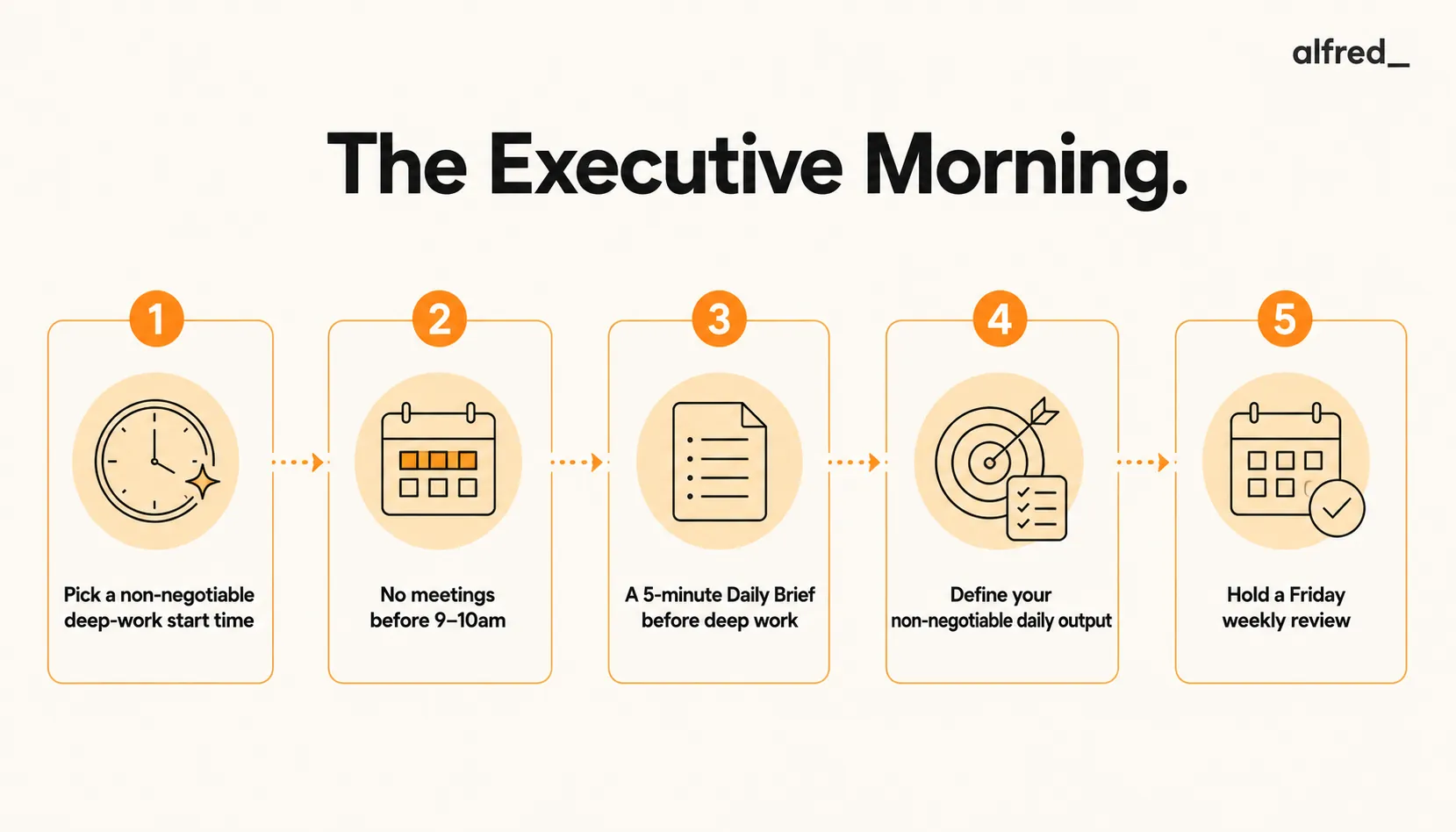
1. Choose Your Deep Work Start Time and Treat It as Non-Negotiable
Pick a specific time (7:15am, 8:00am, whatever fits your life) and commit to it as if it were a standing call with your most important client. Newport’s rhythmic philosophy works because the decision is made once. You don’t renegotiate it each morning based on energy level or competing demands.
2. Protect Mornings: No Meetings Before 9am (Push to 10am If Possible)
Block your calendar before 9am as unavailable. Communicate this as a standing policy: “I’m unavailable for meetings before 9am,” not as a preference but as a standing commitment. Graham’s observation about the anticipatory cost of meetings makes this critical: even a 9am meeting degrades the 8am deep work window.
3. Open alfred_’s Daily Brief Before Deep Work, 5 Minutes Max
Review alfred_’s Daily Brief as the last step before starting deep work, not first thing on waking. This answers “did I miss anything?” definitively. You see the 5 things that need attention, confirm none require immediate action, and close the app. The background anxiety about the inbox is resolved. Deep work can proceed without the nagging “maybe I should check” loop.
4. Define Your 20 Miles: Your Non-Negotiable Daily Deep Work Output
Apply Collins’s principle: define a specific output floor for your morning block. Not “I’ll do some deep work,” which is a hope, not a commitment. “I will complete [specific output] before my first meeting” is a commitment. The 20-Mile March works because the floor is defined before conditions become chaotic, not while managing them.
5. Schedule Your Allen Weekly Review on Friday Morning
Allen’s weekly review (60-90 minutes of processing all inboxes, reviewing all projects and next actions, clearing all open loops) is the maintenance that keeps the system trusted. Schedule it on Friday morning, when energy is still available. Friday afternoon is too late: energy is lowest, attention is scattered toward the weekend.
Common Morning Routine Mistakes for Executives
The patterns that most frequently undermine executive morning routines, and what they reveal:
- Starting with email. This is starting with other people’s agendas. It triggers the reactive mode that dominates the rest of the day. The inbox is not a to-do list (Allen’s principle), and treating it as one in the first minutes of the day sets the wrong frame for everything that follows.
- Scheduling meetings before 9am. Even well-intentioned early meetings, like the 8am check-in that “only takes 20 minutes,” consume not just the meeting time but the anticipatory window before it. Graham’s observation: the cost is often the entire pre-meeting morning, not just the meeting.
- No explicit “most important thing” before starting. Without a defined top priority, the morning’s work gravitates toward the comfortable rather than the important. Busyness fills the vacuum. Allen’s 10-minute review prevents this by confirming the top priority before the deep work block begins.
- Treating every day as equally flexible. Some days will be fragmented by necessity: travel, crises, unavoidable conflicts. The 20 Mile March principle: these exceptions should feel like exceptions, not defaults. When fragmented days become the norm, the morning routine has been abandoned even if the intention remains.