

When everything on your task list feels equally pressing, the problem is rarely that every item genuinely is urgent. The problem is the absence of a prioritization system. Without one, the brain defaults to treating all open tasks with equal urgency, which produces paralysis, reactive work, and the chronic feeling that you are always behind.
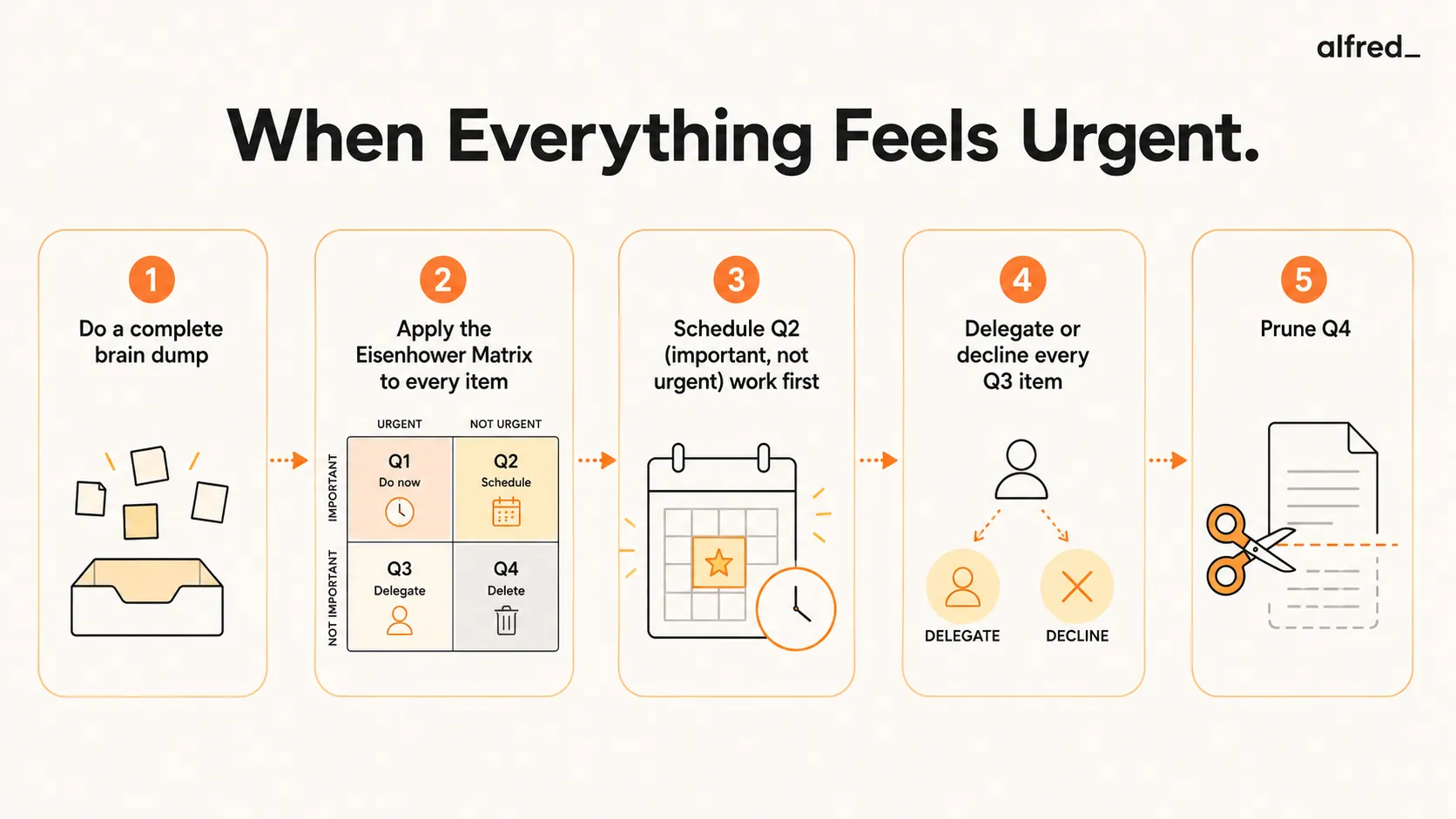
The solution is not to work harder or faster. It is to install a system that forces explicit ranking. Once items have been ranked, the urgency illusion collapses. You can see clearly that most “urgent” items are either someone else’s priority or things that do not need to happen at all.
Everything on your list is screaming for attention, every email is flagged important, every request is “urgent,” and so you triage by whoever shouted last. That is not prioritization; it is reaction, and it guarantees the important-but-quiet work never gets touched. The truth the panic hides is that almost nothing is genuinely urgent, and the genuinely important rarely feels that way in the moment. Here is the framework for telling them apart and spending your day on what actually moves things, even when it all feels like a fire.
The Eisenhower Matrix: The Only Prioritization Framework You Need
Dwight Eisenhower’s observation, later formalized by Stephen Covey in The 7 Habits of Highly Effective People, is that all work can be categorized by two dimensions: urgency and importance. These create four quadrants. Understanding which quadrant your work lives in is the entire game of prioritization.
“The key is not to prioritize what’s on your schedule, but to schedule your priorities.” (Stephen Covey)
Quadrant 1: Urgent + Important: Do Now
Q1 is crisis mode. These are real deadlines, genuine emergencies, and time-sensitive client escalations. A production system is down. A client is threatening to leave. A proposal is due in three hours. These must be handled immediately. The problem is not Q1 itself; it is when professionals treat their entire task list as Q1.
Quadrant 2: Not Urgent + Important: Schedule First
Covey called Q2 “the heart of effective personal management.” This is where great work actually lives: strategic planning, skill development, relationship building, deep work, and prevention. Q2 activities are never screaming for your attention, which is exactly why they never get done. High performers intentionally live in Q2. The path to getting there is to schedule Q2 blocks before everything else, including Q1 fires.
Quadrant 3: Urgent + Not Important: Delegate or Decline
Q3 is the most insidious quadrant. These items feel urgent (the phone rings, the Slack message arrives, someone drops by) but they are not important to your actual work. They are other people’s priorities masquerading as yours. Q3 is where most professionals spend their reactive days: responding to interruptions, attending meetings where they contribute nothing, handling requests that should be delegated. Andy Grove called this “negative leverage,” activities that feel like work but generate zero output.
Quadrant 4: Not Urgent + Not Important: Eliminate
Q4 is waste. Mindless scrolling, pointless busywork, redundant reports nobody reads. The only action for Q4 items is elimination.
The core insight: most professionals spend their days in Q1 and Q3, in reactive mode. High performers intentionally migrate their time into Q2. The Eisenhower Matrix is the map for that migration.
Why Everything Feels Urgent: The Psychology
Urgency bias is neurological, not a personal weakness. The human brain responds more strongly to time pressure than to importance: it is a survival mechanism that served our ancestors well and serves modern professionals poorly. When everything arrives through the same inbox, at the same notification volume, with the same visual weight, the brain cannot distinguish a client crisis from a newsletter.
Cal Newport’s research on attention residue compounds this problem. Newport cites Sophie Leroy’s research showing that even a brief shift in attention (think twenty seconds in an inbox) is enough to leave behind a residue that reduces your cognitive capacity for a non-trivial amount of time. Constant interruptions, each of which feels urgent in the moment, fragment attention to the point where everything seems more pressing than it actually is. Psychologist David Meyer’s research, published by the American Psychological Association, found that the mental blocks created by switching between tasks can cost as much as 40% of someone’s productive time.
Grove identified the same pattern from the management side: most managers dramatically underestimate how much of their perceived urgency is externally imposed rather than genuinely mission-critical. The solution is not to respond faster to every urgent signal. It is to build a system that evaluates signals before you respond to them.
Drucker’s First Things First
Peter Drucker devoted an entire chapter of The Effective Executive to concentration, which he considered the “courage” most executives lacked. His formulation is stark: “Effective executives do first things first and they do one thing at a time.” The implication is that most executives are doing second and third things first, because urgency rather than importance is driving the sequence.
“Concentration is the only hope of becoming the master of time and events instead of their whipping boy.” (Peter Drucker, The Effective Executive)
Drucker’s diagnostic question for prioritization is not “what is most urgent?” It is “what can I contribute that will significantly affect the performance of the institution I serve?” The answer to that question is the first thing. Everything else is ordered behind it. Urgency is a criterion that should be applied only after importance has established the ranking.
The practical consequence: if you start your day by triaging email and responding to the loudest signals, you have already let urgency determine your priority order. Drucker’s discipline is to determine your first thing before any of that, typically before you open your inbox at all.
Collins’s Stop Doing List Applied to Priorities
Jim Collins made an observation in Good to Great that cuts to the root of why prioritization is so hard: most people have an ever-expanding to-do list and no corresponding stop-doing list. “The presence of an ever-expanding to-do list without a robust stop-doing list is a lack of discipline,” Collins wrote. The to-do list grows because it is easy to add; the stop-doing list stays empty because stopping requires acknowledging that past commitments were wrong.
Collins’s diagnostic question is more ruthless than Drucker’s: “If we were starting from scratch today, would we choose to do this?” Not “is it good?” but “would we actively choose it?” If the answer is no, it goes on the stop-doing list.
This matters for prioritization because you cannot meaningfully rank items if the list contains things that should not be on it at all. Before applying the Eisenhower Matrix, apply Collins’s stop-doing filter. Remove what should not exist. Then rank what remains.
“Good is the enemy of great.” (Jim Collins, Good to Great) Every good commitment you keep crowds out a great one you could be making.
41%
of knowledge workers' time is spent on discretionary tasks that offer little personal satisfaction and could be handled competently by someone else
Harvard Business ReviewStep-by-Step: How to Prioritize When Everything Feels Urgent
1. Do a Complete Brain Dump
David Allen’s first step in Getting Things Done is capture: get every task, commitment, and open loop out of your head and onto a list. Do not prioritize yet. Do not evaluate. Just capture. Allen’s principle is that “your mind is for having ideas, not holding them.” Every item you are mentally tracking is consuming working memory and generating background anxiety. The brain dump ends that. Put everything on the list: tasks, projects, promises made, calls to return, emails to send, decisions pending.
2. Apply the Eisenhower Matrix to Every Item
Go through the list and assign each item to Q1 (Urgent + Important), Q2 (Not Urgent + Important), Q3 (Urgent + Not Important), or Q4 (Not Urgent + Not Important). Be honest. Most items that feel Q1 are actually Q3: they are urgent because someone else wants them done, not because they actually matter to your mission. Drucker’s test: “What can I contribute that will significantly affect the performance of the institution I serve?” If an item does not connect to that contribution, it is probably not Q1 or Q2.
3. Schedule Q2 Work First
Before you address a single Q1 item, block time for your most important Q2 work. Covey’s instruction is explicit: “The key is not to prioritize what’s on your schedule, but to schedule your priorities.” Q2 blocks (deep work, strategic thinking, skill development) go on the calendar first, before the Q1 fires fill every available hour. Newport recommends making these blocks the same time every day (the rhythmic philosophy) so that the decision of when to do deep work is removed entirely.
4. Delegate or Decline Every Q3 Item
Q3 items are urgent but not important to your mission. They are interruptions, status requests, meetings that do not require your judgment, emails that could be handled by someone else. Grove’s framework makes this explicit: the test for delegation is whether someone else could do this “just as well, if not better.” If yes, and if it is Q3, it leaves your list. Drucker’s specific question: “Could someone else do this just as well?” applies directly. If the answer is yes and you are the one doing it, you are underutilizing your time and over-consuming your cognitive resources.
5. Apply Grove’s Pruning Test to Q4
For every Q4 item (not urgent, not important), apply Grove’s question: “What would happen if I did not do this activity at all?” If the answer is nothing, the item is eliminated immediately: no rescheduling, no delegating, no guilt. This is Collins’s stop-doing list in action. Q4 items that survive Grove’s test should still be eliminated: if something is not urgent and not important but would cause a problem if not done, it is misclassified; move it to Q3 and delegate it.
Before and After
Before applying the framework:
47 items on the list, all feeling equally urgent, either paralyzed or reactive all day, ending the week exhausted and unsure what was accomplished.
After applying the framework:
5 genuine Q1 items addressed, 3 Q2 deep work blocks scheduled and protected, 8 Q3 items delegated or declined, Q4 eliminated entirely. Work felt purposeful. Output was measurable.
What to Do When Your Boss Makes Everything Urgent
The most common obstacle to this framework is a manager who treats every request as Q1. The root cause, usually, is that your manager does not have a prioritization system either, and without one, they default to the same urgency bias everyone else has.
The solution Grove recommends is to make the capacity constraint visible. When you receive simultaneous urgent requests, bring them to your manager with a specific question: “If I can only complete one of these today, which should it be?” This forces the explicit ranking that should have happened before the requests arrived. It is not insubordination. It is giving your manager the data they need to make a better allocation decision.
Grove’s framework of Task-Relevant Maturity also applies here: the higher your experience level with a given task, the less guidance you should need on prioritizing it. At senior levels, you should be bringing a prioritized list to your manager for confirmation, not waiting for them to rank it for you.
How alfred_’s Urgency Detection Maps to the Eisenhower Matrix
The single biggest source of false urgency for most professionals is email. Inbox notifications generate the same neurological urgency response as a genuine Q1 crisis, even when the email is a newsletter or a thread you are CC’d on for no reason. Newport’s attention residue research shows that even a brief glance at the inbox is enough to fragment cognitive capacity.
alfred_ does the Eisenhower classification on your inbox automatically, so your day starts with pre-ranked input instead of 121 undifferentiated messages. Here’s how alfred_’s urgency scoring maps directly to Eisenhower’s quadrants:
| alfred_ classification | Eisenhower quadrant | What alfred_ does |
|---|---|---|
| Urgency 8-10 + Action Required | Q1 (Urgent + Important) | Surfaces immediately in Daily Brief, flags in inbox, drafts response for approval |
| Urgency 4-7 + Action Required | Q2 (Not Urgent + Important) | Schedules into Daily Brief with deadline context; no interruption |
| Urgency 8-10 + FYI/Scheduling | Q3 (Urgent + Not Important) | Handles or routes without surfacing, drafted reply, RSVP, acknowledgment |
| Urgency 1-3 + FYI/Marketing | Q4 (Neither) | Auto-archives or moves to low-priority folder |
The specific signals alfred_ uses for urgency scoring:
- Sender weight: high-value relationships (clients, direct reports, executives you meet with regularly) boost urgency
- Explicit deadline language: “by Friday”, “EOD”, “today”, “urgent” in the body triggers deadline extraction
- Second-ask pattern: a sender repeating a question they asked previously signals escalation
- Question directed at you: “to:” or “cc:” position + direct question + open action window
- Commitment tracking: your own outgoing “I’ll send by X” creates a pending obligation surfaced before the deadline
- Calendar conflict: incoming scheduling requests are cross-checked against your calendar
The result is that your Eisenhower Matrix starts the day pre-populated. The Q3 noise that typically floods a professional’s morning (the FYI threads, the automated notifications, the reply-alls) has already been processed. Q4 is archived. What remains is Q1 and Q2, the messages actually worth ranking.
This is the practical shift: you stop spending cognitive effort deciding what’s urgent, and start spending it acting on what’s urgent. The system does the classification; you do the judgment.