

You felt it again.
That little buzz against your thigh. You reach for your phone, pull it out, check the screen. Nothing. No notification. No missed call. No message. The screen stares back at you, blank and indifferent.
You could have sworn it vibrated.
You put the phone back. Thirty seconds later, you feel it again. You check again. Nothing again. You are now paying more attention to your pocket than to the conversation happening in front of you.
This is phantom vibration syndrome. And if you think it is just a quirk, a funny modern-life thing to joke about. It is not. It is your nervous system telling you something is wrong.
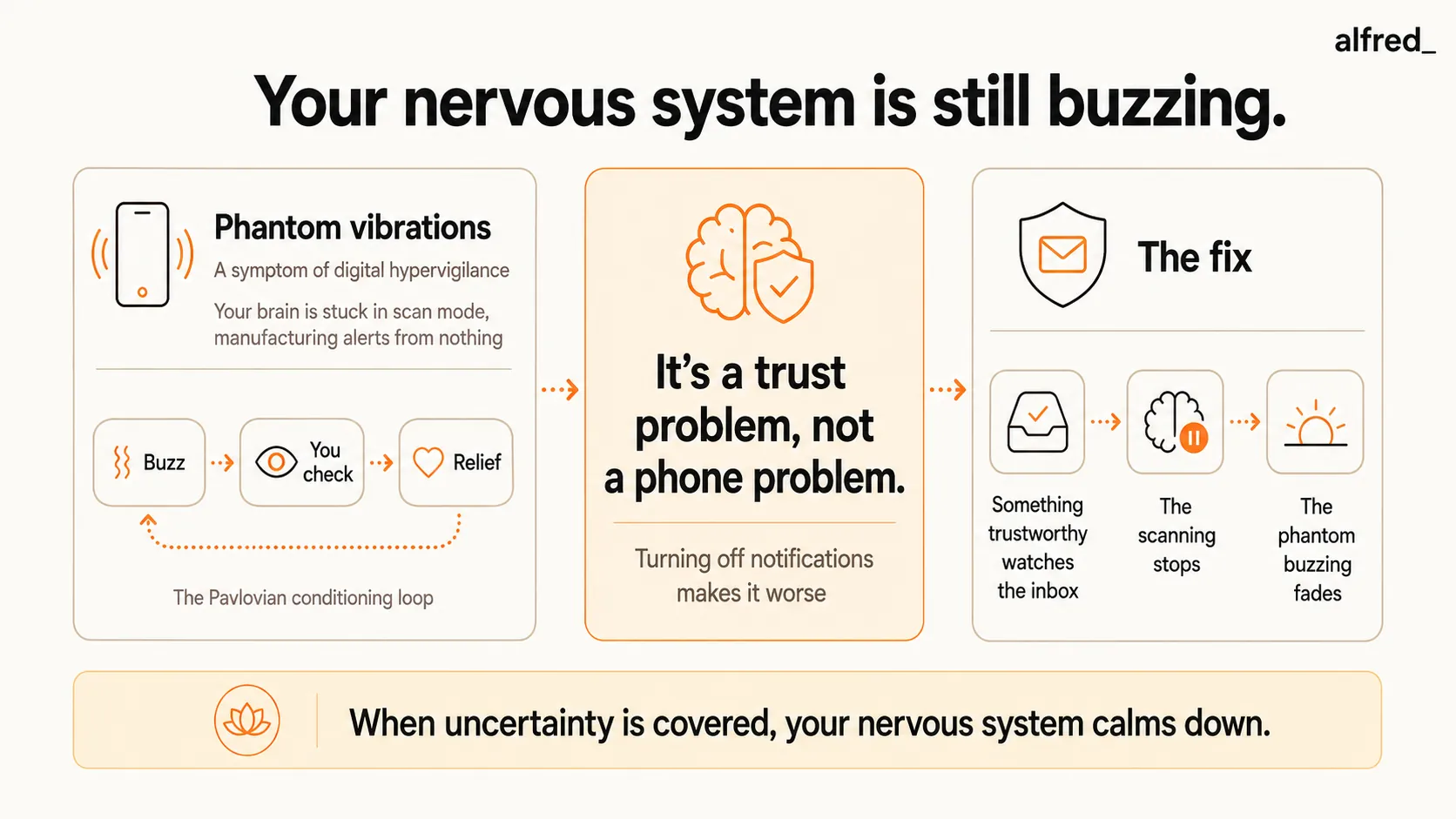
Your Body Is Stuck in Scan Mode
Phantom vibration syndrome has been studied extensively, including by researcher Robert Rosenberger at Georgia Tech. It is a tactile hallucination. Your brain misinterpreting a muscle twitch, a fold in your clothing, or a slight shift in pressure as a phone notification. It happens because your brain has been conditioned to treat every faint sensation near your phone as a potential alert.
The numbers are uncomfortable. A study by Drouin, Kaiser, and Miller published in the journal Computers in Human Behavior found that 89% of undergraduates experienced phantom vibrations, and that people with higher anxiety about their devices experienced them significantly more often. A separate study of medical residents by Rothberg et al. published in the BMJ found that 68% experienced them, with frequency increasing alongside workload and stress.
This is not a minor glitch. Nearly nine out of ten people are hallucinating phone notifications. Your nervous system is so primed for digital alerts that it is manufacturing them from nothing.
“Even when I’m not checking email I’m thinking about what might be in there.”
That quote describes the psychological state that creates phantom vibrations. Your brain is not just passively waiting for notifications. It is actively scanning for them. Continuously. In the background. Like a process that never closes, consuming resources even when you think you have shut it down.
The Pavlovian Conditioning You Did Not Consent To
You did not choose this. Nobody sat you down and said, “We are going to train your nervous system to react to every faint sensation as if it might be an urgent work message.” But that is exactly what happened.
The mechanism is classical conditioning, the same process Pavlov documented with his dogs. The sequence works like this:
- Your phone vibrates (the stimulus)
- You check it (the response)
- Sometimes there is something important (the intermittent reward)
- Your brain learns: vibration = must check = possible reward or threat
- Over thousands of repetitions, your brain lowers the threshold for what counts as a “vibration”
- Eventually, anything that feels slightly like a buzz triggers the checking response
The intermittent reinforcement is the critical piece. If every notification were urgent, you would learn to check calmly. You would know what to expect. If every notification were junk, you would learn to ignore them. But the mix, mostly noise, occasionally critical, creates what behavioral psychologists call the most addiction-resistant reinforcement schedule. You cannot stop checking because you never know which buzz is the one that matters.
Slot machines use the same mechanism. The unpredictable payout keeps you pulling the lever. Your inbox uses unpredictable urgency to keep you checking the phone. And your body, unable to distinguish between a real buzz and a phantom one, keeps pulling you out of whatever you were doing to check.
The Loughborough University study on email stress found that participants experienced elevated cortisol, increased heart rate, and higher blood pressure while processing email, and critically, they did not realize they were stressed. Your body is in a low-grade fight-or-flight state around your phone, and your conscious mind has normalized it so completely that you do not even notice.
Until you feel the phantom buzz. That is the signal breaking through. That is your nervous system saying: I am exhausted from monitoring this and I cannot stop.
The Hypervigilance Trap
In clinical psychology, hypervigilance is a state of elevated alertness where you are constantly scanning your environment for threats. It is a core feature of PTSD, generalized anxiety disorder, and chronic stress. In the context of notifications, digital hypervigilance looks like this:
- You cannot put your phone in another room without anxiety
- You check your phone within seconds of hearing any buzzing sound, even someone else’s phone
- You feel a spike of alertness when you see someone else check their phone
- You reach for your phone automatically during any pause in conversation
- You feel your phone vibrate and check it, even though you know it probably did not vibrate
- You feel uneasy when your phone battery is low or when you are in a poor reception area
Research has found that people check their phones an average of 85 times per day, once every 11 minutes during waking hours. A 2019 Asurion survey put the number at 96 times per day. Each check is a micro-interruption. Each micro-interruption has a cognitive cost. A University of California, Irvine study by Gloria Mark found that it takes an average of 23 minutes and 15 seconds to fully regain focus after an interruption.
But phantom vibrations are worse than real notifications, because they interrupt you and provide no information. You lose focus, check your phone, find nothing, and return to what you were doing, having lost your cognitive thread for zero benefit. The interruption cost is real. The payoff is empty.
“I can’t be fully present anywhere because part of my brain is always half-monitoring what I might be missing.”
That half-monitoring is the hypervigilance. Your brain has allocated a background process to notification detection, and it runs continuously. It runs during dinner. It runs during meetings. It runs during conversations with your kids. It runs while you sleep, people who keep their phones near their beds report worse sleep quality, and research has found that even the expectation of receiving a notification can disrupt sleep by keeping the brain in a state of anticipatory alertness.
Why Turning Off Notifications Makes It Worse
The obvious solution. The one everyone suggests. Turn them off. Go on Do Not Disturb. Put the phone in a drawer.
For people whose phantom vibrations are driven by uncertainty about what might need their attention, this is precisely backward.
“I turned off notifications and it somehow got worse, now I compulsively check manually.”
Here is the paradox. The phantom vibrations are caused by your brain scanning for signals. When you turn off notifications, you remove the signals, but not the scanning. The scanning intensifies because now there is less information, and your brain responds to less information with more vigilance, not less.
Kushlev and Dunn at UBC found that limiting phone checking reduced stress in a controlled study. But here is the distinction that matters: in a controlled study, participants knew nothing urgent could happen during the experiment. In real life, you are a professional with clients, colleagues, and deadlines. You know that turning off notifications does not turn off the emails. They are still arriving. Things are still happening. You just cannot see them.
The not-seeing is worse than the seeing. At least a notification resolves the uncertainty for a moment. Silence lets the uncertainty compound.
So you check manually. Studies show people who disable notifications check their phones more often than those who leave them on, because the internal drive to resolve uncertainty is stronger than the external prompt. You went from being interrupted to interrupting yourself, which feels worse because now it is an option you are making, adding guilt to the anxiety.
The Real Problem Is Not the Phone
Phantom vibrations, compulsive checking, the inability to put your phone down. These are all symptoms. The disease is uncertainty.
You do not know what is in your inbox. You do not know if something slipped. You do not know if a client emailed while you were in that meeting. You do not know if that thing you flagged yesterday got a response. You do not know. And your nervous system, evolved to treat “not knowing” as a threat, stays locked in scan mode until the uncertainty resolves.
But it never resolves. Because new emails keep arriving. New messages keep coming. The uncertainty refreshes every few minutes.
SaneBox ($7-$36/month) sorts your email by sender headers, newsletters to one folder, unimportant mail to another. It reduces volume. But it does not tell you what is in the remaining pile. It does not read your emails and tell you whether the client responded or whether that deadline moved. The uncertainty remains. Your nervous system keeps scanning.
Superhuman ($30-$40/month) makes email processing faster with keyboard shortcuts and split inbox. You get through email more quickly. But speed does not resolve uncertainty. It just reduces the time between checking and returning to not-knowing. The phantom vibrations do not care how fast you are.
Spark and Shortwave offer smart categorization and AI summaries. Better than raw inbox. But you still have to open the app, still have to look, still have to decide. The monitoring is still your job.
The question is not “how do I check more efficiently?” The question is “how do I stop needing to check?”
What Happens When Something Else Is Watching
alfred_ takes a fundamentally different approach. Instead of helping you check faster or sorting your inbox into slightly less overwhelming piles, it watches your inbox for you. Continuously. It reads every email. It understands the context, who sent it, what it references, how it connects to your calendar and prior conversations. It triages by urgency. It drafts replies in your voice. It surfaces what genuinely needs your attention and handles the rest.
The difference is not efficiency. The difference is trust.
When you trust that a system is genuinely watching, not just sorting, not just filtering, but understanding and acting. Your nervous system can stand down. The scanning stops because there is nothing to scan for. The phantom vibrations fade because the hypervigilance that created them is no longer necessary.
This is not theoretical. It is the same mechanism that allows executives with excellent human executive assistants to leave their phones in a drawer during dinner. They are not more disciplined than you. They are not less anxious by nature. They trust that someone is watching. That trust lets their nervous system stop.
alfred_ gives you that same trust. Not through willpower. Not through notification settings. Through the knowledge that if something matters, it will reach you. And if it does not reach you, it does not matter.
The Moment the Buzzing Stops
There is a day. It usually comes in the first week, when you notice something missing. You are sitting at lunch. Your phone is in your pocket. You are actually listening to the conversation. Twenty minutes go by and you did not check.
Not because you decided not to check. Not because you white-knuckled through the urge. Because the urge was not there. Your pocket did not buzz. Not even the phantom buzz. The silence felt normal instead of threatening.
That is what happens when the hypervigilance releases. It is not dramatic. It is an absence. The absence of the hum. The absence of the scanning. The absence of that background process that was consuming your attention even when you did not realize it.
“The mental overhead of ‘I need to respond to that’ is worse than actually responding.”
The phantom vibrations were never about the phone. They were the physical manifestation of mental overhead. Your body’s way of saying it is carrying a weight your conscious mind has stopped noticing. When the weight lifts, the phantom goes with it.
You do not need to turn off notifications. You do not need a digital detox. You do not need to develop better phone discipline. You need something that watches so you do not have to. Something that turns the uncertainty into certainty. Something that lets your nervous system, finally, stop buzzing.
Your nervous system has been paying a lot more than alfred_ ever will.