

You missed a follow-up. Lost the deal. It was in your inbox the whole time.
Not buried under spam. Not caught in a filter. Sitting right there, between a newsletter you meant to unsubscribe from and a meeting confirmation you already read. The client’s email, the one where they said “looks great, let’s talk next steps”, was visible for 11 days. You saw it. You meant to respond. You did not.
By the time you wrote back, they had signed with someone else. Not because the other firm was better. Not because your pricing was off. Because they followed up and you did not. The deal was yours. And then it was not.
“I missed a follow-up. Lost the deal. It was in my inbox the whole time.”
If this has happened to you once, it has happened more times than you know. Because the deals you lose to silence are invisible. Nobody calls to tell you they went with someone else because you were slow. They just stop responding.
The Revenue You Cannot See
The cost of a missed follow-up is not the deal itself. It is every deal behind that deal.
That client would have referred you to two others. Those two would have generated their own referrals. The compounding revenue from a single relationship, maintained by a single timely follow-up, represents tens or hundreds of thousands of dollars over a career.
But you will never see that number. You will never calculate “revenue lost because I forgot to reply to an email on March 3rd.” It does not appear on a P&L. It does not show up in your CRM. It is the largest cost in your business, and it is completely invisible.
Here is what is visible:
- 80% of sales require 5 follow-up calls after the initial meeting, yet 44% of salespeople give up after just one follow-up (The Brevet Group).
- Only 2% of sales close on the first contact (Marketing Donut). The other 98% require persistence.
- Leads contacted within 5 minutes of expressing interest are 21x more likely to qualify than those contacted after 30 minutes (InsideSales.com/MIT).
The math is not subtle. Most deals require multiple follow-ups. Most people stop at one. The gap between what is required and what actually happens is where revenue goes to die, quietly, invisibly, and at scale.
Why You Keep Missing Them
You are not careless. You are not bad at sales. You are drowning in a system that was never designed to protect the conversations that matter.
Your inbox is not a pipeline. It is a river. New messages push old ones down. The email that needed a response on Tuesday is below the fold by Wednesday, buried by Thursday, and functionally invisible by Friday. Your inbox does not know that email was worth $15,000. It treats it exactly the same as the DoorDash receipt from last night.
Your brain cannot hold 40 open threads. The average knowledge worker manages dozens of concurrent conversations across email, Slack, and text. Research by George Miller at Princeton found that human working memory holds roughly 7 items (plus or minus 2). You have 40 threads that need follow-up. Something will slip. It is not a question of if. It is a question of which.
Context switching destroys intent. Gloria Mark’s research at the University of California, Irvine found that the average worker switches tasks every 3 minutes and 5 seconds. Each switch costs an average of 23 minutes and 15 seconds to fully regain deep focus. The follow-up you planned to write at 10:15 AM gets displaced by a Slack ping, a meeting invite, and an urgent request from your boss. By the time you have a clear moment, if you have a clear moment, the intent has been overwritten by 47 other micro-decisions.
The CRM does not catch what you do not log. Salesforce found that sales reps spend only 28% of their time selling. The rest is admin, including the manual logging that makes CRM reminders work. If you did not log the email, the CRM does not know it exists. The follow-up reminder never fires. The deal goes cold, and the system designed to prevent this exact scenario had no data to work with.
The Slow Death of a Deal
Deal death is not sudden. It is a slow fade, and you miss it because there is no single moment where you can say “that was the mistake.”
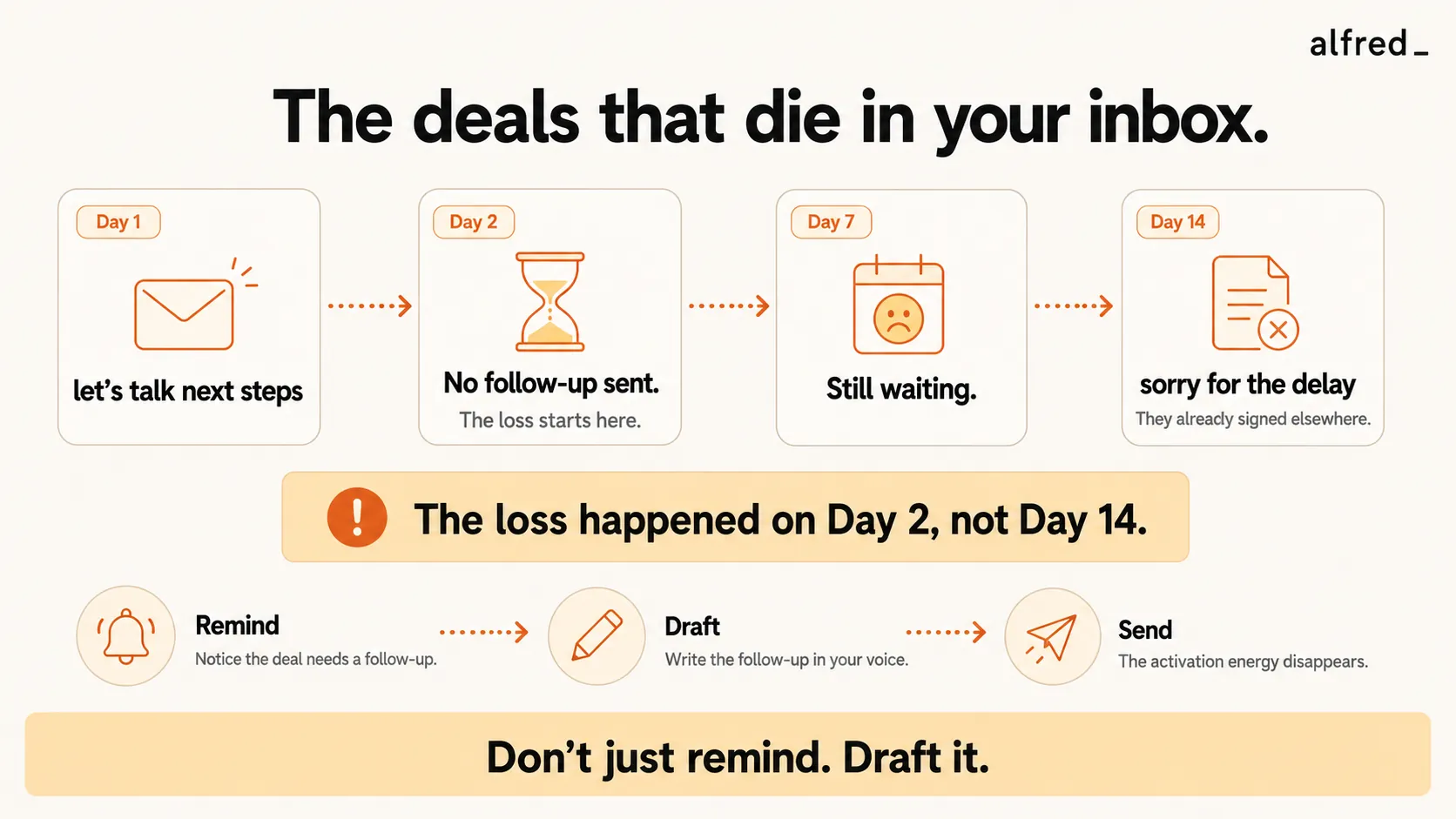
Day 1. The prospect emails: “This looks great. Let’s discuss pricing.” You see it. You are in a meeting. You will respond after.
Day 2. You remember the email. You open it. You start thinking about what pricing to quote. You need to check a few things first. You close it. After lunch.
Day 3. The email is now 15 messages from the top. You think about it during your commute. You will handle it first thing tomorrow.
Day 5. You have not responded. The prospect has not followed up either. “They’re probably busy too,” you tell yourself. “I’ll send something Monday.”
Day 8. Monday came and went. Now the delay itself has become a problem. “It’s been a week. Do I acknowledge the gap? Do I pretend it hasn’t been that long?” The activation energy of the response has tripled since day one. Every day you wait makes it harder to write.
Day 11. You draft something. It feels stale. You close it.
Day 14. You finally send: “Sorry for the delay, wanted to get back to you on pricing.” They do not respond. They signed with someone else four days ago.
You did not lose the deal on day 14 when you sent the late reply. You lost it on day 2 when you closed the email and said “after lunch.” Everything after that was just the slow unwinding of a deal that was already dead.
What Does Not Work
Manual reminders. You tell yourself “follow up on the Anderson proposal by Thursday.” Thursday comes. You are in back-to-back meetings. You do not follow up. You tell yourself Friday. The cycle repeats until the deal is dead.
Boomerang ($4.98-49.98/month) resurfaces the email at a time you choose. The email appears at the top of your inbox on Thursday morning. You look at it. You do not write the response. You snooze it again. The problem was never surfacing the email. It was writing the reply.
Superhuman ($30-40/month) offers snooze, reminders, and a fast interface. You can re-surface emails, but when they appear, you still face a blank reply box. The friction is not finding the email. It is composing the response.
CRM task reminders (HubSpot Free-$150/seat, Salesforce $25-350/user) alert you to follow up, if you logged the conversation. Most conversations are not logged because logging takes time, and the conversations that slip are precisely the ones you did not have time to log.
Spreadsheet tracking. You tried this. A column for “follow-up by” dates. It worked for a week. Then you stopped updating it because updating the spreadsheet was one more task in a day that already had too many tasks.
The common failure: every one of these approaches reminds you to do the thing. None of them do the thing.
How alfred_ Prevents the Loss
alfred_ does not remind you to follow up. It drafts the follow-up.
Conversation tracking. alfred_ keeps the replies you owe on a list, and its Chase what I’m owed and Proposals waiting on a decision routines send you the conversations that went quiet and the proposals with no answer, every Monday. No manual logging. No CRM entry. It watches the conversations themselves.


Pipeline check · Latest · Friday at 4:00 PM
Two deals have gone quiet
Checked 14 threads in Gmail and 9 deals in HubSpot.
 Nine open deals, $212,000 in pipelineHubSpot · 3 moved stage this week
 Priya at Acme replied to the proposalYesterday · you answeredNorthwind quote: no reply in 6 daysTom Reyes · $48,000Needs youHarbor deal has no next stepLuis Ortega · last touch 12 days agoNeeds you
Follow-ups drafted when you ask. When a conversation needs a nudge, ask alfred_ and it drafts the email. Not a template. Not “just following up.” A contextual, personalized draft that references the specific conversation, uses your writing style, and matches the tone you use with that particular contact. The draft is ready when you are. You review, adjust if needed, send.
Timing that makes sense. Not every thread needs a follow-up on day two. A pricing proposal might warrant a nudge after three business days. A casual introduction might need a week. Tell alfred_ when, or make it a routine (“every Monday, draft nudges for proposals with no answer after three business days”), and the follow-up arrives on a schedule that fits the thread.
The activation energy disappears. The reason you did not follow up on day 2 was not that you forgot. It was that the response required thought, pricing, tone, wording, and you did not have the mental bandwidth in that moment. alfred_ removes that barrier. The draft is done. The thinking is done. All that remains is a 30-second review.
Calendar coordination. Follow-ups often include a scheduling ask. “Want to jump on a call this week?” alfred_ handles the scheduling alongside the email, so you are not bouncing between your inbox and your calendar trying to find availability.
One saved deal pays for years of the service. One.
The Follow-Up You Did Not Send Was Worth More Than the Deal You Closed
Think about the deal you closed last month. The one you worked hard on, followed up diligently, negotiated terms for. How much was it worth?
Now think about the deals that went cold. The prospects who stopped responding. The warm leads that cooled off. The introductions that were never closed. How many were there? What were they worth collectively?
For most professionals, consultants, founders, freelancers, salespeople, the revenue lost to missed follow-ups exceeds the revenue earned from closed deals. You just cannot see it because the lost deals are invisible. They never appear in your reporting. They never show up on a dashboard. They simply do not exist.
alfred_ makes them exist. Not by doing your job for you, but by removing the friction between “I should follow up” and “I followed up.” The draft is ready. The context is preserved. The timing is right. All you have to do is send.
The deal that was yours? It stays yours.