

The Origin: A Satirical Essay About Bureaucracy
Parkinson’s Law was introduced by C. Northcote Parkinson in an essay published in The Economist in November 1955. The opening sentence:
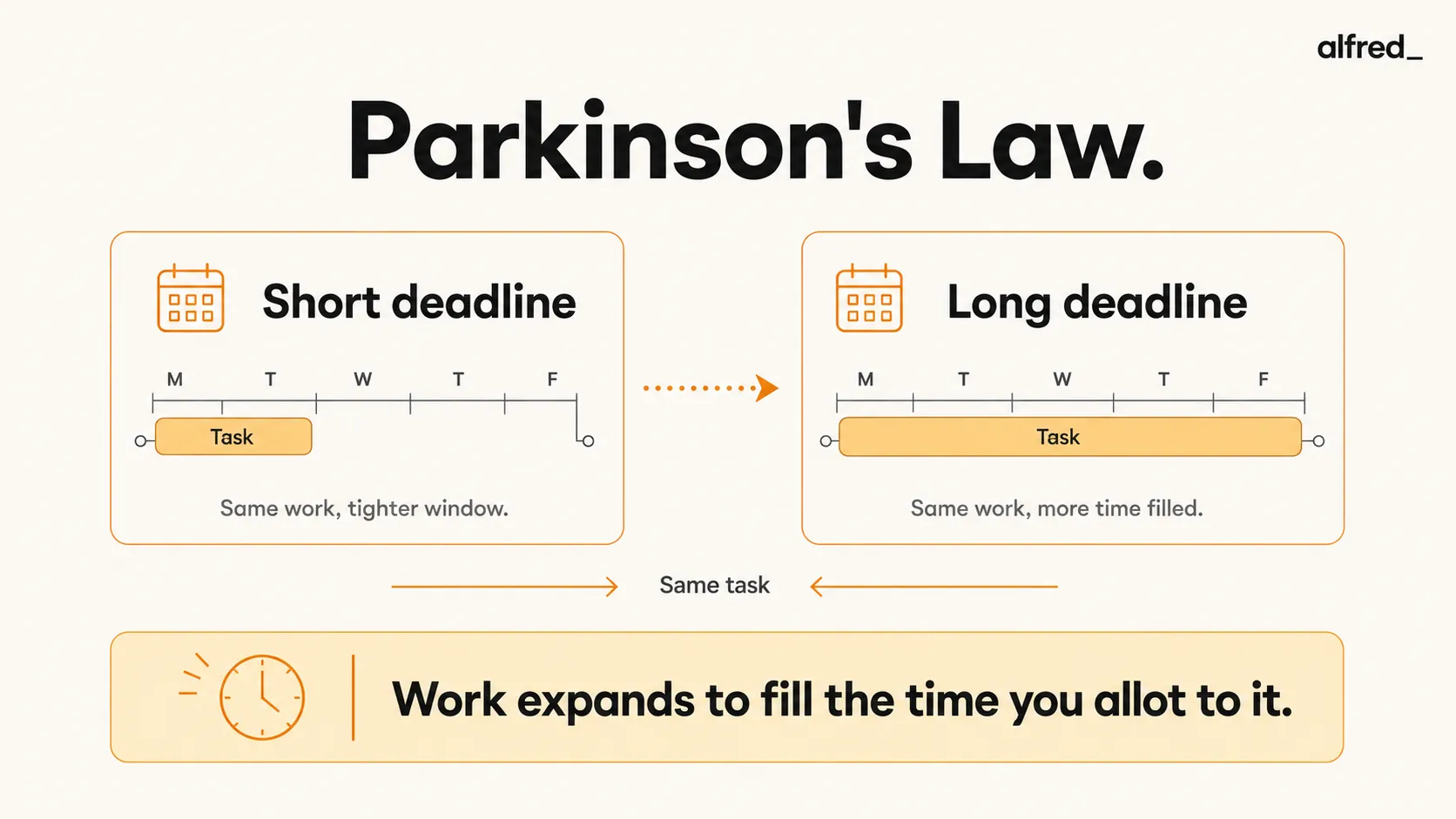
“It is a commonplace observation that work expands so as to fill the time available for its completion.”
Parkinson (1909–1993) was a British naval historian, not a productivity theorist. The essay was explicitly satirical: his target was the British Civil Service, which he observed grew in headcount at a predictable rate regardless of what it actually needed to do. The essay was not written as self-help advice. It was a skewering of institutional bureaucracy.
The essay was popular enough to be expanded into a book: Parkinson’s Law, and Other Studies in Administration (Houghton Mifflin, 1957). The productivity application, using the observation to compress your own work by imposing tighter deadlines, came later, through practitioners like Tim Ferriss, who applied it prescriptively in The 4-Hour Workweek (2007).
Parkinson never made that application himself. Understanding the gap between what he observed and what others later prescribed from it is essential to using the law correctly.
The Actual Data Parkinson Used
The law wasn’t purely satirical intuition. Parkinson grounded it in documented British Admiralty figures, comparing 1914 to 1928, a period during which the Royal Navy dramatically shrank:
| Metric | 1914 | 1928 | Change |
|---|---|---|---|
| Capital ships in commission | 62 | 20 | −68% |
| Officers and men | 146,000 | 100,000 | −32% |
| Dockyard workmen | 57,000 | 62,439 | +10% |
| Dockyard officials/administrators | 3,249 | 4,558 | +40% |
| Admiralty officials and clerks | 2,000 | 3,569 | +78.45% |
The irony is stark. The Royal Navy lost roughly two-thirds of its warships and a third of its personnel, yet the Admiralty bureaucracy administering it grew by nearly 80%, at an average annual rate of 5.6%. Parkinson argued this growth had “little or no relationship” to the underlying workload.
His broader claim: in any organization, administrative staff tends to grow at 5–7% per year regardless of whether the work being administered increases, decreases, or disappears entirely. Bureaucracies generate internal work: committees beget sub-committees, correspondence begets correspondence, to justify and expand their own existence.
+78.45%
growth in Admiralty officials between 1914 and 1928, while the number of capital ships in the Royal Navy fell by 68% over the same period
C. Northcote Parkinson, The Economist, November 1955The Full Formulation and the Satirical Example
Parkinson did not just state the law abstractly. He illustrated it immediately with one of the most precise comic examples in the productivity literature:
“Thus, an elderly lady of leisure can spend the entire day in writing and dispatching a postcard to her niece at Bognor Regis. An hour will be spent in finding the postcard, another in hunting for spectacles, half an hour in a search for the address, an hour and a quarter in composition, and twenty minutes in deciding whether or not to take an umbrella when going to the post box in the next street.”
The same task a busy person handles in five minutes (write a postcard, mail it) becomes an all-day endeavor when unlimited time is available. Not because the person is lazy, but because the task expands to fill the container it’s given.
The Productivity Application: Constrain the Container
Tim Ferriss applied Parkinson’s observation prescriptively in The 4-Hour Workweek (2007):
“If I give myself a week to complete a two-hour task, then… the task will increase in complexity to justify the time allowed and seem more important.”
Ferriss’s prescription: artificially constrain deadlines to compress work into its actual required duration. If a task genuinely takes two hours, give yourself two hours, not a week.
Research by Dan Ariely and Klaus Wertenbroch (2002, Psychological Science) provided empirical support. Their study examined three deadline conditions: evenly-spaced external deadlines, a single final deadline, and self-chosen deadlines. Key findings: self-imposed deadlines improved performance over a single final deadline, but externally imposed evenly-spaced deadlines outperformed self-chosen ones. Hard external constraints compress work more reliably than internal ones, consistent with Parkinson’s original observation that absent constraints, work expands.
Why Work Expands: The Behavioral Mechanisms
Three distinct mechanisms drive the expansion Parkinson described.
1. Effort matching
People unconsciously calibrate effort to the perceived importance and scope of a task. A week-long deadline signals “this is a week-level task,” which leads to week-level effort, scope expansion, and perfectionism that would never arise under a tighter constraint. The deadline doesn’t just set a boundary. It sets an implicit standard for how seriously the task should be taken.
2. The perfectionism ratchet
Additional time is filled with refinement. Given an extra day, most people don’t rest. They add to the work. A presentation that could be delivered after two hours of preparation becomes a four-hour production given four hours. This is not irrationality; it’s a rational response to perceived opportunity. More time means more chances to improve. The law is that the improvement rarely justifies the time.
3. Procrastination + compression
Work expands in the planning phase: thinking about it, worrying about it, preparing to do it. The actual execution gets compressed into the period immediately before the deadline. The full time is “used,” but productive work occupies only a fraction of it. The remaining time is consumed by the psychic overhead of an open loop (see the Zeigarnik Effect).
The Bike-Shed Effect: Parkinson’s Other Law
Parkinson’s 1957 book included a companion observation that is equally useful and even less well-known: the Law of Triviality.
“The time spent on any item of the agenda will be inversely proportional to the sum involved.”
His example: a committee approving a nuclear reactor will spend little time on the reactor. It’s too complex; most members defer to experts. But the same committee will spend extensive time debating the construction materials for a bike shed, because everyone has an opinion on bike sheds. Hence “bike-shedding,” now standard terminology in software development for wasted time on trivial decisions.
Together, the two laws form a coherent theory of organizational time waste: important work gets too little attention; unimportant work expands to fill available time; and bureaucracies grow independent of output. All three tendencies operate simultaneously in most organizations.
Where the Law Breaks Down
The productivity application of Parkinson’s Law has real limits that its advocates rarely acknowledge.
Not all tasks can be compressed
Creative work, research, and complex problem-solving have genuine minimum time requirements. Imposing a 2-hour deadline on a problem that requires 10 hours of thinking doesn’t compress the work. It produces inferior output. The law is most applicable to tasks with elastic time requirements: email, meetings, planning, administrative work. It is least applicable to tasks with irreducible cognitive demands.
Artificial urgency is physiologically costly
Chronic work under tight artificial deadlines produces sustained cortisol elevation, reduced quality of sleep, and eventually burnout. Parkinson never suggested manufacturing permanent urgency. He was describing a tendency, not prescribing a lifestyle. The optimization is finding the shortest deadline that produces acceptable quality output, not the shortest deadline possible.
It was satire first
Parkinson himself never applied the law as a personal productivity tool. The extrapolation from “bureaucracies grow regardless of workload” to “set tight deadlines for yourself” is a significant interpretive leap. The law is most reliable as a diagnostic question (“is this task taking as long as it needs to, or as long as I’ve allowed it?”) rather than as a rigid scheduling formula.