

You can have hours of free time on your calendar and still produce nothing worth keeping, because the hours were the wrong ones. Time management treats 9am and 3pm as interchangeable units to be allocated. Your brain does not. It runs a sharp, finite peak and a long depleted tail, and most people unknowingly spend the peak on email and the tail on the work that actually mattered. Managing energy rather than time means matching your hardest work to your highest-capacity hours, protecting that capacity, and recovering it deliberately. Here is how.
The Energy vs. Time Distinction
Tony Schwartz’s research in The Power of Full Engagement makes the foundational point explicit: “The number of hours in a day is fixed, but the quantity and quality of energy available to us is not.” This reframe changes the optimization target entirely. Time management asks: how do I fit more into each hour? Energy management asks: how do I ensure my best hours go to my most important work?
Peter Drucker gets at the same insight from a different angle. His instruction to effective executives: “start with your time.” But the right extension of that principle is: start with your highest-quality time. Know which hours are yours at peak, and protect them for the work that requires it. All other hours are for everything else.
The four energy dimensions that affect knowledge work performance are physical (body, sleep, nutrition, exercise), emotional (mood, stress levels, interpersonal friction), mental (focus, cognitive capacity, decision-making bandwidth), and purpose (meaning, motivation, connection to why the work matters). Managing energy means attending to all four, not just scheduling around the mental dimension while neglecting the others.
Circadian Performance Peaks: When Your Brain Is Actually Available
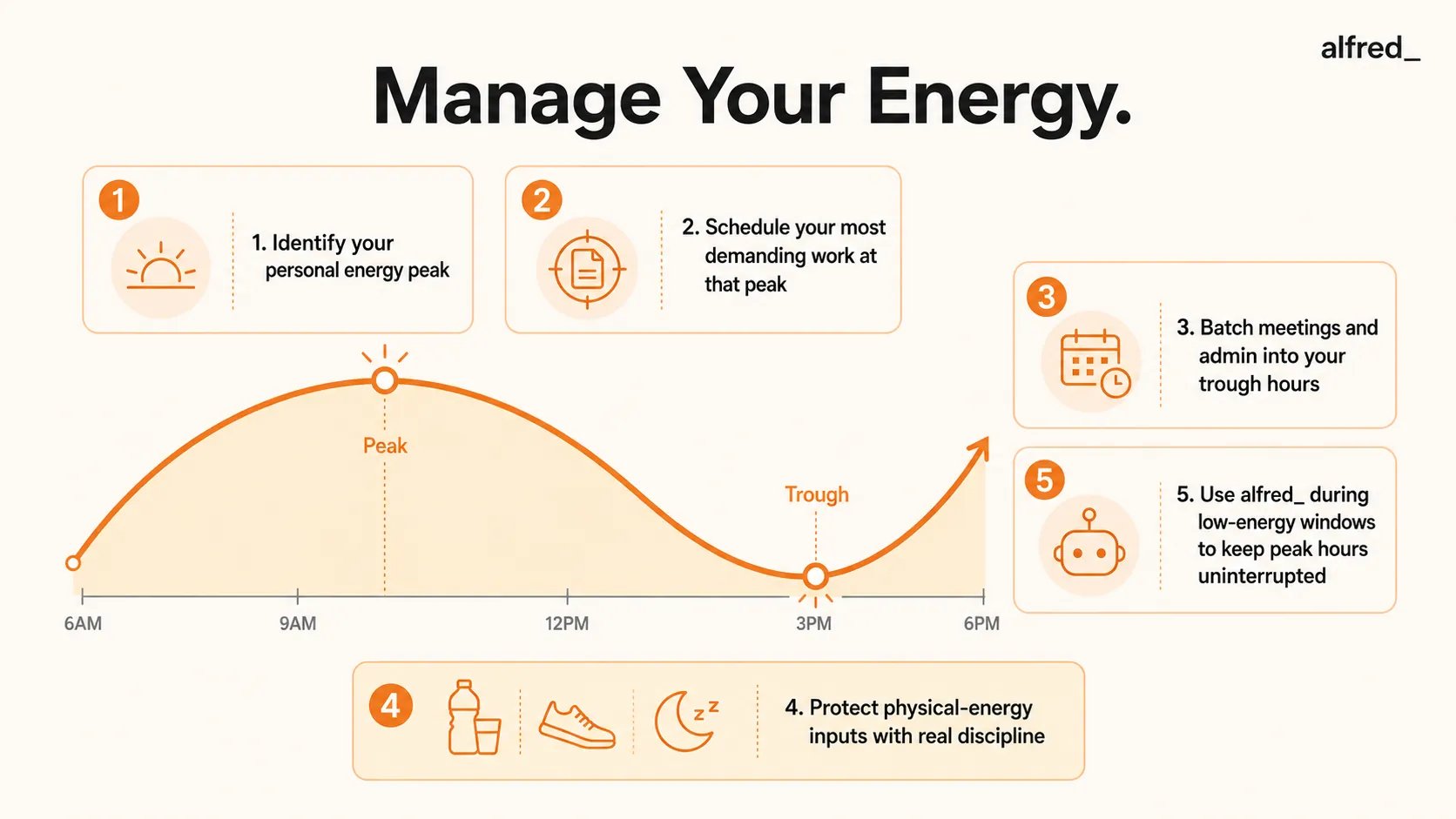
Cognitive performance follows a predictable daily pattern for most people. Daniel Pink, synthesizing chronobiology research in When, describes a three-part structure: peak, trough, and rebound. The peak, characterized by the sharpest analytical thinking, highest alertness, and best error-detection, occurs in mid-morning for the roughly 80% of people who aren’t night owls (Pink’s “larks” and “third birds”). The trough comes in early-to-mid afternoon. The rebound, a secondary peak better suited for creative and insight work, arrives in late afternoon.
The Three-Phase Daily Pattern
- Peak (mid-morning): Analytical work, difficult decisions, writing, strategy, anything requiring vigilance and critical thinking.
- Trough (early afternoon): Administrative tasks, routine email, meetings that don’t require your sharpest judgment, anything procedural.
- Rebound (late afternoon): Creative brainstorming, insight problems, conceptual work that benefits from looser associative thinking.
Newport’s rhythmic deep work philosophy aligns with this pattern: schedule deep work at the same time every day, and for most people, that time is the morning peak. The “same time every day” discipline removes the daily decision of when to do deep work, which is itself a decision that consumes cognitive resources. The ritual is set; the decision is pre-committed.
Collins’s 20 Mile March Applied to Energy
Jim Collins’s 20 Mile March in Great by Choice describes companies that set both a floor and a ceiling for their performance. They march at least 20 miles every day regardless of conditions, but they also stop at 20 miles even on good days when they could go further.
“The 20 Mile March imposes order amidst disorder, consistency amidst uncertainty. It builds confidence and creates a track record of hitting your targets.”, Jim Collins, Great by Choice
Applied to energy management: the ceiling matters as much as the floor. On high-energy days, many professionals extend their working hours and sprint, depleting tomorrow’s energy reserves in the process. Collins’s insight is that consistent output from consistent effort beats irregular sprints followed by recovery crashes. The professional who works a disciplined seven hours every day for a month outperforms the one who sprints for twelve hours three days a week and then collapses.
This is counterintuitive. The impulse on a high-energy day is to work more. Collins’s research suggests the correct instinct is to maintain the march and protect the recovery time that makes tomorrow’s march possible. The ceiling is not a limitation on your ambition. It’s what makes the ambition sustainable.
Grove’s Leverage Applied to Energy Allocation
Andy Grove’s leverage framework from High Output Management asks: which activities produce the most output relative to the time and resources invested? Applied to energy: which activities deserve your peak-energy hours?
Grove’s answer would be clear: the activities that affect many people or affect someone for a long period should receive the most managerial attention and the best managerial energy. A manager’s most important decisions (the ones that shape strategy, resolve conflicts, set direction) should be made during peak-energy hours, not in the cognitive trough after lunch.
Energy-to-Task Matching (Grove’s Leverage Applied)
- Peak energy: Deep work, high-stakes decisions, difficult conversations, complex analysis, strategy. These require your best cognitive resources and get them.
- Mid energy: Meetings, collaboration, one-on-ones, communication. Social and organizational work that requires presence and engagement but less raw analytical power.
- Low energy: Email processing (with alfred_’s triage making this brief), administrative tasks, routine reviews, scheduling, anything procedural.
The Decision Fatigue Problem
Roy Baumeister’s ego depletion research demonstrates that willpower and decision-making capacity deplete throughout the day. Every decision, including trivial ones, consumes cognitive resources from a finite daily pool. This is why complex decisions made at 4pm are demonstrably lower quality than the same decisions made at 9am, even when the decision-maker doesn’t feel tired.
The implication for knowledge workers: minimize trivial decisions throughout the day to preserve cognitive bandwidth for important ones. This is the real reason Barack Obama famously wore only gray or blue suits: not aesthetic preference, but decision hygiene. Every trivial decision eliminated is cognitive capacity preserved for decisions that matter.
Drucker’s “first things first” principle has an energy dimension that’s rarely discussed. Doing first things first isn’t just about priority ordering. It’s about ensuring your most important decisions get made when your decision-making capacity is highest. A decision deferred to the afternoon is not just delayed; it’s made with a depleted cognitive instrument.
40%
reduction in the brain's ability to form new memories after a single night of sleep deprivation, from Matthew Walker's lab at UC Berkeley
Walker et al., Nature Neuroscience (UC Berkeley)Step-by-Step: Manage Your Energy for Peak Performance
1. Identify Your Personal Energy Peak
Track your energy for one week before making permanent scheduling changes. Note when you feel sharpest and when you feel sluggish. Most people discover their peak is mid-morning, but this varies. Night owls have a genuine late-evening peak. The point is to map your actual pattern, not assume the standard one. Use this data to anchor your deep work blocks.
2. Schedule Your Most Cognitively Demanding Work at Your Peak
Reserve peak hours exclusively for deep work, difficult decisions, and high-stakes problems. Block these hours on your calendar before anything else. Then apply Grove’s leverage test: is this activity worth your peak-energy hours? If it can be done at lower energy without quality loss, move it. If it genuinely requires your best thinking, protect its place in your peak window.
3. Batch Meetings and Admin into Your Trough Hours
Schedule meetings, email processing, administrative tasks, and routine coordination into your natural energy trough, typically early afternoon. This is Graham’s office hours principle with an energy rationale: you’re not just consolidating meetings to protect your mornings, you’re placing them where the cognitive cost is lowest. A meeting at 2pm costs less than a meeting at 10am, in energy terms, not just time terms.
4. Protect Physical Energy Inputs with the Same Discipline as Meetings
Sleep, movement, and deliberate breaks are inputs to cognitive output, not optional luxuries. Schedule them with the same commitment you give meetings. A 20-minute walk at noon is not a break from productivity. It’s a recovery investment that pays off in the quality of your afternoon work. Skipping lunch, pushing through exhaustion, and working until collapse is not discipline. It’s poor energy accounting.
5. Use alfred_ During Low-Energy Windows to Keep Peak Hours Uninterrupted
alfred_ handles email triage continuously, so your email processing windows, already scheduled in your trough hours, are short and complete. More importantly: your peak hours are protected from the background anxiety of “am I missing something important in my inbox?” This anxiety is itself an energy drain, independent of whether you actually check email. alfred_ removes it.
Recovery as Performance
Newport’s shutdown ritual has an energy dimension that goes beyond productivity management. True recovery from work, not just physical presence away from a desk but genuine mental disengagement, is what restores cognitive capacity. Work that has no explicit end point, that bleeds into evenings through notifications and open-loop anxiety, produces incomplete recovery. Incomplete recovery compounds over time.
Collins’s 20 Mile March ceiling applies directly: the ceiling exists because recovery is mandatory, not optional. The march continues because the marcher rests. A professional who never fully rests is not a professional who works more. They’re a professional whose work quality declines progressively until recovery is forced by illness, burnout, or breakdown. Managing energy includes managing recovery with the same intentionality you apply to work.
How alfred_ Reduces Cognitive Load Throughout the Day
Energy management is partly about reducing unnecessary cognitive drain, meaning the background processes that consume cognitive resources without producing commensurate value. The most significant of these, for most knowledge workers, is inbox anxiety: the persistent background concern that something important has arrived that requires immediate attention.
alfred_ removes this anxiety structurally. Because it monitors your inbox continuously and surfaces only what genuinely needs you, the question “what am I missing?” is always answered by alfred_, not by you. This removes a significant cognitive drain that most professionals don’t even notice because it’s been present so long it feels normal.
The Daily Brief replaces 60 minutes of inbox scanning with 5 minutes of focused review. This is not just a time saving. It’s an energy saving. Inbox scanning is cognitively expensive because it involves rapid context-switching: read, evaluate, triage, move on, repeat. Replacing 60 minutes of that with a 5-minute review of pre-triaged items is a meaningful cognitive load reduction, with more energy preserved for the work that requires it.