

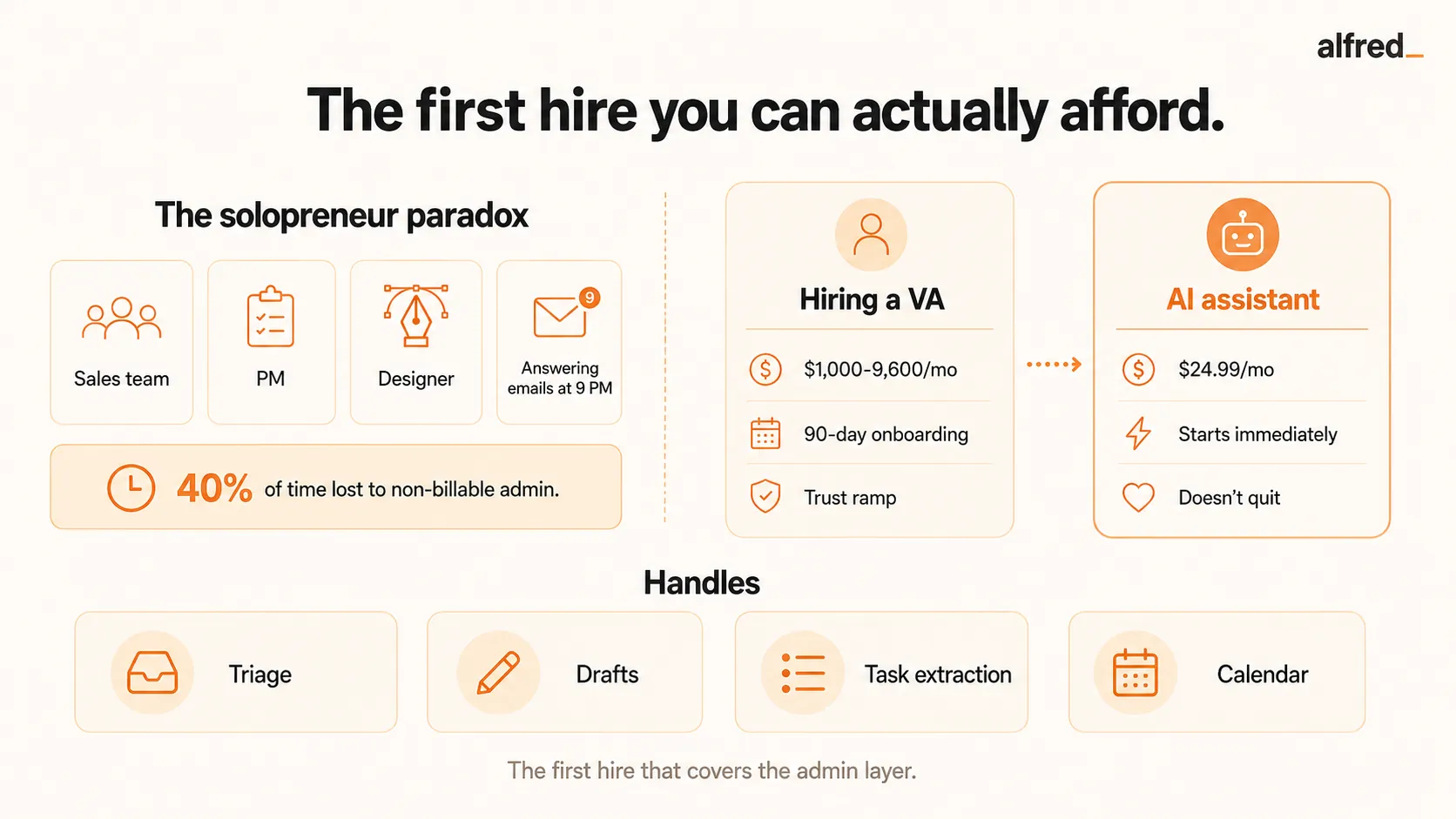
You’re the sales team, the PM, the designer, and the person answering “quick questions” at 9 PM.
You didn’t plan this. When you started your business, the consulting practice, the design studio, the coaching firm, whatever your thing is. You pictured doing the work. The actual work. The thing you’re good at, the thing people pay you for, the thing that made you leave the 9-to-5 in the first place.
Nobody told you that 40% of your time would go to email.
“Being a freelancer means I’m always either doing the work or finding the work. Email is a third job I didn’t sign up for.”
There are nearly 30 million solopreneurs in the United States. That number keeps growing, 84% of US businesses now operate without employees. The solo model works. It’s profitable. 77% of solopreneurs are profitable in their first year, compared to 54% of businesses with employees.
But there’s a catch that nobody puts in the success stories: when you’re the only person, you’re every person. And “every person” includes the one who spends three hours a day on email that has nothing to do with the work you actually get paid for.
The Billable Hour Bleed
Let’s do the math that nobody wants to do.
“I bill $200/hr and I spend 3 hours a day on email I could have a $15/hr assistant handle.”
If you bill $150-$200/hr and spend three hours a day on email, that’s $450-$600 per day in opportunity cost. Per day. That’s $2,250-$3,000 per week. $9,000-$12,000 per month. Not in actual losses, you’re not writing a check. But in time that could have been billable, spent instead on scheduling calls, answering “quick questions,” chasing invoices, and triaging the 121 emails that hit your inbox every day.
The average freelancer works 35-40 hours per week but only bills 60% of that time. The other 40% is admin. Email. Scheduling. Follow-ups. The invisible work that keeps the business running but generates zero revenue.
41% of solopreneurs say time is their number one operational challenge. 60% say it’s their biggest personal challenge. Not money. Not clients. Time. Specifically, not having enough of it because the non-billable work expands to fill every gap.
“By the time I actually sit down to do the work I was hired for, half my day is gone.”
That’s the solopreneur paradox. You left your job for freedom. Freedom means you do everything. The work you love is maybe half your day. The rest is admin that somebody needs to do, and somebody is you.
The 9 PM Email (And Why You Can’t Ignore It)
Client emails don’t respect business hours. When you’re the only point of contact, every message carries weight. Not answering tonight means risking the perception that you’re slow, unresponsive, or, worst of all. That you don’t care.
“My clients don’t email me to say things are fine. They only email me when something’s wrong. So every email is a small crisis.”
So you answer at 9 PM. And at 10 PM. And you check one more time before bed, just in case. The boundary between “business owner” and “person who lives a life” erodes until they’re the same thing. You’re technically independent, but you’re on call 24/7 for every client, every thread, every “quick question” that takes 45 minutes.
“The invoice is 30 days overdue and I’ve sent two ‘just following up’ emails. This is not what I went independent for.”
The irony is sharp. You left a job where someone else handled the administrative overhead. Now you are the administrative overhead, plus the revenue generator, the strategist, the account manager, and the person who empties the metaphorical trash.
Why You Can’t Just Hire Your Way Out
The obvious answer is “hire someone.” A virtual assistant. An EA. Someone to handle the email so you can do the work.
The math doesn’t work for most solopreneurs.
A virtual assistant costs $1,000-$3,000/month for offshore help. That’s before the time zone gaps, the communication overhead, and the training investment. A US-based VA is $4,000-$9,600/month, solid, reliable, and more than many solopreneurs clear in profit after expenses.
Email management VAs specifically run $25-$60/hour depending on specialization. At three hours per day, that’s $75-$180/day, $1,500-$3,600/month.
And then there’s the onboarding. 90 days before a VA is effective at email, 30 days to learn your basic patterns, 30 days to handle routine messages, 30 more before they can touch anything nuanced. That’s three months of training where you’re doing more work, not less, because you’re teaching and supervising on top of your normal load.
“What I want is an EA. What I can afford is another subscription I won’t use.”
The trust issue is real too. Handing your client email to someone else feels like handing them your reputation. One wrong tone, one missed context, one reply that doesn’t sound like you, and the client relationship you spent months building shifts. The stakes feel too high for a person you hired last week.
Why Project Apps Add More, Not Less
The solopreneur’s problem isn’t a lack of apps. It’s a lack of time. Every app you add is another thing to learn, configure, maintain, and check.
Asana / Monday.com / ClickUp ($7-$25/month): Built for teams. Collaboration features, team views, multi-user workflows. For a solo operator, 80% of it is overhead. You don’t need a Gantt chart. You need someone to answer the email while you do the work.
Notion ($10-$12/month): “Build your own system!” Many users report twenty hours of setup. Five hours per week of maintenance. A beautiful dashboard you stop opening after three weeks because maintaining it has become its own job.
Zapier / Make ($20+/month): Automation sounds perfect until you’re debugging a broken workflow at 11 PM because the API changed. You’ve added “automation engineer” to the list of hats you’re wearing, right next to “accountant” and “marketing department.”
The meta-problem: every app designed to help you get more done requires you to do more. You don’t need another thing to check. You need fewer things to do. Period.
How 5 Approaches Compare for Solo Operators
| Approach | Price | Handles Email Triage? | Drafts Replies? | Extracts Tasks? | Key Limitation |
|---|---|---|---|---|---|
| Hiring a VA | $1,000–$9,600/mo | Yes (after 90 days) | Yes (after training) | Yes (manually) | Cost, training time, trust ramp, turnover risk |
| SaneBox | $7–$36/mo | Sorts only | No | No | Cleaner inbox, not emptier. You still do everything |
| Superhuman | $30/mo | Split inbox | AI assist (you initiate) | No | Faster email, same volume, same burden |
| Notion + Todoist + Calendar | $15–$25/mo | No | No | Manual | Three apps to maintain; the bridge is still you |
| alfred_ | $29.99/mo | Yes, automatic | Yes, in your voice | Yes, automatic | Requires Gmail or Outlook |
Hiring a virtual assistant
The ideal answer, in theory. In practice, most solopreneurs can’t justify $1,000-$3,000/month before they’ve seen ROI. The 90-day onboarding means three months of extra work before you see relief. And if they leave, the knowledge walks out the door. You start over with someone new, another 90 days, another trust ramp. For established businesses with consistent revenue, a great VA is worth every penny. For a one-person agency trying to scale from $8K/month to $15K/month, it’s a chicken-and-egg problem. You need help to grow, but you need to grow to afford help.
SaneBox
Strong at what it does: sorting incoming email. Newsletters go to @SaneLater. Persistent noise goes to @SaneBlackHole. Your inbox gets quieter. But SaneBox doesn’t draft replies. It doesn’t extract tasks. It doesn’t touch your calendar. You still process everything yourself. It’s just a shorter list. For a solopreneur drowning in admin, a slightly shorter list isn’t enough.
Superhuman
A keyboard-driven email client. Keyboard shortcuts, split inbox, AI summaries. You process 121 emails in 90 minutes instead of 120 minutes. But faster email for a solopreneur still means doing all the email. The volume hasn’t changed. The burden hasn’t changed. You’re a faster email answerer, which is not the same thing as not being the email answerer.
The DIY stack (Notion + Todoist + Calendar)
Three apps. Three subscriptions. Three things to keep in sync. Powerful when maintained. Nobody maintains it when they’re in back-to-back client calls from 9 to 4 and catching up on email from 4 to 7. The system that was supposed to reduce overhead becomes overhead.
alfred_
The first hire you can actually afford.
AI handles email triage, draft replies, task extraction, and calendar management. For the cost of a moderately nice lunch, you get what used to require a $1,000-$3,000/month VA.
No onboarding period. No 90-day trust ramp. No time zone issues. It connects to your Gmail or Outlook, learns your patterns, and starts working. Email triage happens automatically. Draft replies wait for your approval. Action items get extracted from threads without you lifting a finger. Your calendar stays organized without the back-and-forth.
“I got into consulting to use my expertise. I spend most of my day proving I read emails.”
alfred_ gives you that time back. Not by making you faster at email, by doing the email work that doesn’t require your expertise. The routine responses. The scheduling. The follow-up tracking. The “can you send me that by Thursday?” action items hiding in paragraph four.
You go from wearing every hat to wearing the hats that only you can wear. The sales calls. The strategy sessions. The creative work. The thing you started this business to do.
The Math That Finally Works
- VA: $1,000-$9,600/month + 90 days onboarding + turnover risk
- alfred_: $29.99/month + starts immediately + doesn’t quit
If you bill $200/hour and alfred_ saves you even one hour per day, that’s $200/day in recovered billable time. The ROI breaks even on day one.
20% of solopreneurs earn $100K-$300K per year without employees. The difference between a $100K solopreneur and a $200K solopreneur often isn’t talent or pricing. It’s the number of billable hours they reclaim from admin. Every hour you’re not answering email is an hour you can bill.
“I bill $200/hr and I spend 3 hours a day on email I could have a $15/hr assistant handle.”
Now you can. For a fraction of what that assistant would cost.
The first hire you can actually afford.