

The invoice is 30 days overdue. You have sent two “just following up” emails. The client has not responded.
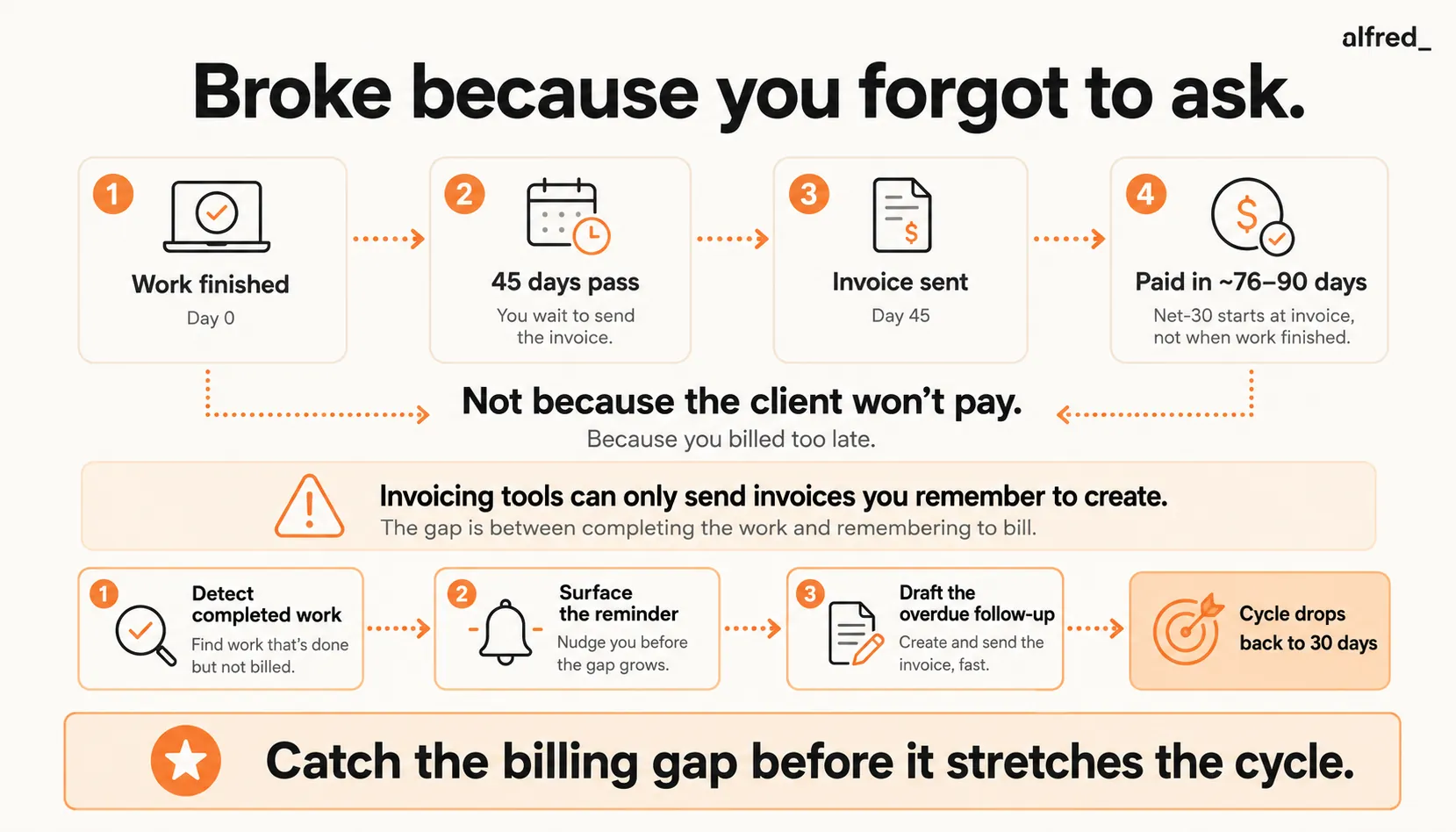
But here is the part you are not telling anyone: the invoice was not 30 days overdue because the client refused to pay. It was 30 days overdue because you sent it 45 days after the work was done. You finished the project in January. You meant to invoice on February 1st. You invoiced on March 15th. And now it is April, the invoice is “overdue,” and the real story is that you forgot to ask for money you already earned.
“The invoice is 30 days overdue and I’ve sent two ‘just following up’ emails. This is not what I went independent for.”
This is not what you went independent for. You did not leave a stable paycheck to become your own accounts receivable department. You did not start freelancing to spend your evenings writing “per our conversation on January 12th, please find attached…” You went independent to do the work. And the work is great. The admin is killing you.
The Cash Flow Problem You Created
There is a particular cruelty to the freelancer cash flow crisis. You are not broke because you lack work. You are not broke because clients refuse to pay. You are broke because the invoice is sitting in your drafts folder, or worse, in your head, while the rent is due.
A FreshBooks study found that 40% of freelancers head into any given season with unpaid invoices outstanding. But “unpaid” is misleading. A large portion of that balance is not unpaid. It is un-invoiced. The work was completed. The client is ready to pay. Nobody has asked them to.
According to a SCORE/SBA study, 82% of small business failures are due to cash flow problems. For freelancers and independent consultants, cash flow problems have two causes: clients who pay late, and you who invoice late. You can control the second one. You are not controlling it.
The math is brutal. You complete a project on January 15th. You mean to invoice on February 1st. You actually invoice on March 1st, 45 days after completion. The client’s payment terms are Net 30. If they pay on time, the check arrives April 1st, 76 days after you finished the work. If they are a few days late, you are looking at 80-90 days between doing the work and seeing the money.
Three months. Because you forgot to send a PDF.
Why You Keep Forgetting
You are not lazy. You are not disorganized. You are doing the thing that every human brain does when faced with competing priorities: you defer the task that feels least urgent.
Invoicing does not feel urgent on the day you finish the work. You just wrapped a project. You are riding the high of completion, or you are already deep in the next deliverable. The invoice can wait until tomorrow. Tomorrow, the next project is demanding your attention. The invoice can wait until the weekend. The weekend, you are finally not working. The invoice can wait until Monday.
This is not a discipline failure. It is a well-documented cognitive pattern. Research by Dr. Piers Steel at the University of Calgary, whose meta-analysis of procrastination (Steel, 2007) synthesized 691 correlations from the research literature, found that task delay correlates strongly with low perceived urgency and low intrinsic reward. Invoicing scores near zero on both dimensions. The work is done. The urgency is invisible, until the rent is due.
Admin work gets deprioritized behind billable work. Industry surveys consistently show that freelancers spend roughly 25-36% of their working time on non-billable administrative work. Invoicing. Bookkeeping. Contract review. Email management. Every hour spent on admin is an hour not spent on billable work, and your brain knows it. So admin gets pushed. Invoicing, which has no immediate consequence for delay, gets pushed hardest.
The follow-up is even harder than the invoice. Sending an invoice is admin work. Following up on an unpaid invoice is emotional work. You have to write an email that says “please pay me” without sounding desperate, confrontational, or unprofessional. The follow-up requires tone calibration, firm but friendly, direct but not aggressive, and that tone calibration takes energy you do not have after a full day of client work.
So the invoice goes out late. And then the follow-up goes out later. And you, who did excellent work, who delivered on time, who earned every dollar, are the last person in the chain to get paid.
The Shame Spiral
There is a specific shame that comes with being broke because of your own administrative neglect. It is not the shame of failure. Your work is excellent. It is the shame of competence undermined by logistics.
You can build a beautiful website but cannot remember to bill for it. You can deliver a consulting engagement that transforms a client’s business but cannot send a PDF within 30 days of completion. You can close deals, ship products, and manage complex projects, but you cannot manage your own invoicing.
This shame keeps you from talking about it. You will tell a friend “cash flow is tight” but you will not say “cash flow is tight because I forgot to send three invoices.” Because that sounds like something a disorganized person does, and you are not disorganized. You are overwhelmed. There is a difference.
The shame also makes the problem worse. The longer the invoice is delayed, the more awkward it feels to send it. “It’s been 6 weeks since the project ended, can I really invoice now? Will they think I’m unprofessional?” Yes, you can. And yes, they might. But the alternative is not getting paid at all.
“I finished the work in November. I sent the invoice in January. I got paid in March. I need to stop doing this to myself.”
What People Try
Invoicing software (FreshBooks $19-65/month, QuickBooks $38-275/month, Wave Free). These are excellent at creating, sending, and tracking invoices. They have templates, automatic payment reminders, and online payment processing. But they all share the same blind spot: they cannot remind you to create an invoice you have not created yet. Recurring invoices work for retainer clients. But project-based work, milestone billing, and one-off engagements require you to manually initiate the invoice. And that is the step you keep missing.
Calendar reminders. “Invoice Client X - Friday.” The reminder fires. You are on a call. You dismiss it. It does not fire again. The invoice is not sent.
Task lists. You add “Send invoice - Project Y” to Todoist or Notion. The task sits in your list alongside “Review contract,” “Update portfolio,” and 35 other items. The invoicing task is not the most urgent. It gets deprioritized. It rolls over to next week. Then the week after.
Batch invoicing. You decide to do all your invoicing on the first of every month. The first falls on a Monday. Your busiest day. You defer to Tuesday. Tuesday has three client calls. Wednesday you finally sit down to invoice, but you cannot remember everything you completed last month. You check your project management app, your email, your time tracker. The batch session takes 2 hours instead of 30 minutes. Next month, you dread the batch session so much that you defer it to the 5th. Then the 10th.
The pattern: every approach assumes you will remember to do the thing. The problem is that you do not remember to do the thing.
How alfred_ Closes the Gap
alfred_ does not create invoices. It does something more important: it makes sure you never forget to create them.
Work completion check. Ask alfred_, or make it a weekly routine, and it reads your email for signals that work has been completed: client approvals, delivered files, milestone confirmations, project wrap-up conversations. It lists what it finds: “Project X for Client Y appears complete as of March 3rd. Invoice not yet sent.”
You do not need to remember. The system remembers for you.
Payment follow-up drafting. When invoices go overdue, the hardest part is writing the follow-up email. “Hey, just wanted to check on the status of…”. You have started this email fourteen times and sent it twice. alfred_ drafts the follow-up in your voice: professional, specific, and calibrated to the relationship. It references the invoice number, the amount, the due date, and the payment terms. All you do is review and send.
No more agonizing over tone. No more “do I sound desperate?” No more putting off the follow-up because writing it feels worse than not getting paid.
Timing that escalates appropriately. The first follow-up at 7 days overdue is gentle. The second at 14 days is firmer. The third at 30 days is direct. alfred_ calibrates the tone of each follow-up to the stage of the collection process, so you do not have to decide how assertive to be. The drafts are ready. You adjust if needed and send.
Less than one hour of your billable rate. Less than the late fee on one overdue invoice. Immeasurably less than the cash flow crisis caused by three un-sent invoices stacking up simultaneously.
The Arithmetic of Getting Paid
Here is what changes:
You finish a project on Monday. On Monday evening, alfred_ surfaces the reminder. On Tuesday morning, you create the invoice in FreshBooks (or whatever invoicing tool you use) and send it. The client receives it while the work is still fresh. They process it through their accounts payable. Payment arrives in 30 days.
30 days. Not 76. Not 90. 30.
The invoice that would have sat in your head for 6 weeks goes out in 24 hours. The follow-up that would have taken you 2 weeks to write goes out automatically on day 7. The cash flow crisis that would have hit in April never materializes, because the money arrived in February, when it should have.
You did the work. You earned the money. You got paid. On time. Without chasing. Without shame. Without writing “just following up” at 11 PM on a Tuesday.
This is what you went independent for.




