


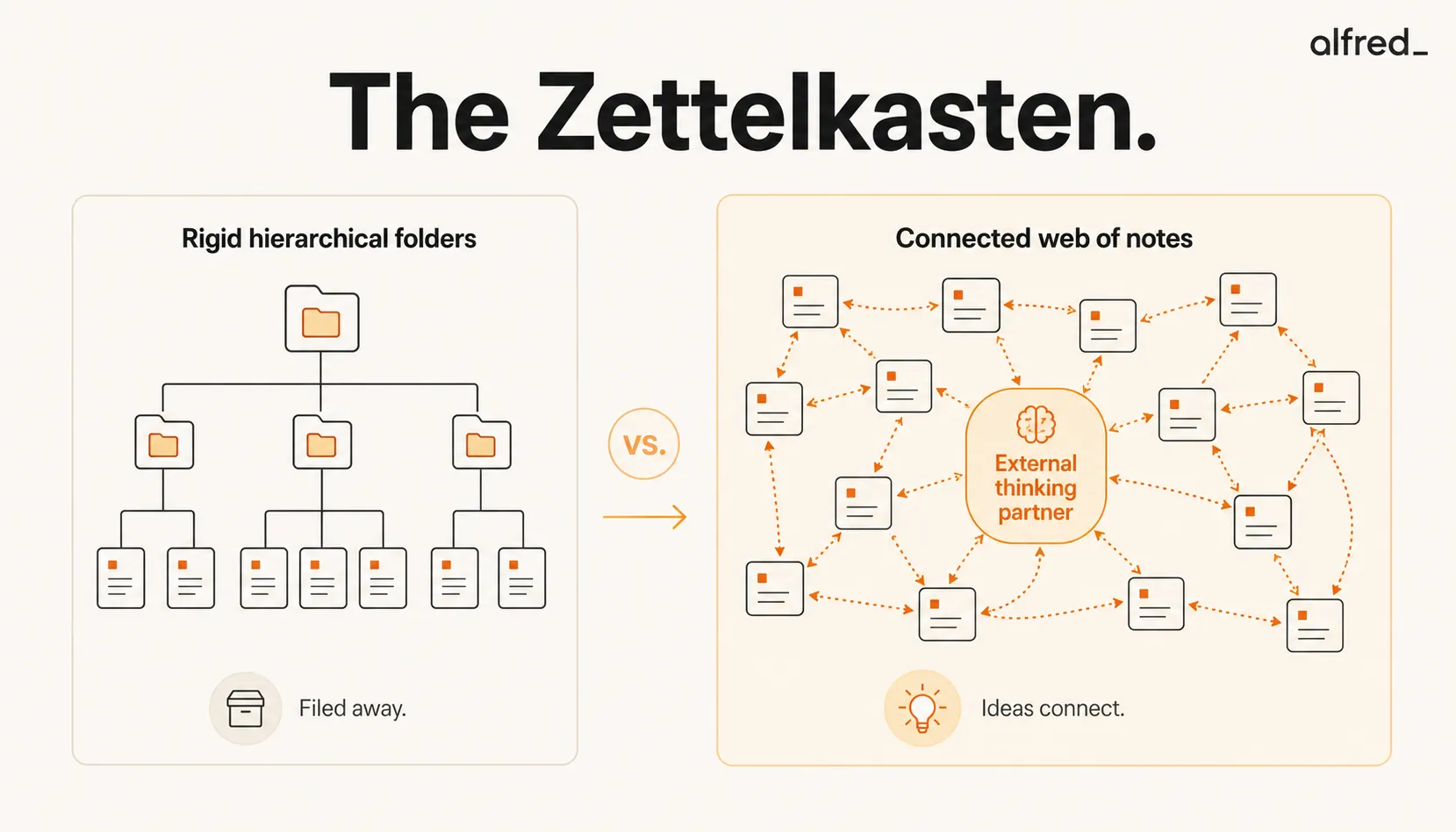
One German sociologist published 58 books and over 600 articles across fields most scholars never cross between, and he credited not his intellect but a wooden box of index cards. The Zettelkasten is often mistaken for a fancy note-taking app, but its power was never in storage. It was in connection: notes linked to other notes until the box itself became something Luhmann described as a thinking partner. Here is how the system actually worked, why a network beats a hierarchy for ideas, and the discipline that separates a real Zettelkasten from a pile of orphaned notes.
Luhmann’s System
Niklas Luhmann described his Zettelkasten method in “Kommunikation mit Zettelkästen” in Baier, Kepplinger & Reumann (eds.), Öffentliche Meinung und sozialer Wandel (Westdeutscher Verlag, 1981), pp. 222–228. The physical system consisted of wooden slip-boxes (Zettelkästen) containing approximately 90,000 index cards at his death in 1998, now preserved at Bielefeld University and partially digitized.
Each card followed three rules: one atomic idea per card (a single thought, argument, or reference, not a summary of a chapter); a unique alphanumeric identifier that allowed any card to be referenced from any other card; and explicit links (written references to the identifiers of related cards, whether those cards addressed the same topic, offered a counterargument, or connected unexpectedly from a different domain). The alphanumeric IDs were not hierarchical category labels but location addresses, allowing new cards to be inserted anywhere in the sequence by extending the number (1/1, 1/1a, 1/1b, 1/2…).
58 books, 600+ articles
Niklas Luhmann published 58 books and over 600 academic articles across his career using the Zettelkasten as his primary thinking and writing tool. His output spanned systems theory, sociology of law, sociology of religion, and media theory: fields that most scholars treat as entirely separate domains.
Schmidt, J.F.K. (2018). Niklas Luhmann's Card Index: The Fabrication of Serendipity. Sociologica, 12(1), 53–60.Luhmann described the Zettelkasten as a “communication partner,” not a passive repository but a system with emergent properties that arose from the density of its linkages. When writing, he did not retrieve notes from a folder on the topic; he navigated the network from an entry point, following links, discovering what the system had accumulated on questions he had not anticipated. The value was not in any individual card but in the connections between cards built over years of use.
Why Networks Beat Hierarchies for Knowledge
The conventional note-taking approach is hierarchical: create folders (or notebooks, or tags), assign each note to a category, retrieve notes by navigating the category structure. The problem is that ideas rarely belong to one category. An insight about organizational psychology may be equally relevant to a discussion of leadership, behavioral economics, and personal productivity, but a hierarchical system forces a single placement.
The Zettelkasten addresses this through explicit bidirectional linking. A note on cognitive load can link directly to notes on decision fatigue, working memory research, and instructional design, regardless of where those notes sit in any organizational structure. The network represents the actual relationship structure of ideas rather than the artificial hierarchy of a folder system.
The practical implication is that the Zettelkasten becomes more valuable as it grows, since each new note can link to a larger existing network, creating more potential connections and more opportunities for unexpected synthesis. A hierarchical system suffers from folder proliferation as it grows; a networked system benefits from density.
Implementing the Zettelkasten Principle
- Atomic notes. Each note should contain one idea, not a summary of a source. A book chapter might produce five separate cards, one for each distinct argument, rather than one card summarizing the chapter. Atomic notes are linkable to specific ideas rather than to a general topic, which makes the links more precise and more useful.
- Writing in your own words. Luhmann did not copy quotations into his Zettelkasten; he restated ideas in his own language, which forced genuine understanding rather than passive collection. A note that could have been written without reading the source is not a Zettelkasten note; it is a verbatim extract. The processing required to restate an idea in your own words is the processing that creates understanding.
- Explicit links at the time of writing. The value of the Zettelkasten comes from links, and links are most usefully made at the time of writing a note, when the connections are most visible. Linking is not a filing decision (“which folder does this go in?”) but an intellectual one (“what does this connect to, and why?”). The connection and its rationale should both be noted.
The Real Bottleneck Isn’t the Box
Both ways the Zettelkasten fails come back to the same scarce resource. Writing atomic notes in your own words and forging explicit links is slow, deliberate work, and it pays nothing back until the network reaches density. That is precisely the kind of unrewarded, focus-heavy effort that a reactive workday devours first. The note-taking is not what people abandon; the uninterrupted time to do it properly is what they never manage to protect. No tool can do this part for you, and it would be dishonest to suggest one could. Luhmann’s network was Luhmann’s thinking, card by card.
What can be removed is the thing that keeps eating the hours the practice requires. alfred_ triages your inbox, drafts the routine replies, and surfaces only what genuinely needs you, so the deep, quiet blocks where atomic notes actually get written and linked stop being the first casualty of a busy week. It does not build your Zettelkasten. It defends the conditions under which you can, which for most people is the difference between a living network and a folder of notes they stopped adding to in March.