

The Scope of the Evidence
Baumeister, Bratslavsky, Finkenauer, and Vohs published “Bad Is Stronger Than Good” in the Review of General Psychology in 2001 (Vol. 5, No. 4, pp. 323–370). The paper is a broad theoretical review, synthesizing decades of research across domains rather than reporting a single experiment. It has since exceeded 10,000 citations, making it one of the most-cited papers in psychology.
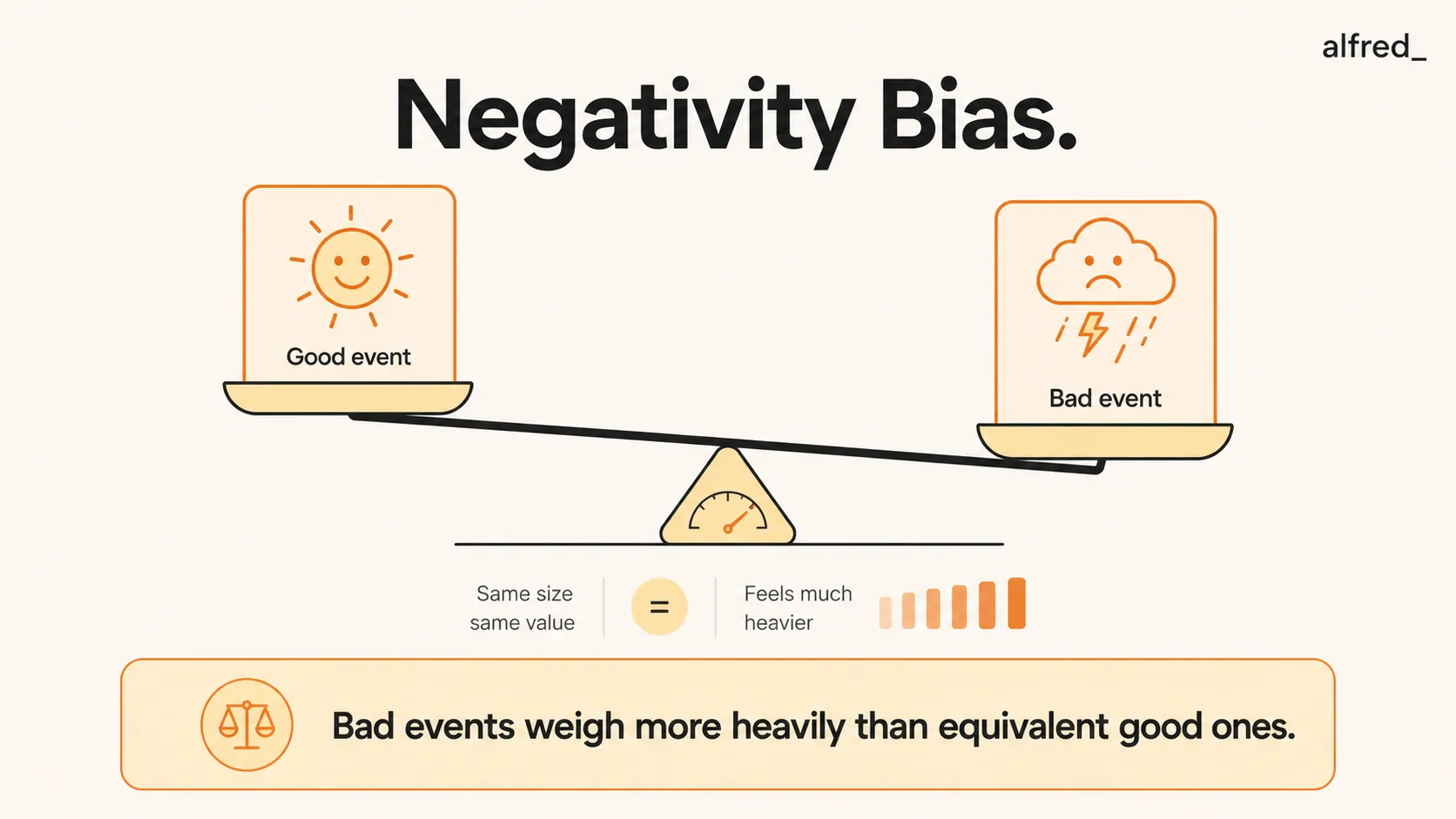
The paper documents the negativity advantage across five domains: bad events in close relationships (a bad day with a partner has more impact on relationship quality than an equivalent good day), bad parenting (neglect and abuse have stronger effects on developmental outcomes than equivalent amounts of positive parenting), bad feedback (criticism has greater impact on performance than equivalent praise), bad information in impression formation (a single negative trait makes a negative first impression harder to overcome than equivalent positive traits make a positive impression), and bad events in general emotional life (the hedonic impact of bad events is greater than that of good events of equivalent objective magnitude).
The proposed evolutionary mechanism: in ancestral environments, negative stimuli such as threats, poisons, predators, and social rejection had asymmetrically high consequences. Missing a positive was costly; missing a negative was potentially fatal. The nervous system that evolved under those conditions is calibrated for threat detection, not opportunity maximization.
Mechanisms: Attention, Memory, and Impact
The negativity bias operates through at least three distinct mechanisms that compound each other:
- Attentional priority. Negative stimuli capture attention more quickly and hold it longer than equivalent positive stimuli. Eye-tracking studies show that threatening or negative images are fixated sooner and longer. In professional contexts, this means a single critical sentence in an email receives more cognitive processing time than several paragraphs of positive content.
- Memory consolidation. Emotionally negative events are better encoded and more durably retained than equivalent positive events. This is partly mediated by the amygdala’s role in consolidating emotionally significant memories. The practical consequence: negative incidents are remembered more accurately, in more detail, and for longer periods than positive incidents of the same objective magnitude.
- Disproportionate impact on evaluation. In impression formation, negative information carries more diagnostic weight than positive information; it is seen as more revealing of true character. This asymmetry means that a single observed failure of integrity, for example, is weighted more heavily in overall impression than multiple observed acts of integrity. The bad is more informative about the underlying person than the good.
Professional Applications
- Performance feedback delivery. Research on feedback ratios (the Losada ratio and related work) suggests that negative feedback has roughly 3–5x the hedonic impact of positive feedback in team settings, which means that even calibrated feedback delivery requires deliberate attention to positive signals, not because the positive is more important, but because negativity bias will systematically over-weight the critical content.
- Reputation and trust repair. Negative events in professional relationships persist in memory and in reputation significantly longer than they deserve by their objective severity. A single public failure, a breach of a commitment, or a conflict interaction tends to anchor perceptions for months or years, while equivalent positive contributions fade faster. Recovery from reputation damage requires sustained, highly visible positive behavior over extended periods, not a single equivalent positive event.
- Information processing in decisions. When evaluating a proposal, a candidate, or a business case, the negative elements in the information will be processed more thoroughly, remembered more accurately, and weighted more heavily in the final judgment than positive elements of equivalent objective importance. Decision processes that don’t structurally counteract this produce systematically risk-averse outcomes biased toward rejecting good opportunities.
- Email and communication load. The proportion of incoming communications that carry negative or threatening content (problems, complaints, errors, conflicts) receives disproportionate attentional weight relative to neutral or positive communications. This contributes to inbox anxiety: the negative messages that demand response dominate cognitive presence even when they are a minority of total volume.