


The Wheel-of-Fortune Experiment
Tversky and Kahneman introduced the anchoring heuristic in their landmark 1974 paper “Judgment under Uncertainty: Heuristics and Biases,” published in Science (Vol. 185, No. 4157, pp. 1124–1131). The anchoring experiment is among the most cleanly designed in behavioral research.
45 vs 25
median estimates of the percentage of African countries in the United Nations: participants who saw the wheel stop at 65 gave a median estimate of 45%; those who saw it stop at 10 gave a median of 25%. A 20-point gap driven entirely by an arbitrary number.
Tversky & Kahneman (1974), Science, 185(4157)Participants were shown a wheel of fortune rigged to stop at either 10 or 65. They were then asked to estimate the percentage of African countries that are members of the United Nations. The wheel spin was explicitly presented as random: participants were told the number was chance-generated and had no bearing on the question. Yet those who saw 65 gave median estimates of 45%, while those who saw 10 gave median estimates of 25%. The anchor shifted the final estimate by 20 percentage points despite being demonstrably irrelevant.
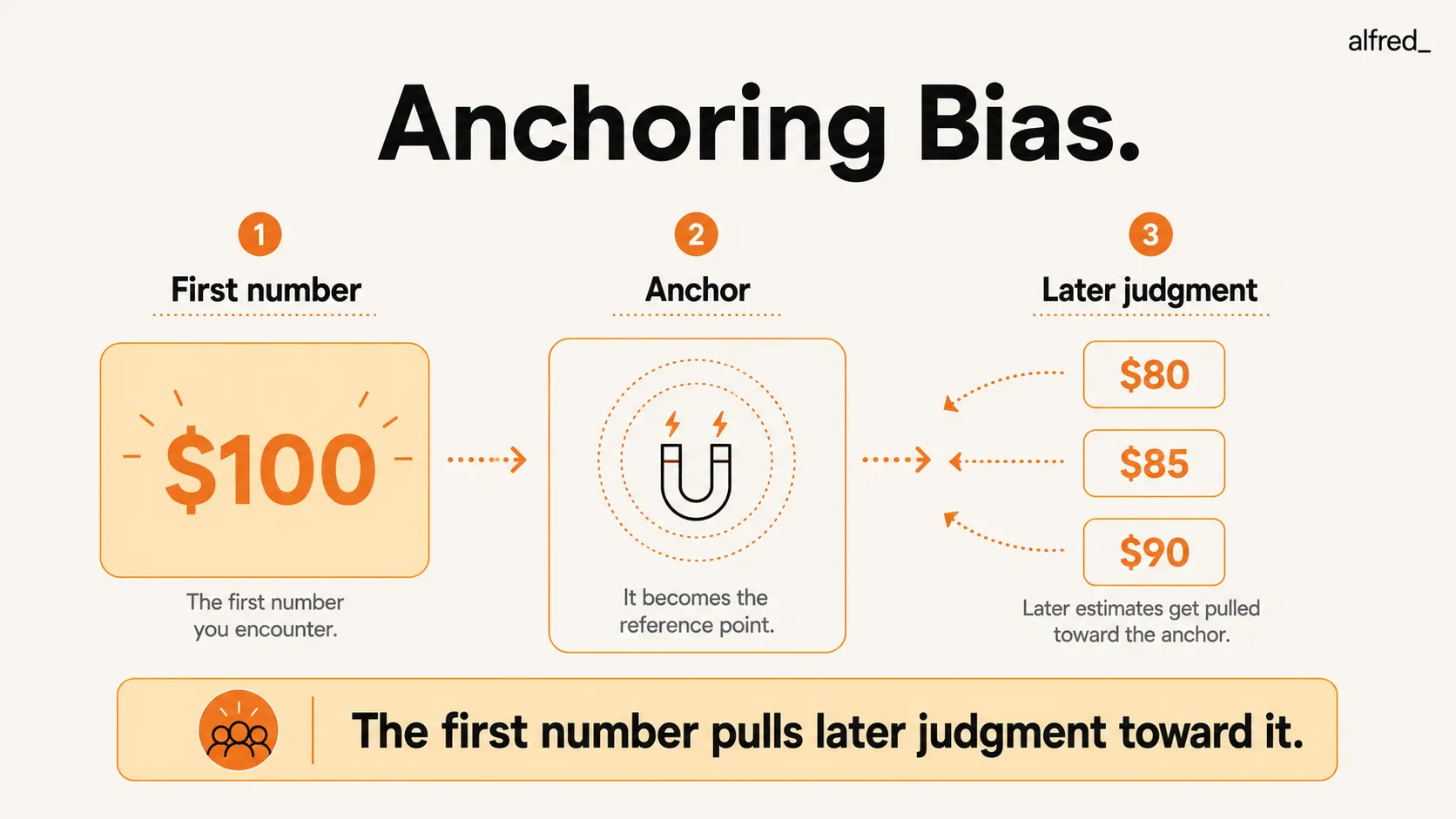
The mechanism Tversky and Kahneman identified is insufficient adjustment: people start from the anchor value and adjust in the direction they believe is correct, but they stop adjusting before they should. The anchor creates a starting point that biases the search for a plausible answer; the adjustment process terminates too early, leaving the final estimate too close to the anchor.
Why Anchors Work Even When You Know
Subsequent research has consistently shown that anchoring effects persist even when participants are explicitly warned about the bias, offered financial incentives for accuracy, or told that the anchor was generated randomly. Strack and Mussweiler (1997) demonstrated that anchors activate associated knowledge: after seeing a high anchor, information consistent with that anchor becomes more accessible, and the estimation process disproportionately draws on that information.
This makes anchoring unusual among cognitive biases: it cannot be eliminated by knowing about it. A negotiator who understands anchoring in principle is still subject to the same directional pull from the first number on the table. The structural response is not awareness but procedure: who presents first, what number appears in written materials, what baseline is established before discussion begins.
Professional Applications
- Salary negotiation. The first number named in a salary negotiation functions as an anchor regardless of who names it. Research by Galinsky and Mussweiler (2001) found that first offers in negotiation predicted final outcomes significantly, and that the effect was partially (but not fully) offset by counterfactual anchoring, which involves deliberately thinking about what the other party wants rather than adjusting from their anchor.
- Project estimation. Initial estimates in project planning function as anchors for all subsequent revisions. Teams that start with an optimistic budget estimate systematically underestimate costs even after multiple revision rounds, because each revision adjusts from the prior estimate rather than performing a clean re-estimation from first principles.
- Pricing and perceived value. The “original price” shown alongside a discounted price anchors value perception. A $200 item discounted to $120 is perceived as a better value than a $120 item priced without comparison, because the anchor creates a reference against which the final price is evaluated.
- Email and communication. The first number mentioned in an email thread, whether a timeline, a budget figure, or a headcount, establishes an anchor that subsequent discussion adjusts around rather than independently assesses. The person who writes the first email with a number often determines the range within which the negotiation settles.