


Festinger’s Original Theory
Leon Festinger published “A Theory of Social Comparison Processes” in Human Relations in 1954 (Vol. 7, pp. 117–140). The paper proposed a set of formal hypotheses about when and how people compare themselves to others.
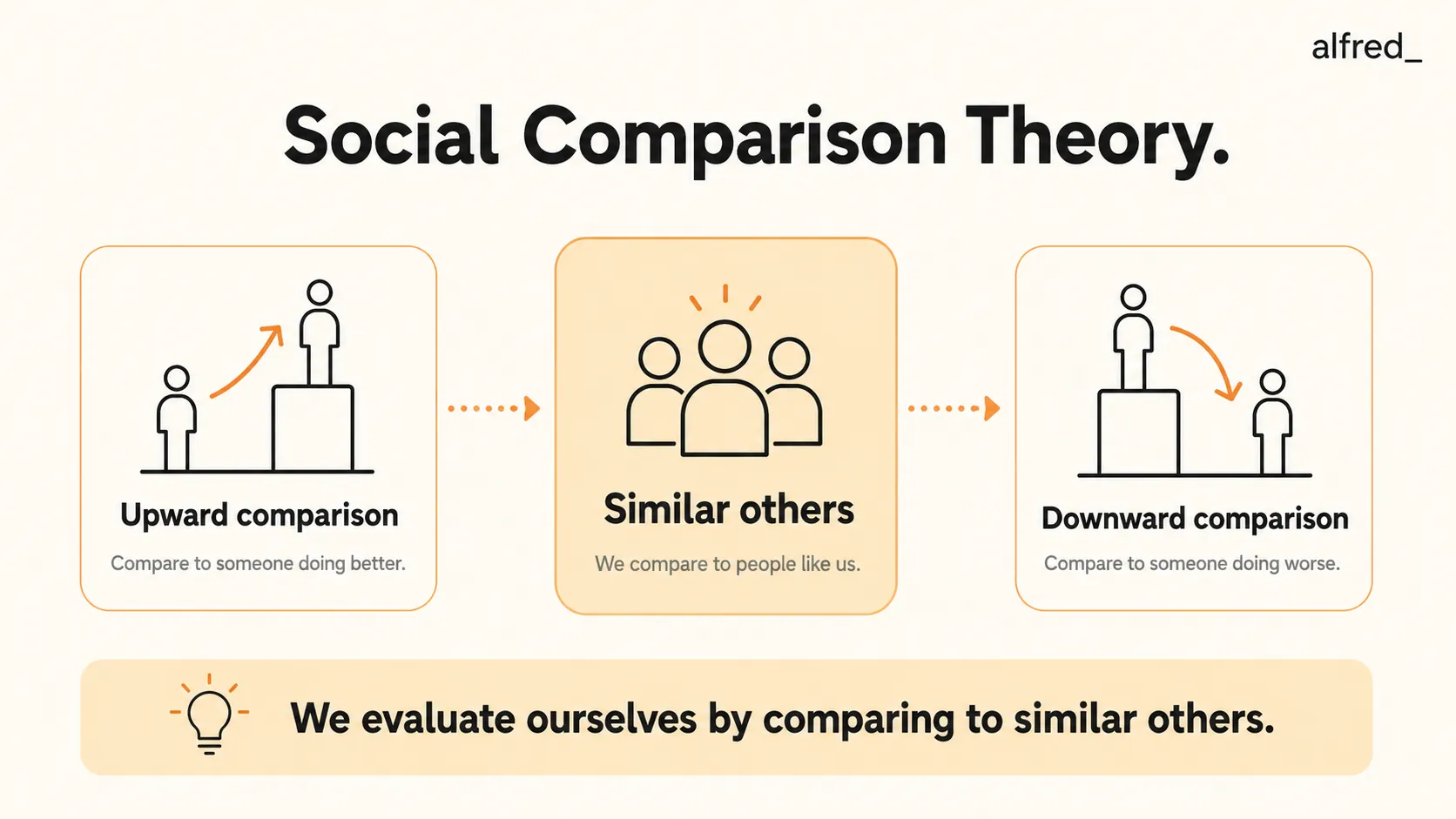
The foundational premise: people have a drive to evaluate their opinions and abilities. When objective, physical means of evaluation are available (you can measure how fast you run by timing yourself), social comparison is less necessary. But for most opinions and abilities in professional life (Am I a good executive? Is this strategy correct? Is this salary fair?), there are no purely physical standards. Social comparison fills the gap, providing a reference point when objective standards are absent.
A key hypothesis in Festinger’s paper: people prefer to compare with others who are similar to them. A highly skilled professional gains limited information from comparing with a complete novice; the novice gains limited calibration from comparing with a world-class expert. The most informative comparison targets are those who are close in ability or opinion. They provide the reference point against which your own standing can be assessed.
Festinger also described a “unidirectional drive upward” for abilities: people are motivated to improve their abilities, and this drive influences comparison choice. They tend to compare with those slightly above them in ability, which creates a directional pull toward improvement rather than simply evaluation.
Upward and Downward Comparison
The specific terminology of “upward” and “downward” social comparison was formalized by researchers after Festinger. Downward social comparison (comparing with those worse off than oneself) was specifically introduced as a theoretical construct by Thomas Wills in his 1981 paper “Downward Comparison Principles in Social Psychology” in Psychological Bulletin. Wills proposed that downward comparison serves a self-enhancement function: when self-esteem is threatened, people compare with less fortunate others to boost their relative standing.
Upward comparison (comparing with those better off, more capable, or more successful) has two distinct effects depending on the perceiver’s appraisal of achievability. When the comparison target’s level of performance feels attainable, upward comparison produces inspiration and motivation: seeing what’s possible raises effort and aspiration. When the target’s performance feels unattainable, upward comparison produces envy and negative affect without motivational benefit. The same upward comparison can produce opposite effects depending on whether the gap feels closeable.
Downward comparison produces a temporary self-esteem boost through favorable relative assessment. It is a coping mechanism that functions when self-evaluation is threatened, but it is not a driver of improvement. Comparing with worse performers does not raise effort or aspiration. The asymmetry matters for organizational design: environments that trigger frequent downward comparison (e.g., relative ranking systems that prominently display low performers) may stabilize mood without improving performance.
Professional Implications
- Peer group and mentor selection. The people you routinely compare with determine your working standard for performance. A team where the comparison targets are high performers pulls individual standards upward through upward comparison; a team where comparison is primarily with median or low performers produces a different calibration. Deliberate construction of comparison environments (through peer groups, mastermind groups, and mentorship from people operating at the level you’re aiming for) is social comparison applied strategically.
- Salary transparency and equity. Salary is an ability-domain evaluation where social comparison is intense and reference points matter enormously. Research consistently shows that perceived equity (how your compensation compares to relevant others) affects motivation, satisfaction, and retention more than absolute compensation level (this is Festinger’s theory directly applied). Salary transparency shifts the comparison reference point for every employee simultaneously, with consequences that depend heavily on where each person lands in the distribution.
- Performance feedback and relative ranking. Ranking systems make social comparison explicit and immediate. The motivational effect depends on position: those in the middle and upper-middle tend to show motivational responses to rankings; those at the bottom may show demotivation and disengagement when the gap feels uncloseable. Feedback systems that provide comparison targets slightly above the individual’s current performance (activating attainable upward comparison) outperform systems that provide full ranking visibility across the distribution.