
Psychology

The Dunning-Kruger Effect:
Why Low Performers Overestimate Their Ability

Hiring interviews surface candidates who are supremely confident in skills they demonstrably lack. Performance reviews reveal employees who believe they are performing at the top of the team while objective measures put them at the bottom. The Dunning-Kruger effect is a documented finding about the metacognitive deficit that prevents low performers from recognizing their own errors.

Feb 19, 20266 min read
Quick Answer

What is the Dunning-Kruger effect?

  • The Dunning-Kruger effect is the finding that low performers systematically overestimate their ability while high performers underestimate their relative standing
  • Bottom-quartile performers rated themselves at the 62nd percentile while actually scoring around the 12th (Kruger & Dunning, 1999)
  • The mechanism: the cognitive skills needed to perform correctly are the same skills needed to evaluate your own performance. Poor performers lack both.
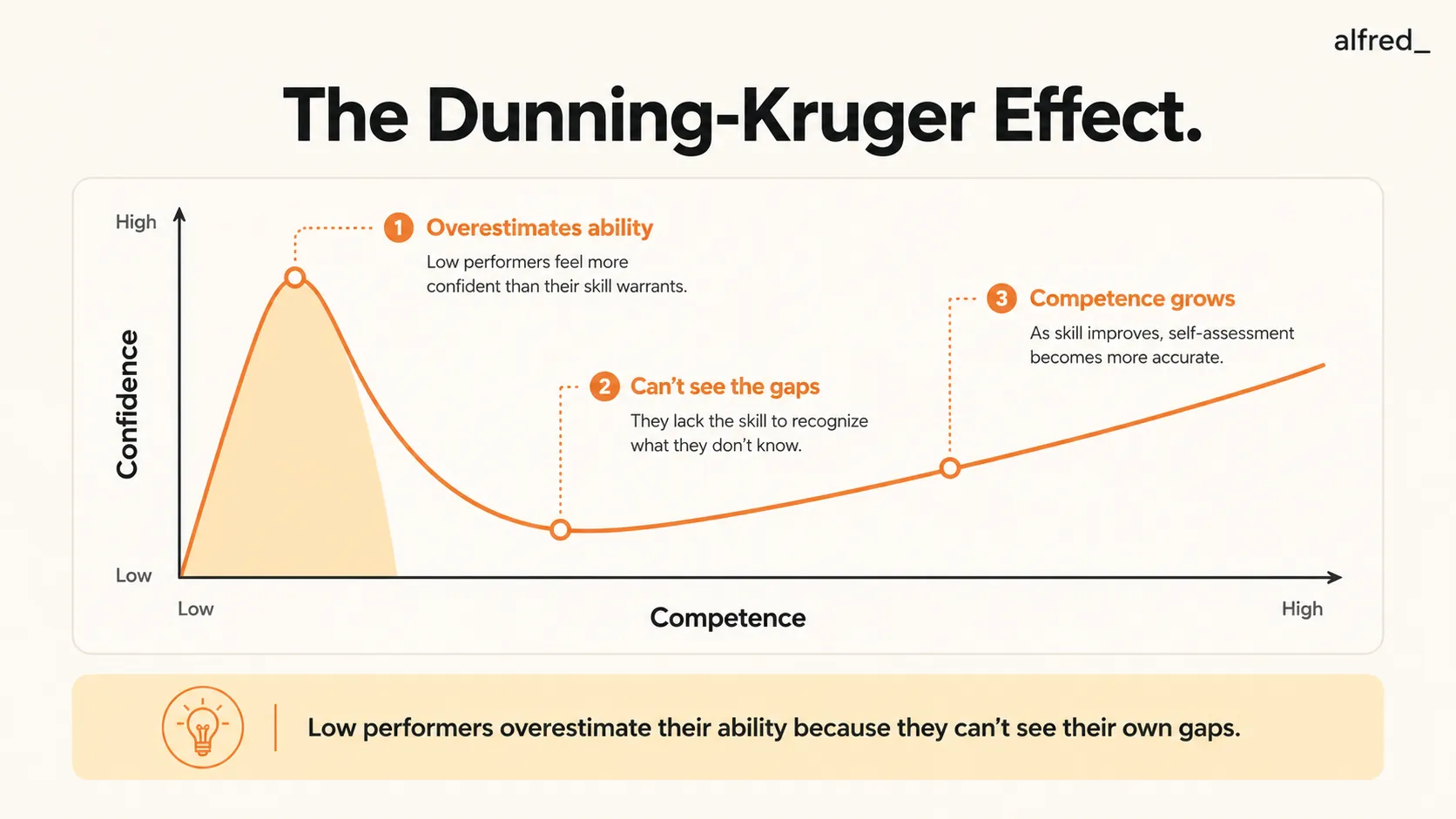
  • Note: the popular "Mount Stupid" curve does not appear in the original paper, and methodological challenges have emerged since 2020

The practical application is structural: use objective performance benchmarks and task-based evaluation rather than relying on self-assessment or confident self-presentation.

The Original Studies

Justin Kruger and David Dunning published "Unskilled and Unaware of It: How Difficulties in Recognizing One's Own Incompetence Lead to Inflated Self-Assessments" in the Journal of Personality and Social Psychology in 1999 (Vol. 77, No. 6, pp. 1121–1134). The paper reported four studies using tests of logical reasoning, English grammar, and the ability to identify what is and isn't funny.

62nd vs 12th

percentile self-rating versus actual performance for bottom-quartile performers across studies: participants who scored in the bottom quartile rated their relative performance at approximately the 62nd percentile while actually scoring around the 12th percentile.

Source: Kruger & Dunning (1999), Journal of Personality and Social Psychology, 77(6)

The pattern for high performers was the opposite: participants who scored in the top quartile (approximately the 86th percentile) rated themselves at approximately the 68th percentile, significantly underestimating their relative standing. Top performers knew they were good, but underestimated how much better they were than most others.

The mechanism Kruger and Dunning proposed: the cognitive skills needed to perform a task correctly are largely the same skills needed to recognize correct versus incorrect performance and to evaluate your own work accurately. Someone who lacks the knowledge to answer a question correctly also lacks the knowledge to recognize that their answer is wrong. The metacognitive deficit and the performance deficit share the same underlying cause.

What the Research Does and Does Not Show

The popular "Mount Stupid" visualization, a curve showing confidence peaking at low competence and then dipping as learning progresses, is a later popular simplification that does not appear in the original 1999 paper. The paper's finding is a straightforward overestimation/underestimation pattern across performance quartiles, not a single-peaked confidence curve across learning stages.

Additionally, since approximately 2020, the Dunning-Kruger effect has faced substantive methodological challenges. Researchers including Gignac and Zajenkowski (2020) have argued that the observed pattern may be partially or largely a statistical artifact: specifically, that the pattern emerges from regression to the mean and from the way self-ratings and objective scores are correlated when both use similar scales. The debate is ongoing and unresolved. The effect is not discredited, but it should be presented as a plausible and useful framework with ongoing methodological scrutiny, rather than as settled science.

alfred_ surfaces the gap between what was intended and what was completed, providing the external reference point that calibrates self-assessment.

Try alfred_ free

Professional Applications

  • Self-assessment in hiring. Structured skills assessments and work samples outperform self-reported competence in predicting job performance precisely because self-reports are subject to the metacognitive deficit the Dunning-Kruger research documents. Candidates who rate themselves highest on a self-assessment are not systematically the best performers, and in domains where the effect operates, they may be inversely related. This is the strongest argument for replacing self-assessment-heavy interviews with task-based evaluation.
  • Feedback calibration. The finding that poor performers overestimate their standing while good performers underestimate it means that confident self-appraisals are not evidence of actual performance level. Managers who interpret confident self-presentation as evidence of competence are making the inference that the original paper was specifically designed to debunk.
  • Skill development and learning. The metacognitive model suggests a specific pattern in skill acquisition: beginners often don't know what they don't know, which is why early-stage feedback and structured exposure to good-quality exemplars matters. Seeing high-quality work, rather than simply being told your work is low quality, builds the evaluative capacity that makes self-assessment accurate. This is the Johari Window problem applied to skill.

Frequently Asked Questions

Is the Dunning-Kruger effect real, or is it a statistical artifact?

The debate is genuine and unresolved as of 2025. The original Kruger and Dunning (1999) findings have replicated across multiple domains and samples. However, Gignac and Zajenkowski (2020) and others have provided evidence that some portion of the observed pattern may result from regression to the mean, a mathematical property of correlated variables, rather than from the metacognitive mechanism Dunning and Kruger proposed. Dunning and colleagues have responded to these critiques, arguing the effect survives even when statistical corrections are applied. The practical implication for practitioners: treat the finding as a useful framework for understanding the limits of self-assessment, while avoiding claims about its exact magnitude or claiming it definitively proves any particular case of overconfidence.

Do experts ever show the Dunning-Kruger effect in domains outside their expertise?

Yes, and this is one of the more consistently replicated aspects of the finding. High performers in one domain are not systematically more calibrated about their performance in other domains. An expert in one field who enters a new domain may show the same pattern as any other beginner, because expertise in one area does not transfer to metacognitive accuracy in another. The mechanism is the same: accurate self-evaluation requires domain knowledge, not general intelligence or self-awareness. This makes cross-functional career moves and domain-switching particularly susceptible to overconfidence in early stages.

How should organizations use the Dunning-Kruger research in talent development?

The most defensible applications are structural rather than diagnostic. Don't use it to categorize employees as 'Dunning-Kruger cases': the methodological debates make individual diagnosis unreliable. Use it to design better feedback systems: create objective performance benchmarks that give people external reference points, rather than relying solely on self-assessment. Use task-based evaluation alongside self-reported competence in hiring. Expose developing employees to high-quality work in their domain, because seeing what expert-level performance looks like builds the evaluative capacity that makes accurate self-assessment possible. And create psychological safety to surface uncertainty, since self-censorship about perceived gaps may compound the metacognitive deficit.

Try alfred_

Build accurate self-assessment through feedback.

alfred_ surfaces the gap between what was intended and what was completed, creating the external reference point that calibrates self-assessment more accurately than introspection alone can. $24.99/month.

Try alfred_ free