

Where the Term Comes From
Lee Ross coined “fundamental attribution error” in “The Intuitive Psychologist and His Shortcomings: Distortions in the Attribution Process,” a chapter in Leonard Berkowitz’s edited volume Advances in Experimental Social Psychology (Vol. 10, pp. 173–220, Academic Press, 1977). The chapter was a theoretical synthesis, not a single experimental study. Ross surveyed and organized a body of empirical research showing that people systematically over-attribute behavior to persons and under-attribute it to situations.
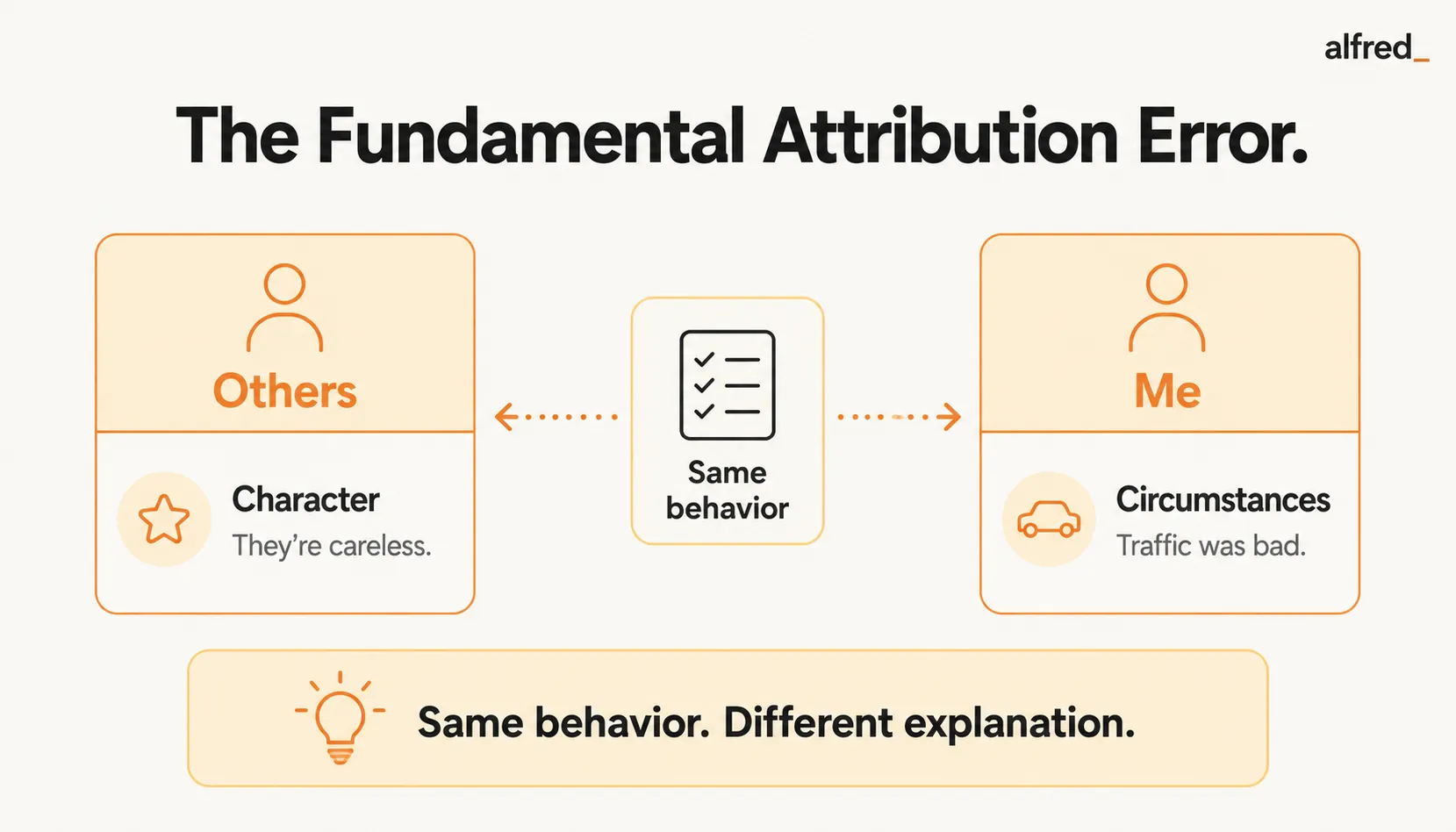
Ross called it “fundamental” because it is not a domain-specific bias but a pervasive tendency built into how people process behavioral information. Behavior is visible and cognitively salient; situational constraints are often invisible or require active inference. This asymmetry in salience produces a systematic bias in attribution.
The Empirical Demonstrations
The best-known experimental demonstration is Jones and Harris (1967), “The Attribution of Attitudes,” published in the Journal of Experimental Social Psychology (Vol. 3, pp. 1–24). Participants read essays either supporting or opposing Fidel Castro’s Cuban government. In one condition, participants were told the essay writer had freely chosen their position; in another, they were told the position had been randomly assigned.
Even when participants were explicitly told the essay position was randomly assigned (and thus conveyed no information about the writer’s actual views), they still attributed the expressed views to the writer’s true beliefs. The situational constraint (random assignment) was known and irrelevant, yet it failed to prevent dispositional attribution. The inference from behavior to character happened automatically, and the situational correction was incomplete.
Ross, Amabile, and Steinmetz (1977) provided a second demonstration in an organizational context, published in the Journal of Personality and Social Psychology (Vol. 35, No. 7, pp. 485–494). Participants were randomly assigned to the roles of questioner or contestant in a general knowledge quiz. Questioners could choose any questions they liked, which meant they could select from their own areas of knowledge, creating a systematic advantage. Contestants struggled to answer questions drawn from questioners’ idiosyncratic knowledge domains.
Despite knowing that roles were randomly assigned, both questioners and outside observers rated the questioners as significantly more knowledgeable than the contestants. The role assignment, a situational factor, was transparent, but it failed to override the dispositional inference from performance. People inferred knowledge from a role that artificially conferred performance advantage.
Professional Consequences
- Performance evaluation. Managers who observe a team member performing poorly in adverse conditions (an understaffed project, a broken process, an unclear mandate) systematically over-attribute the poor performance to the individual’s ability or effort. The situational constraints are less visible than the output. Performance management systems that don’t surface situational factors produce biased evaluations.
- Hiring and credentialing. The quizmaster effect operates in interviews: candidates who are asked questions in their preparation domain perform well and are attributed high general capability; candidates asked outside their domain perform poorly and are attributed low capability. Structured interviews with standardized questions across candidates reduce (but don’t eliminate) this role-assignment effect.
- Attribution of success and failure. The FAE is asymmetric in a specific professional pattern: others’ successes are attributed to their situation (good luck, good conditions, good team) while their failures are attributed to their character. Your own successes are attributed to your ability; your own failures are attributed to situation. This actor-observer asymmetry, documented by Jones and Nisbett (1971), produces systematic bias in competitive attribution.
- Organizational post-mortems. Post-mortems driven by the FAE produce individual accountability assignments (“this person made the wrong call”) rather than systemic analysis (“what conditions made this outcome predictable regardless of who was in the role”). The former is emotionally satisfying and systematically unhelpful for preventing recurrence.