

The Uncomfortable Question
You are staring at 47 unread emails. You have a client deliverable due at 3pm. And you know that if you paste each email into ChatGPT and ask it to write a reply, you could clear this backlog in 15 minutes instead of 90.
So you hesitate. Not because the technology does not work, but because something feels off about it.
Is it dishonest? Will people notice? Are you being lazy, or are you being smart?
These are real questions, and they deserve honest answers.
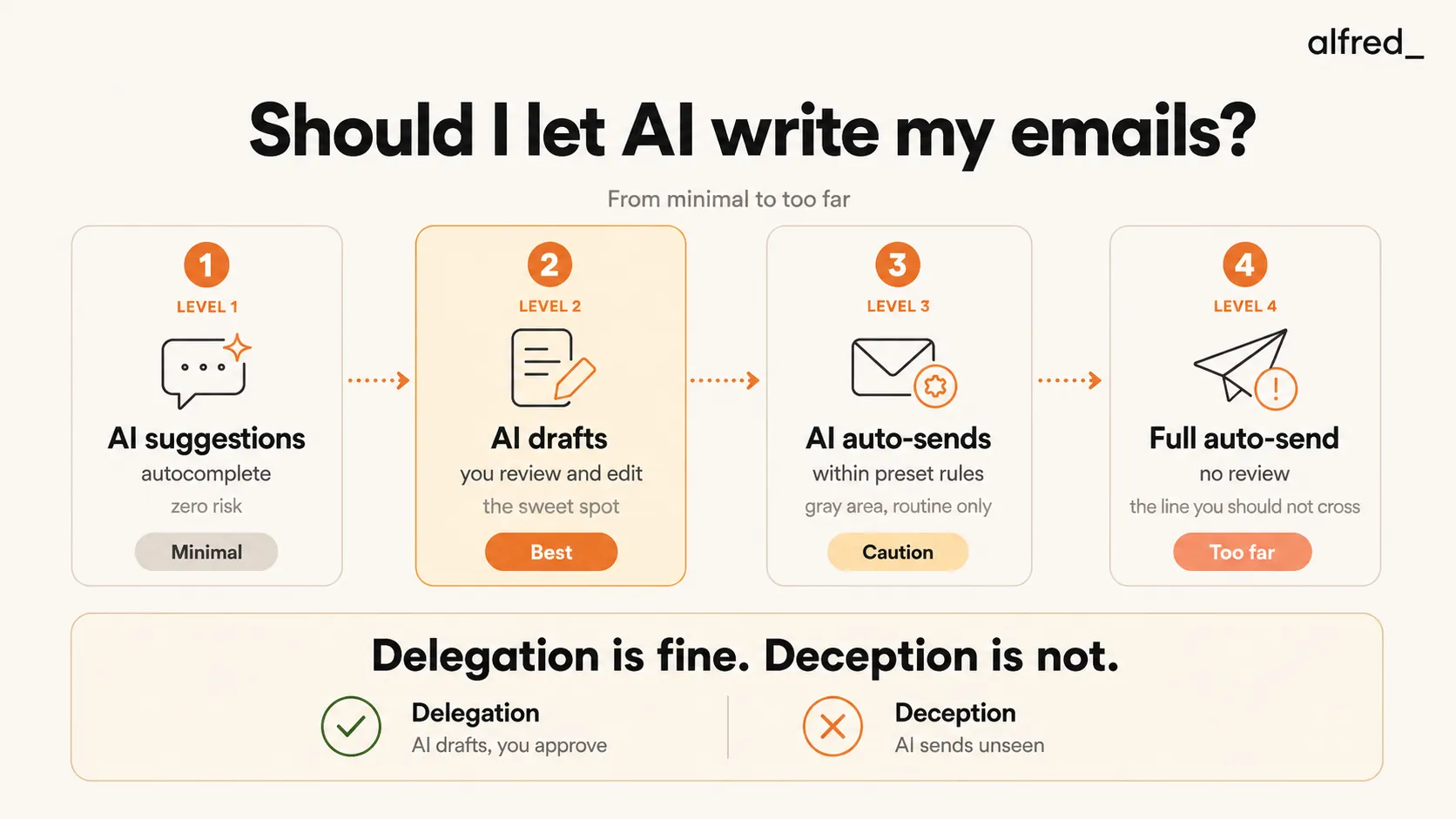
The Spectrum of AI Email Writing
AI email assistance is not one thing. It is a spectrum, and where you land on it determines whether the result is genuinely helpful or genuinely problematic.
Level 1: AI suggestions (minimal involvement)
Gmail’s smart compose finishes your sentences. Outlook suggests quick replies like “Sounds good!” or “Thanks for letting me know.” This is AI at its most lightweight. Nobody questions the ethics of autocomplete. You are still doing the work; the tool just reduces keystrokes.
Risk level: Essentially zero. This is a typing accelerator.
Level 2: AI drafts you review and edit (the sweet spot)
You provide context, either directly or through a tool that reads your inbox, and AI generates a complete draft. You read it, adjust the tone, fix any details, and send it as your own. This is the model used by tools like alfred_, Superhuman’s AI compose, and Shortwave.
This is also how professional communication has worked for decades. Executive assistants draft correspondence. Speechwriters draft remarks. Legal associates draft briefs for partners to review. The person whose name is on it reviews and approves the output. The draft is leverage. The judgment is yours.
Risk level: Low, as long as you actually review. The output carries your voice because you shaped it.
Level 3: AI sends on your behalf with pre-set rules (the gray area)
Some tools can auto-respond to certain categories of email: meeting confirmations, simple acknowledgments, newsletter unsubscribes. The AI sends without your explicit review of each message, but within boundaries you have defined.
This is where reasonable people disagree. For low-stakes operational email (confirming a meeting time, acknowledging receipt of a document), automated responses are practical and widely accepted. For anything with nuance, sending without review creates real risk.
Risk level: Moderate. Appropriate for routine operational messages. Inappropriate for anything requiring judgment.
Level 4: Full AI auto-send with no review (the line you should not cross)
AI reads your email, decides what to say, and sends it without you ever seeing the message. You find out what you “said” by checking your sent folder.
This is where the technology crosses from helpful to dangerous. Not because AI cannot write a competent email, it often can, but because communication carries commitments. Every email you send is a micro-promise: a deadline agreed to, a tone set, a relationship nudged in one direction or another. Outsourcing those commitments entirely without review is not efficiency. It is abdication.
Risk level: High. Do not do this for professional email.
Can People Actually Tell?
This is the question everyone asks, and the answer is more nuanced than the hot takes suggest.
When AI is obvious
Generic AI-written emails share recognizable tells. Research from Cornell found that people identify AI-generated text at rates barely above chance in controlled settings. However, in real-world professional email, detection is easier because context matters, especially when the reader knows the writer personally.
Your colleagues know your voice. They know you write short, direct emails. When they suddenly receive a four-paragraph message with semicolons and phrases like “I trust this message finds you in good spirits,” they notice. Not because they ran a detector, but because it does not sound like you.
The most common tells of generic AI email:
- Excessive formality. AI defaults to a register that is more formal than how most people actually write to colleagues.
- Hedge phrases. “Certainly,” “absolutely,” “I completely understand,” and “please do not hesitate to reach out” appear at rates no human matches.
- Uniform paragraph length. AI tends to produce balanced, even paragraphs. Humans are messier.
- Lack of personality. No abbreviations, no sentence fragments, no casual asides. The output is polished in a way that reads as impersonal.
When AI is invisible
AI that learns your specific patterns is a different story. Tools that analyze hundreds or thousands of your previous emails and then generate drafts that mirror your vocabulary, sentence length, formality level, and even your habit of starting emails with “Hey” instead of “Hi” produce output that recipients genuinely cannot distinguish from your writing.
The difference is personalization depth. A generic AI prompt produces generic output. An AI that has been trained on your communication history produces your voice at scale.
This is not theoretical. alfred_ analyzes your sent email patterns and drafts replies that match your style, not a generic professional style, but yours. The result reads like you wrote it quickly, which in a sense you did. You approved it.
The Ethics Question, Answered Directly
Let’s address this head-on.
Is using AI to draft emails dishonest?
No. And here is why.
When a CEO sends an email to the company, nobody assumes the CEO personally typed every word. When a lawyer sends a brief, nobody assumes a partner drafted every paragraph. When a politician gives a speech, nobody assumes they wrote it alone. Professional communication has always involved delegation of the mechanical work while retaining ownership of the message.
AI drafting is the same principle, democratized. Previously, only people wealthy enough to hire assistants got this leverage. Now it is available for $25 per month.
The ethical obligation is not to personally type every character. It is to stand behind the content. If you review an AI draft, agree with what it says, adjust anything that misses the mark, and send it as your position, you have met that obligation.
When does it become dishonest?
When the AI sends messages you have never seen that create commitments you did not authorize. When AI fabricates details (hallucinated meeting times, made-up project names). When you use AI to pretend you put thought into something you did not care about at all. The dishonesty is not in the tool. It is in the disengagement.
What about the “personal touch” argument?
Some emails genuinely require personal investment: a note to a grieving colleague, a thoughtful response to a mentee’s career question, feedback on a direct report’s performance. For these, the act of writing is part of the value. AI should stay out of those moments.
But the other 90% of professional email, status updates, scheduling, information requests, routine approvals, follow-ups? These are logistics. They require accuracy and professionalism, not your creative soul. Using AI for logistics so you can invest personally where it matters is not less authentic. It is more intentional about where your authenticity goes.
The Practical Guide: How to Do It Well
If you decide to use AI for email (and you probably should), here is how to do it without the pitfalls.
Train the AI on your voice
Generic prompts produce generic output. The more context AI has about how you write, the better the results. Tools like alfred_ do this automatically by analyzing your sent email. If you are using ChatGPT or Claude directly, create a detailed style guide: your typical greeting, your sign-off, your average sentence length, words you use frequently, words you never use.
Always review before sending
This is the non-negotiable rule. Read every draft before it goes out. Not skimming. Reading. Check that the tone matches the relationship, the facts are accurate, and the commitments are ones you want to make. This review takes 10-20 seconds per email. It is the difference between delegation and abdication.
Know your “never AI” list
Identify the categories of email where you will always write personally. For most people, this includes: sensitive HR matters, deeply personal messages, high-stakes negotiations, and crisis communication. Everything else is fair game for AI drafting with review.
Edit freely
AI drafts are starting points, not final products. If a sentence feels stiff, rewrite it. If the tone is too formal, cut half the words. If it missed context from earlier in the thread, add it. The best AI-assisted emails are collaborations: AI handles the structure and boilerplate, you add the nuance and judgment.
Do not apologize for using it
You do not tell people you used spell-check. You do not disclose that your assistant helped format a document. AI drafting is a tool, not a confession. The email is yours because you reviewed it, approved it, and sent it with your name.
Where alfred_ Fits
alfred_ operates at Level 2 on the spectrum described above: it drafts, you approve. Specifically, it reads your incoming email, understands the context of each thread, and generates reply drafts that match your communication style. You review each draft in your morning brief, edit anything that needs adjusting, and approve with a click.
The difference between alfred_ and pasting emails into ChatGPT is the difference between a trained assistant and a random stranger. ChatGPT does not know how you write, who the recipient is to you, or what you discussed three emails ago. alfred_ does. The result is drafts that sound like you, require minimal editing, and go out in seconds instead of minutes.
alfred_ is positioned as the option for professionals who want AI leverage without losing control over their communication.
The Bottom Line
The question is not “should I let AI write my emails?” That ship has sailed. AI is already writing emails for millions of professionals, and the tools are only getting better.
The real questions are:
How much control do you keep? AI drafting with review is smart. AI auto-sending is reckless. Draw the line at your review.
How personalized is the output? Generic AI output is detectable and damages trust. Personalized AI output that mirrors your voice is indistinguishable from your own writing.
Where do you invest your personal energy? Use AI for the 90% of email that is logistics. Write personally for the 10% that is relationships. This is not cutting corners. It is allocating your authenticity where it has the most impact.
The professionals who refuse to use AI for email are not more authentic. They are spending 2-3 hours per day on mechanical work that a tool could handle in minutes. That time has a cost, and it comes directly out of the work that actually requires their judgment, creativity, and personal investment.
Use the tool. Keep the control. Invest your real attention where it matters.