


Every Sunday I block two three-hour focus sessions, the way every productivity article tells you to. And nearly every Wednesday both are gone, quietly overwritten by a client call and an “urgent” sync that could have been an email. For a long time I assumed the problem was my willpower, or my colleagues, or the week. It was none of those. The problem was the order I built my calendar in, and the fact that a block named “Focus Time” is an invitation, not a boundary. Here is what actually keeps deep work on the calendar once it is there.
Why “Finding Time” Doesn’t Work
You will never “find” time for deep work. Time doesn’t appear. It gets claimed. And if you don’t claim it first, meetings, email, and reactive work will claim it for you.
Most professionals approach deep work backwards. They schedule their meetings and commitments first, then look for gaps to do focused work. The problem: there are no gaps. Every available slot gets filled with more meetings, more calls, more “quick syncs.”
The result is a calendar packed with reactive commitments instead of deep work and zero protected time for the work that actually creates value. You end up doing deep work at night, on weekends, or not at all.
The solution is simple but counterintuitive: schedule deep work first, before anything else. Treat it like your most important meeting, because it is.
The Deep Work First Principle
Deep work first means exactly what it sounds like: before you accept any meeting, before you check email, before you process any requests. You block time for focused, high-value work.
The Scheduling Hierarchy
- 1. Deep work blocks: Non-negotiable focus time for high-leverage work
- 2. Strategic commitments: Key client meetings, important calls
- 3. Communication batches: Defined windows for email and messages
- 4. Everything else: Gets scheduled only if space remains
This hierarchy ensures that your most valuable work gets protected, not squeezed into whatever time remains after everyone else has claimed your calendar.
How to Schedule Deep Work: The Tactical Guide
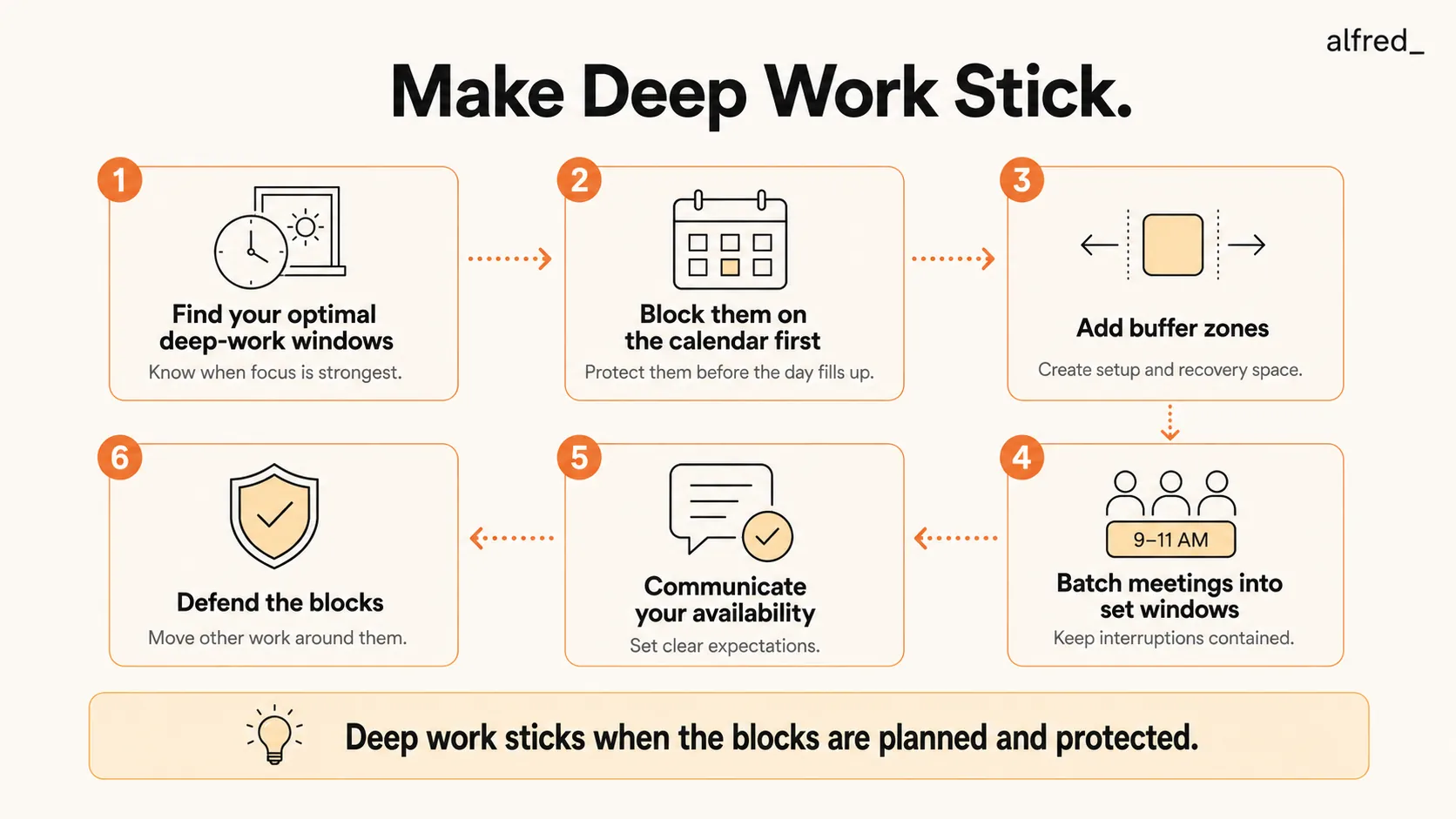
Step 1: Determine Your Optimal Deep Work Windows
Not all hours are equal for deep work. Most people have 2-4 hours of peak cognitive capacity per day, usually in the morning before decision fatigue sets in. Identify when you do your best thinking.
Common Peak Windows:
- Morning types: 6:00 AM - 10:00 AM
- Late starters: 9:00 AM - 1:00 PM
- Afternoon focus: 2:00 PM - 6:00 PM (after the post-lunch dip)
Your optimal window is when you naturally feel most alert and focused. Protect this time fiercely.
Step 2: Block Deep Work on Your Calendar First
Before your week starts, ideally on Friday or Sunday, block your deep work time for the entire upcoming week. Create calendar events that show you as “busy” to prevent others from scheduling over them.
Recommended Blocking Strategy:
- Block 2-4 hour continuous chunks (not 1-hour slots)
- Schedule at least 2 deep work blocks per day
- Name the blocks specifically: “Deep Work: Q1 Strategy” not just “Focus Time”
- Set them as “busy” so scheduling tools can’t book over them
Step 3: Create Buffer Zones
Deep work doesn’t start instantly. You need transition time to get into focus mode. Schedule 15-30 minute buffers before deep work blocks, time to close tabs, review your objectives, and mentally prepare.
Similarly, don’t schedule meetings immediately after deep work. You’ll need time to capture insights, document progress, and transition back to reactive mode.
Step 4: Batch Meetings Into Specific Days or Windows
Instead of scattering meetings throughout the week, concentrate them into specific days or time windows. This protects full days (or half-days) for uninterrupted deep work. This is the same principle behind using your calendar as a strategic tool.
Sample Weekly Structure:
- Monday: Deep work AM, meetings PM
- Tuesday: Meeting day (batch all calls here)
- Wednesday: Full deep work day (no meetings)
- Thursday: Deep work AM, meetings PM
- Friday: Deep work AM, planning PM
Step 5: Communicate Your Availability
Let colleagues and clients know when you’re available for meetings and when you’re not. This isn’t about being difficult. It’s about being intentional with your time and theirs.
- Share your scheduling link that only shows available windows
- Add a note to your calendar blocks: “Focus time - available for urgent matters only”
- Include your availability in your email signature
- Tell key stakeholders directly about your schedule structure
Step 6: Defend the Blocks
Scheduling deep work is easy. Protecting it is hard. You will get requests to “just hop on a quick call” during your focus time. You’ll be tempted to check email “just for a second.” Resist.
Defense Strategies:
- Default to “no” on meeting requests during deep work: offer alternative times instead
- Turn off all notifications: close email, Slack, and messaging apps entirely
- Use physical signals: headphones, closed door, or working from a different location
- Create an escalation path: for genuine emergencies, people can call or text
The 2-Hour Minimum Rule
Deep work requires sustained focus. Research shows it takes 15-25 minutes just to reach a state of deep concentration. If you schedule 1-hour blocks, you’re spending half the time getting into flow and half doing actual work.
The minimum viable deep work block is 2 hours. Ideally, aim for 3-4 hour blocks when possible. This gives you enough time to:
- Transition into focus mode (15-20 minutes)
- Do substantial deep work (90-180 minutes)
- Capture insights and wrap up (15-20 minutes)
Short blocks don’t work. If you only have 45 minutes, use it for shallow work, email, admin, or meeting prep. Save deep work for when you can truly focus.
What to Do During Deep Work Blocks
Having the time is only half the battle. You also need to use it effectively. Here’s how to maximize your deep work sessions:
Before the Block
- Define the objective: What specific outcome will you produce?
- Gather materials: Have everything you need ready so you don’t break focus
- Clear the environment: Close unnecessary tabs, silence devices, prepare your workspace
During the Block
- Work on one thing: No multitasking, no switching between projects
- Capture distractions: When other thoughts arise, write them down to address later
- Push through resistance: The first 20 minutes are often hardest, keep going
After the Block
- Document progress: What did you accomplish? What’s next?
- Celebrate completion: Acknowledge the focused work you did
- Transition deliberately: Take a short break before reactive work
Common Mistakes (And How to Avoid Them)
Mistake 1: Scheduling Deep Work in Leftover Slots
If you schedule meetings first and try to fit deep work into the remaining gaps, you’ll end up with fragmented 30-45 minute slots that can’t support real focus.
Fix: Block deep work first. Let meetings fill around it, not the other way around.
Mistake 2: Treating Deep Work Blocks as Optional
When something “urgent” comes up, deep work is often the first thing sacrificed. But if a client meeting is non-negotiable, why isn’t your most important work?
Fix: Treat deep work blocks like external commitments. You wouldn’t cancel a client call for a random request, don’t cancel deep work either.
Mistake 3: Not Specifying What You’ll Work On
Vague blocks like “Focus Time” or “Deep Work” often get wasted because you spend the first 30 minutes deciding what to do.
Fix: Name your blocks specifically: “Deep Work: Client Proposal” or “Focus: Q2 Strategy Document.” Know exactly what you’ll work on before the block starts.
Mistake 4: Checking Email “Just Once”
“I’ll just check email quickly” destroys more deep work sessions than any other habit. One glance at your inbox creates attention residue that lingers for 20+ minutes. The real cost of context switching goes far beyond lost minutes.
Fix: Close email completely. Use website blockers if needed. Check email only during designated communication windows.
Mistake 5: Scheduling Back-to-Back Blocks
Deep work is cognitively demanding. Scheduling 8 hours of continuous deep work leads to diminishing returns and burnout.
Fix: Limit deep work to 4-5 hours per day maximum. Intersperse with breaks, shallow work, and recovery time.
The Compound Effect of Protected Deep Work
When you consistently protect 3-4 hours of deep work daily, the results compound dramatically:
Deep Work Compounding
- Week 1: 20 hours of deep work (vs. typical 2.8 hours)
- Month 1: 80 hours of deep work completed
- Quarter 1: 240 hours of deep work = major projects finished
- Year 1: 1,000+ hours of deep work = career-defining output
At $300/hour value rate, 1,000 hours of deep work represents $300,000 in high-value capacity. That’s the difference between a good year and a transformative one.
High-leverage professionals understand this math intuitively. They protect deep work because they know that’s where exponential returns come from.
What Actually Defends the Block
Every defense strategy above eventually runs into the same wall: it depends on you, in the moment, saying no. No to the meeting request that lands on your focus block. No to the “quick” inbox check that quietly eats the next twenty minutes. Willpower is a renewable resource right up until the week gets hard, which is exactly when the blocks vanish. A boundary that only holds when you are disciplined is not a boundary.
This is where alfred_ does the defending for you. It manages the scheduling requests that would otherwise land on your focus time, offering alternatives instead of letting the block get booked over, and it triages your inbox so the urge to “just check email once” has nothing to feed on, because anything genuinely urgent has already been surfaced and the rest is handled. The block stays a block not because you white-knuckled it, but because the two forces that erase it, meeting creep and inbox pull, are being held off by something other than your willpower.
Summary: Schedule It First, Protect It Always
Deep work is the engine of high-value output. Without protected time for focused work, you’re limited to the shallow tasks that reactive work allows, email responses, meeting attendance, and administrative coordination.
The right way to schedule deep work is simple:
-
- Block deep work first, before any other commitments
-
- Schedule in 2-4 hour continuous blocks
-
- Batch meetings into specific days or windows
-
- Communicate your availability clearly
-
- Defend your blocks like non-negotiable commitments
You’ll never find time for deep work. You have to make it. Schedule it first, protect it always.