

The Problem: Your Calendar Is Being Used Against You
Most professionals treat their calendar as a passive record of meetings and commitments other people have requested.
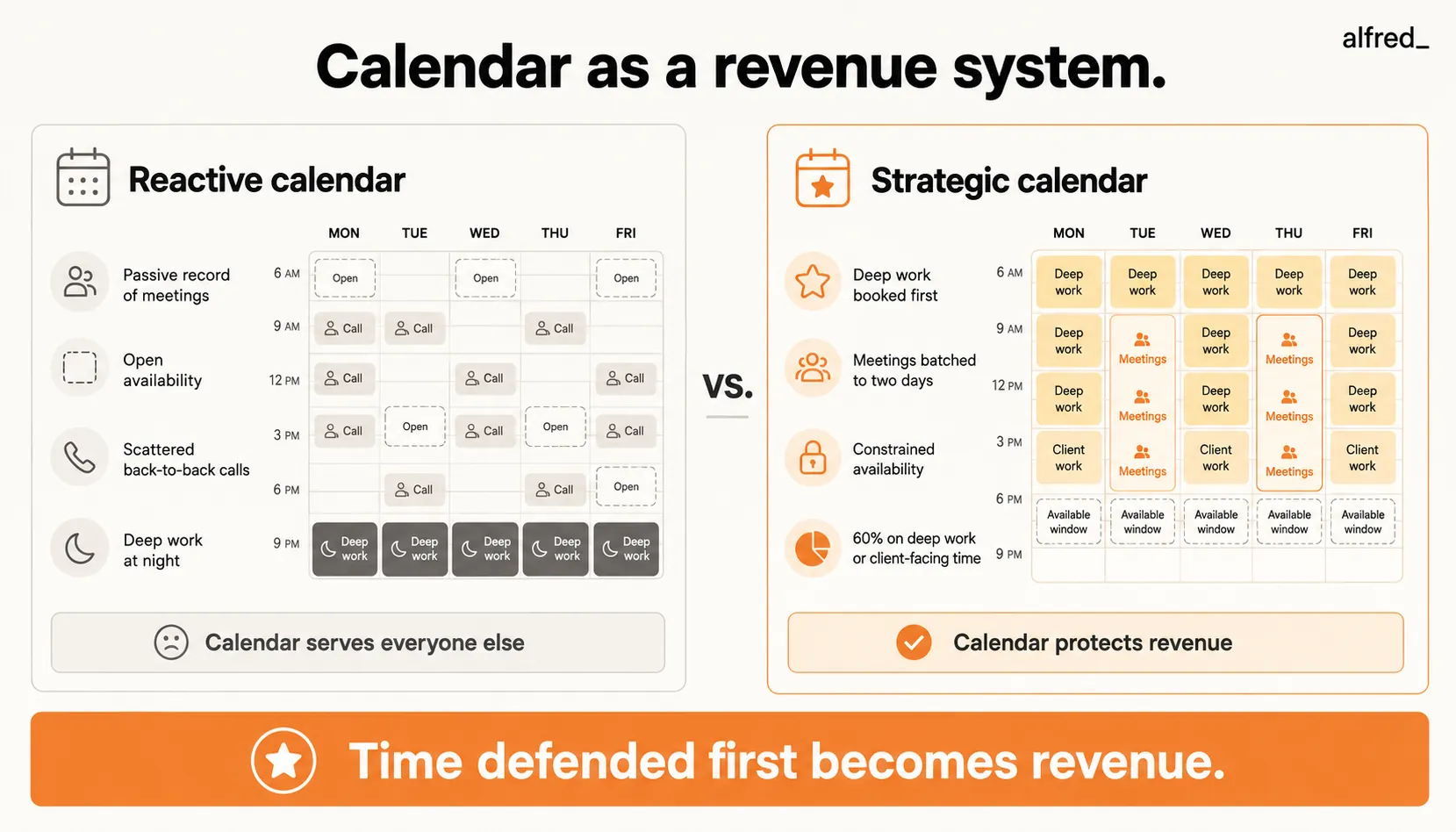
This is backwards. Your calendar should not reflect what other people want from you. It should reflect what creates value for your business.
Here’s what a reactive calendar looks like:
- Meetings scattered throughout the day at times others suggested
- No blocks for deep work, proposal writing, or strategic thinking
- Open availability that encourages others to fill your time
- Back-to-back calls with no recovery time between them
- Personal time, exercise, or focused work left to “whenever there’s time”
The result: you’re busy all day, but billable work, client delivery, and high-leverage output get squeezed into nights and weekends.
What It Means to Use Your Calendar Strategically
A strategic calendar is one that actively protects the time that creates value and limits the time spent on reactive coordination. Specifically:
- how to time block your calendar: /blog/how-to-time-block-your-calendar
- how high-earners protect their calendar: /blog/consultant-calendar-strategy
-
- Availability Is Constrained by Default: Instead of showing all open time as available, strategic calendars show limited windows for scheduling. If someone wants to meet, they choose from predefined times. You don't offer custom availability. This ensures that meetings happen on your terms, not whenever someone else requests them.
- lying about your priorities: /blog/calendar-lies-about-priorities
The goal: your calendar actively defends the time that creates value, instead of passively recording whatever other people request.
How to Structure a Strategic Calendar
Here’s the specific structure that high-value professionals use to protect revenue and ensure high-leverage work happens:
- Weekly planning: review commitments, deadlines, and revenue-critical tasks
- Identify this week\
- ,
- Deep work block: client deliverables, proposal writing, strategic work
- No meetings unless revenue-critical
- Deep work block: prep for meetings, finish deliverables
- Client meetings, prospect calls, external coordination
- 30-minute buffer between each meeting for notes and follow-up
- Internal meetings, team coordination, admin tasks
- Deep work block: strategy, planning, business development
- Follow-up on commitments made this week
- Review outstanding proposals and deals
- Send summaries, status updates, and next steps to clients
- Weekly review: what shipped, what slipped, what needs attention
- Plan next week\
This structure ensures that deep work happens before meetings fragment the day, and that revenue-critical tasks get time blocked before they become urgent.
Calendar Rules That Protect Revenue
Beyond structure, strategic calendars operate under specific rules that protect time and ensure high-leverage work happens:
- Rule 1: Deep Work Blocks Are Scheduled First: At the start of each week, block time for the 3 most important outcomes before accepting any meeting requests. If someone asks for a meeting during a deep work block, offer alternative times. Never sacrifice deep work to accommodate scheduling requests.
- Rule 2: No Meetings Before 10:00 AM: The first 1–2 hours of the day are protected for planning, email triage, and focused work. Mornings are when cognitive energy is highest, so don't give that time to meetings.
- Rule 3: All Meetings Have Buffers: Build 15–30 minute buffers between meetings for notes, follow-up, and mental recovery. Back-to-back calls eliminate time to process what was discussed or capture next steps.
- Rule 4: One-Hour Meetings Are the Exception, Not the Default: Default to 30-minute meetings unless there's a specific reason to go longer. Most meetings expand to fill the time available. Shorter default durations force clarity and focus.
- Rule 5: Revenue-Critical Prep Gets Calendar Time: If you have a client presentation on Thursday, block 2 hours on Wednesday to prepare. If a proposal is due Friday, block time Tuesday and Wednesday to write it. Revenue-critical work gets scheduled, not hoped for.
- Rule 6: Declined Meetings Don't Require Justification: If a meeting doesn't align with your priorities, decline it. You don't owe an explanation beyond “I'm not available at that time.” Protecting your calendar is not rude. It's professional.
How to Handle Common Calendar Conflicts
Even with a strategic calendar, conflicts arise. Here’s how to handle them without sacrificing deep work or revenue-critical time:
- Client Requests a Meeting During Deep Work Block: “I'm not available at that time, but I have availability on [Tuesday afternoon] or [Thursday afternoon]. Would either of those work?”: Don't explain why you're unavailable. Offer alternative times that align with your meeting blocks. Clients respect boundaries when you hold them.
- Internal Meeting Request Conflicts With Client Deliverable: “I have a client deliverable due this week that needs this time. Can we move the meeting to [Wednesday morning] or handle this async?”: Revenue-generating work takes priority over internal coordination. Offer alternatives or suggest async communication.
- Prospect Wants to Meet Outside Your Scheduled Meeting Days: “I'm not available on Monday, but I have time on Tuesday afternoon or Thursday afternoon. Would either of those work for you?”: High-value prospects respect structure. Offering limited options demonstrates that your time is valuable, which reinforces the value of what you're selling.
- Urgent Request Comes In During Deep Work: Ask: “Is this truly urgent, or just unexpected?” If it's revenue-critical (client emergency, deal closing, deadline about to miss), address it immediately. If it's unexpected but not urgent, schedule time later that day or the next morning.: Most “urgent” requests are just unexpected. Don't sacrifice deep work for interruptions that can wait 2–4 hours.
How alfred_ Automates Strategic Calendar Management
Maintaining a strategic calendar manually requires constant vigilance: declining conflicting requests, protecting deep work blocks, ensuring prep time gets scheduled, and rescheduling when conflicts arise.
alfred_ automates this:
- Automatic deep work blocking: alfred_ identifies your most productive hours and blocks them for focused work before meetings fill the calendar.
- Meeting batching: alfred_ suggests meeting times that align with your batching strategy (e.g., only Tuesday/Thursday afternoons), preventing calendar fragmentation.
- Prep time scheduling: For every client meeting, alfred_ automatically blocks 30 minutes before for review and preparation.
- Buffer enforcement: alfred_ ensures 15–30 minute buffers between meetings, preventing back-to-back calls that eliminate recovery time.
- Conflict resolution: When a meeting request conflicts with deep work or a deadline, alfred_ suggests alternative times or handles rescheduling.
The result: your calendar actively protects revenue-generating time instead of passively recording whatever gets requested. Learn more about what an AI calendar assistant actually does and how it handles scheduling on its own.
Measuring Whether Your Calendar Is Working
A strategic calendar should be measurable. Here’s how to know if your calendar is protecting revenue or working against you:
- Metric 1: Deep Work Ratio: Hours per week spent on revenue-generating deep work (client deliverables, proposals, strategy) vs. total work hours.: 60%+ of calendar should be deep work or client-facing time. If meetings consume more than 40% of your week, your calendar is being used against you.
- Metric 2: Reactive vs. Proactive Time: Hours per week spent on meetings others requested vs. time you blocked for your priorities.: At least 50% of your calendar should be time you scheduled for your priorities, not time others requested.
- Metric 3: Revenue-Critical Work Completion Rate: Percentage of revenue-critical tasks (proposals, deliverables, follow-ups) completed on time vs. rushed or late.: 95%+ should be completed before deadlines. If you're consistently scrambling, your calendar isn't protecting the time required to deliver.
If your metrics show low deep work ratio, reactive calendar dominance, or late deliverables, your calendar is a schedule, not a strategic tool.
Summary: Your Calendar Is Either Protecting Revenue or Costing You
Most professionals treat their calendar as a passive record of meetings and commitments others have requested. This is backwards.
A strategic calendar actively protects the time that creates value: deep work blocks for client deliverables, batched meetings to preserve flow, constrained availability to prevent fragmentation, and revenue-critical prep scheduled before it becomes urgent.
The calendar should reflect what creates value for your business, not what other people want from you. If your calendar doesn’t actively defend your time, it’s working against you.
Your calendar is either a revenue protection system or a coordination tool. Choose which one you want.