


You have tried more than one of these. The ranked list, the timer, the four quadrants, the folders, the calendar packed with colored blocks. Each worked for a few weeks and then quietly stopped, and you assumed you had picked the wrong one and went looking for the next. But line the major systems up next to each other and something strange appears: under wildly different mechanics, they are all solving the exact same problem, and it is not the one most people think. Here is the single premise every productivity system shares, why it works when it works, and why the search for the perfect one is the thing keeping you stuck.
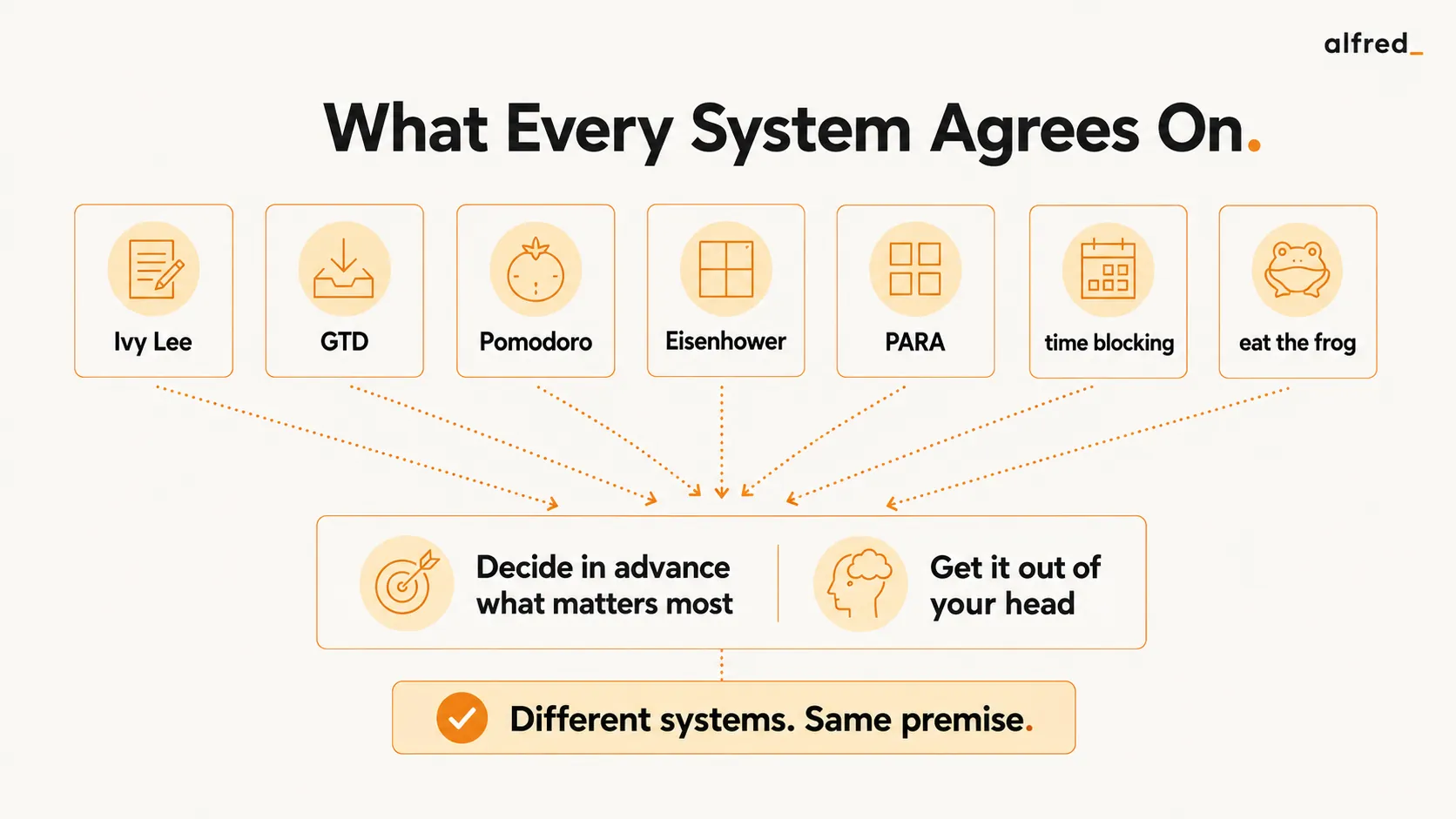
The Shared Premise
Every major productivity system, without exception, begins with the same underlying assumption about the human mind.
The mind cannot be trusted to hold commitments, priorities, and plans simultaneously without degradation. Every system provides a different answer to the same question: where do the things in your head go?
David Allen stated this most explicitly: “Your mind is for having ideas, not holding them.” He called the cognitive cost of carrying uncaptured commitments “psychic RAM,” drawing on the computer science metaphor deliberately. Like RAM, working memory is limited in capacity and time. Unlike RAM, the brain treats everything stored in it as “now.”
Allen: “Ask any psychologist how much of a sense of past and future that part of your psyche has, the part storing the list you dumped: zero. It’s all present tense in there.”
This creates a specific kind of cognitive tax. Every unresolved commitment in working memory occupies attention, whether the person is aware of it or not. The chronic background noise of uncaptured tasks, the errands not yet written down, the emails not yet processed, the projects with no next action, is what Allen means by “psychic weight.” It is measurable, even if invisible.
12
Major productivity systems analyzed, including Ivy Lee, GTD, Pomodoro, Eisenhower Matrix, PARA, Time Blocking, Eat the Frog, 1-3-5 Rule, Weekly Review, 80/20 Rule, Deep Work Philosophies, and Maker's Schedule, all sharing one foundational premise
alfred_ AnalysisHow Each System Answers the Question
Every system provides a different answer to “where do the things in your head go?” The mechanics differ radically. The premise, that the things need to go somewhere outside your head, is identical.
IL
Ivy Lee Method
Into tonight’s ranked list of six. You offload tomorrow’s priorities into a specific, ordered sequence before you leave work. The decision is made in advance; execution is mechanical.
GTD
Getting Things Done
Into a trusted external system with defined next actions. Every commitment is captured, clarified, and organized until the mind is empty and the system is complete. The trusted system replaces working memory.
PT
Pomodoro Technique
Into a timer that makes the decision for you. The 25-minute interval externalizes the question “how long should I work on this?”, removing the decision from working memory entirely.
EM
Eisenhower Matrix
Into 4 quadrants by urgency and importance. The quadrant system externalizes the prioritization decision. You don’t hold “is this important?” in your head. You put the task in the appropriate box.
PA
PARA Method
Into the right folder based on actionability. Projects, Areas, Resources, Archives: the folder structure externalizes the organizational decision so you’re not mentally categorizing every document you encounter.
TB
Time Blocking
Into named time slots on a calendar. The schedule externalizes the sequencing decision. You don’t hold “what should I be doing right now?” in your head. You look at the calendar.
EF
Eat the Frog
Into a morning-first sequencing rule. The rule externalizes the sequence decision: the most important and most avoided task goes first. You don’t decide this in the moment; the rule decides for you.
WR
Weekly Review
Into a deliberate recalibration session. The review externalizes the meta-question “is my system still working?” You don’t hold a constant background check running; you schedule a dedicated check once a week.
The Zeigarnik Effect: Why Open Loops Are So Costly
The psychological mechanism behind the shared premise is the Zeigarnik effect: the observation that incomplete tasks generate persistent mental rumination. Named after Russian psychologist Bluma Zeigarnik, who found in the 1920s that waiters could remember orders in progress but forgot them quickly after the table was cleared.
Sophie Leroy’s 2009 research on attention residue validated this in professional contexts. When participants switched from an incomplete task to a new task, the incomplete task generated cognitive “residue,” meaning measurably worse performance on the subsequent task. The residue was proportional to the incompleteness of the previous task. Completed tasks generated less residue than abandoned ones.
The brain generates anxiety about open loops not because they’re dangerous but because it cannot distinguish between “I need to act on this now” and “I need to remember this later.” Every system solves that by outsourcing the distinction to something outside the brain.
Every productivity system is, at its foundation, a mechanism for closing loops, or creating the cognitive equivalent of a closed loop. A task in a trusted system feels complete enough to stop generating rumination, even if the underlying work is unfinished.
Why Any System Beats No System
This is the most important practical insight from the shared premise: the specific mechanics of a system matter less than whether the system reliably externalizes commitments.
A person who uses the Ivy Lee Method consistently will outperform a person who theoretically understands GTD but implements it inconsistently. The six-item list is a complete externalization of tomorrow’s priorities. It closes the loop. Incomplete GTD implementation, such as a capture inbox that never gets processed or a project list that hasn’t been reviewed in three weeks, is not an externalization. It’s a pile.
The corollary: there is no perfect system. The systems differ in complexity, in granularity, in the type of work they’re suited for. GTD is powerful and demanding. The Ivy Lee Method is simple and limited. Neither is universally superior. The right system is the one that externalizes your commitments reliably enough that you stop re-encountering them mentally.
Systems That Stack Well
Because the systems address different problems, several combinations produce more complete coverage than any single system alone.
GTD + Time Blocking + Weekly Review
The full-stack combination. GTD handles capture, clarification, and organization. Time blocking handles daily execution. The Weekly Review handles maintenance. Together they cover the entire cycle: external capture, scheduled execution, and periodic recalibration.
PARA + GTD
Forte’s explicit recommendation. GTD manages tasks and actions; PARA manages the information, notes, and files surrounding those tasks. The Projects folder in PARA mirrors the Projects list in GTD. Together they create a complete external brain: action side and reference side.
1-3-5 Rule + Eat the Frog
A lightweight daily alternative to full GTD. The 1-3-5 Rule structures today’s task list into one big thing, three medium things, and five small things. Eat the Frog sequences the list: start with the big thing. Together they provide planning and sequencing without infrastructure overhead.
Ivy Lee + Eisenhower Matrix
The Eisenhower Matrix provides the prioritization framework for selecting the six Ivy Lee tasks. The Matrix helps distinguish the urgent from the important; the Ivy Lee Method then converts that distinction into a ranked execution list. Simple and deployable without infrastructure.
The Meta-Lesson: Stop Searching for the Perfect System
The most common productivity mistake is system-hopping: adopting a new system before mastering the previous one, driven by the belief that the right mechanics will solve the problem. They won’t. The mechanics are secondary.
The shared premise points to a more useful question: does your current system reliably externalize your commitments? Not perfectly, since perfectly is unavailable. Reliably enough that you stop re-encountering your commitments mentally. That you can engage with a task list without the ambient anxiety of wondering what you’re forgetting.
If the answer is yes, you have a working system. The mechanics don’t matter as long as they work for you.
If the answer is no, the problem is almost never “I need a better system.” It’s “I need to implement this system consistently enough that it becomes the trusted repository for my commitments.” That is a behavioral problem, not a methodological one.
The System That Doesn’t Depend on Your Discipline
Here is the uncomfortable implication of everything above. If the mechanics are secondary and consistency is the real variable, then every system has the same single point of failure: you. The externalization only holds as long as you keep feeding it. Miss a few captures, skip a couple of weekly reviews, and the trusted system silently becomes a pile again, and the loops reopen in your head.
This is the reason an assistant like alfred_ works on the same principle the systems do, but removes their weak point. It offloads the tracking, the reminders, and the follow-ups that would otherwise live in your psychic RAM, except the externalization does not depend on your discipline to stay current. alfred_ reads the inbox, extracts the commitments, and surfaces what needs you whether or not you remembered to process anything. The mechanism is identical to what makes GTD work, externalizing commitments to reduce cognitive noise. The difference is that the loop stays closed even on the weeks you would otherwise have let the system lapse.
100–200 items
What a full GTD mind sweep reveals is already in your head: the total inventory of open loops most people have been silently carrying in working memory
David Allen, Getting Things Done (Penguin, 2001)1 shared premise
Every productivity system answers 'where do the things in your head go?' The specific mechanics vary; the underlying insight does not.
alfred_ Analysis