


Mental Accounting: Why Your Brain Treats Time and Money as Non-Fungible
Standard economics assumes money is fungible: a dollar is a dollar regardless of where it came from. Behavioral economics has documented convincingly that the human brain disagrees. People treat money, time, and effort differently based on their mental category, which creates predictable, consistent, and often costly biases in allocation decisions.
What is mental accounting?
- Mental accounting is the behavioral economics phenomenon documented by Thaler (1985) whereby people categorize resources into separate non-fungible mental accounts, treating money (or time) differently based on its source, intended use, or mental category. A dollar from a bonus feels different from a dollar of earned income, even though both buy the same things. Applied to time: 'email time,' 'meeting time,' and 'deep work time' are maintained as psychologically separate accounts with high resistance to cross-account reallocation, even when reallocation would be rational.
Thaler's Research
Richard Thaler introduced mental accounting in Marketing Science (1985) and elaborated the framework in the Journal of Behavioral Decision Making (1999). The core observation: people do not treat all money as equivalent even when it is objectively identical. Windfall money (a bonus, a gift, a tax refund) is spent more freely than earned money of the same amount. "Fun money" and "investment money" are treated as non-interchangeable even when the financial logic of fungibility would dictate treating them identically.
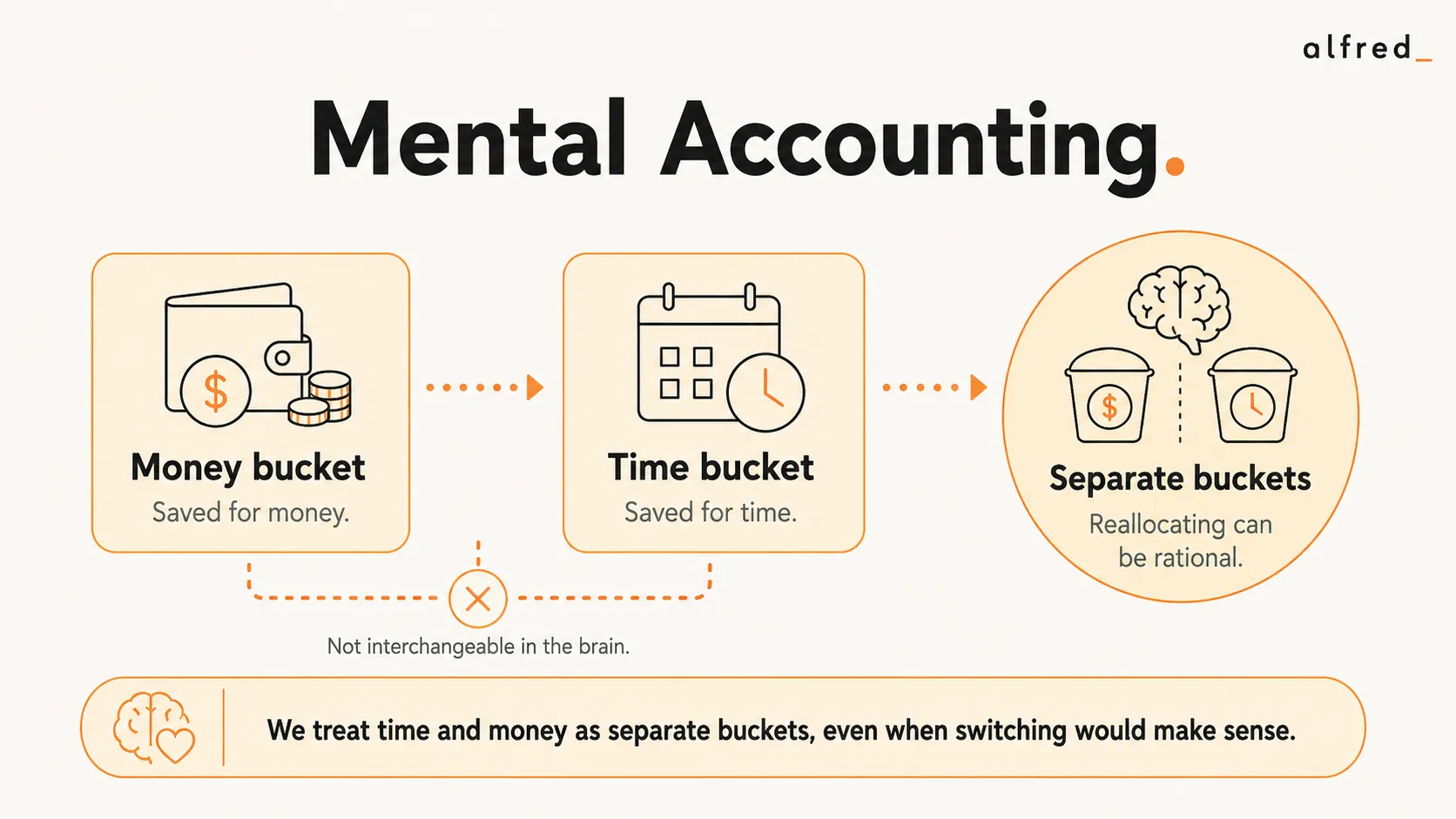
Three properties characterize mental accounting behavior: opening accounts (categorizing an acquisition or expenditure into a mental account), balancing accounts (experiencing satisfaction or discomfort based on whether accounts are in surplus or deficit), and closing accounts (the settlement of an account when a transaction is complete, which is when loss aversion triggers for sunk costs).
The Taxi Driver Study
Camerer, Babcock, Loewenstein, and Thaler (1997) in the Quarterly Journal of Economics examined NYC taxi driver work decisions to test mental accounting in the field. Taxi drivers face genuinely variable demand: some days are high-demand (busy, high-fare), some are low-demand (slow, lower total fares per hour).
A rational optimizer would work longer on high-demand days (when the return per hour is highest) and shorter on low-demand days (when the return per hour is lowest). The researchers found the opposite pattern: drivers tended to quit earlier on high-demand days. Once they had reached their implicit daily income target, they stopped work even though conditions were optimal. On low-demand days, they worked longer to reach the same target.
The mechanism: drivers were mentally accounting by day, not by week or month. Each day was a separate account with a target. Hitting the target closed the account, making additional high-demand hours feel like surplus beyond the goal. Missing the target on a low-demand day meant the account was still open, requiring more hours regardless of efficiency. This is financially suboptimal but psychologically coherent under mental accounting.
Try alfred_
See what this looks like in practice
alfred_ applies these principles automatically — triaging your inbox, drafting replies, extracting tasks, and delivering a Daily Brief every morning. Theory becomes system. $24.99/month. 30-day free trial.
Try alfred_ freeMental Accounting Applied to Time
The same mechanisms operate for time. Professional time is mentally categorized into accounts that are treated as non-interchangeable: "email time," "meeting time," "deep work time," "admin time." These mental accounts create psychological barriers to reallocation that don't exist in purely economic analysis.
- Spillover resistance. A meeting that runs over into "deep work time" is experienced as more costly than the same number of minutes spent in a different part of the day, because it violates a mental account boundary. This explains why people protect certain time blocks with disproportionate energy relative to their objective value.
- Completing small tasks first. Closing a mental account (finishing a simple task) produces satisfaction independent of the task's actual value. This explains the persistent preference for handling easy emails before difficult strategic work: each completed email closes a small account, producing a stream of small account-closing satisfaction.
- Administrative time as its own category. When administrative tasks are mentally categorized separately from "real work," there is high psychological resistance to doing administrative work during "real work" time, and high resistance to reducing administrative time even when its actual productivity value is low. The mental account boundary is stickier than the rational allocation would justify.
Frequently Asked Questions
Is mental accounting always irrational, or does it serve useful purposes?
Mental accounting serves several legitimate functions. It simplifies decision-making by reducing the cognitive load of treating every allocation as a fully open optimization problem. Household budgeting categories such as food, rent, and entertainment are mental accounts that function as useful constraints. The irrationality appears at the margin: when mental account boundaries prevent genuinely beneficial reallocations (like working longer on an unusually productive day, or shifting money from a 'vacation' mental account to pay off high-interest debt). The practical insight is to be aware of which mental account boundaries are serving useful discipline functions versus which are causing suboptimal allocation, and to dissolve the latter while preserving the former.
How does mental accounting relate to the failure of annual budgets?
Annual budget cycles create powerful mental accounts: the budget allocation for each category is treated as a commitment rather than an approximation, and the 'use it or lose it' dynamic at year-end is a direct mental accounting artifact. Departments spend remaining budget allocations on marginal uses because allowing the account to close with a surplus signals that the budget was set too high, a loss for next year's negotiation. This behavior is financially irrational (the money's best use would be to return it to the organization) but psychologically coherent under mental accounting. Understanding this explains a large fraction of organizational budget behavior that otherwise appears inexplicable.
What is the practical way to override mental accounting in time allocation?
The most effective technique is collapsing the mental accounts into a single integrated priority view. When email, tasks, and calendar are presented as separate systems with separate accounting, the cross-system reallocation feels psychologically costly. When they are unified into a single priority queue (asking 'what is the highest-value use of the next hour, regardless of category'), the mental account boundary dissolves and reallocation becomes psychologically available. This is why integrated work systems produce better allocation decisions than siloed ones: it's not just about convenience, it's about eliminating the artificial account boundaries that create suboptimal stickiness.
Related Articles
Try alfred_
See what this looks like in practice
alfred_ applies these principles automatically — triaging your inbox, drafting replies, extracting tasks, and delivering a Daily Brief every morning. Theory becomes system. $24.99/month. 30-day free trial.
Try alfred_ free