


Psychology

The Sunk Cost Fallacy: Why Finishing Things Hurts You

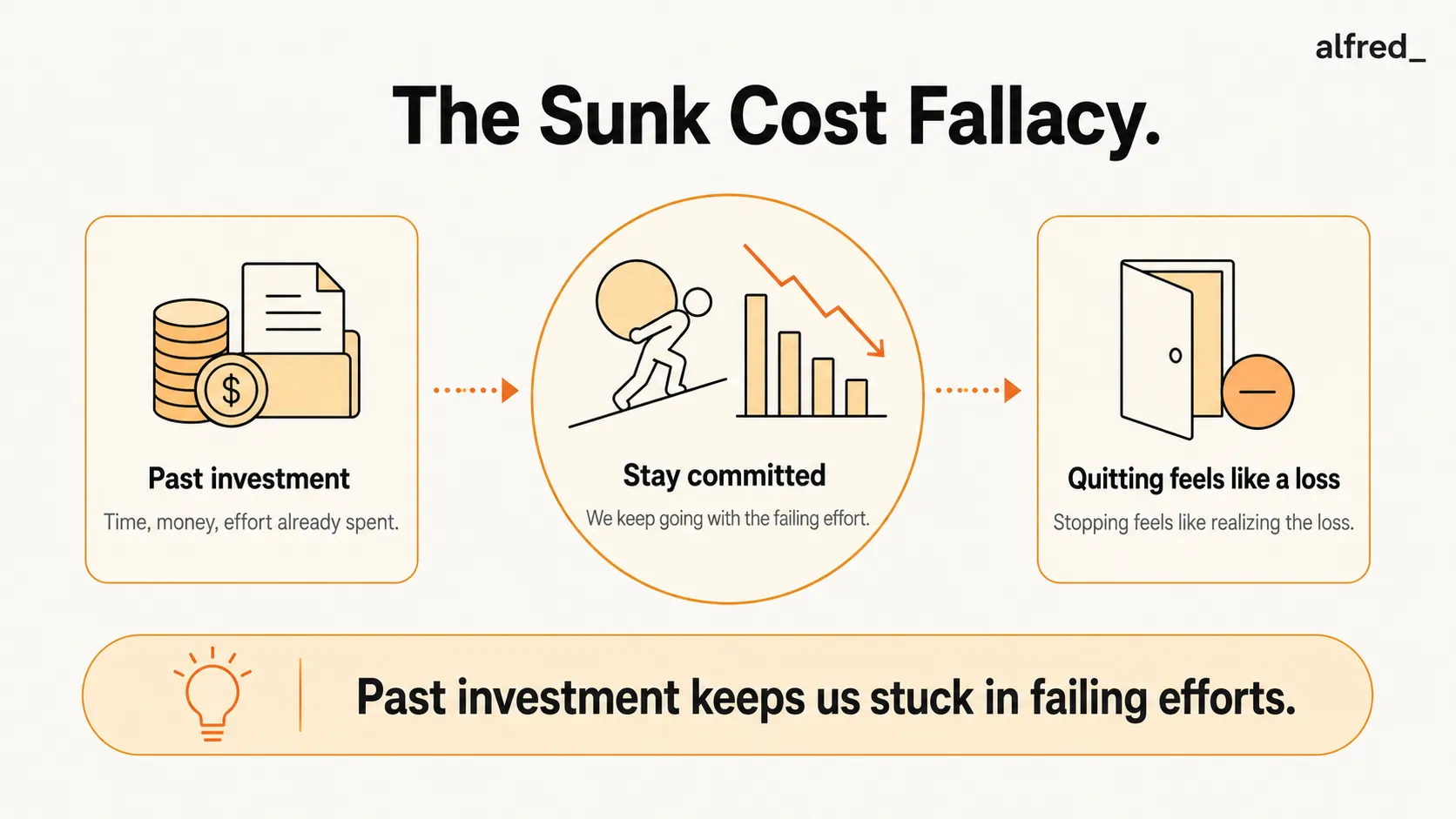
Rational decision-making should be forward-looking: what will produce the best outcome from here, given current resources? The sunk cost fallacy is the systematic error of allowing past irrecoverable investment (time, money, effort) to influence that calculation. The investment is gone regardless of what you decide. Including it in the calculation is not prudent; it is bias.

Feb 19, 20266 min read
Quick Answer

What is the sunk cost fallacy?

  • The sunk cost fallacy is the error of allowing past irrecoverable investment to influence forward-looking decisions, even though that investment is gone regardless of what you decide
  • Arkes & Blumer (1985) showed 85% voted to continue a failing military program when $9B prior investment was mentioned; only ~10% did without that context
  • The mechanism is loss aversion: abandoning a project converts the investment into a realized loss, which the brain weights roughly twice as heavily as equivalent gains
  • The diagnostic question: "If I had not already invested anything, would I take this opportunity at the current expected cost and return?" If no, sunk costs are driving the decision

Arkes & Blumer (1985), Organizational Behavior and Human Decision Processes, 35(1), 124–140.

The Research

Arkes and Blumer published the canonical study in Organizational Behavior and Human Decision Processes (1985). The key scenario: participants were told about a military aircraft program where $9 billion had already been spent and the project was behind a competitor's superior aircraft. Should they continue?
85% vs ~10%

participants who voted to continue the failing military aircraft program: 85% when told $9B had already been spent; only ~10% when no prior investment was mentioned. The sunk cost alone produced a 75-percentage-point difference in the continuation decision.

Source: Arkes & Blumer (1985), Organizational Behavior and Human Decision Processes, 35(1)

When prior investment was mentioned, 85% voted to continue the failing program. When no prior investment was mentioned (same future prospects), only approximately 10% chose to continue. The identical future, the same forward-looking calculation, produced dramatically different decisions based purely on what had already been spent.

Their theater ticket field study confirmed the effect in real behavior: full-price season ticket subscribers attended more performances than subscribers who received discounted tickets, despite the cost being identical going forward. The larger sunk cost produced stronger motivation to "get value from" the investment by attending, regardless of whether attending on any given night was actually what the person wanted to do.

Why It Happens: Loss Aversion

The mechanism is loss aversion, one of the most robust findings in behavioral economics. Kahneman and Tversky's prospect theory established that losses are weighted approximately twice as heavily as equivalent gains. Abandoning a project converts the investment into a realized loss. Continuing the project keeps the possibility of recovery alive, which means the loss is not yet realized.

This is why sunk cost reasoning is not simply irrational. It feels profoundly rational from the inside. Stopping means admitting the loss. Continuing preserves the possibility, however remote, that the investment was not wasted. The emotional logic is coherent even when the financial logic is not.

Try alfred_

See what this looks like in practice

alfred_ applies these principles automatically — triaging your inbox, drafting replies, extracting tasks, and delivering a Daily Brief every morning. Theory becomes system. $24.99/month. 30-day free trial.

Try alfred_ free

Three Executive Sunk Cost Traps

  • The failing hire. A significant investment in recruiting, onboarding, and training (6 to 12 months of management time and salary) creates intense sunk cost pressure to "make it work." The forward-looking question (is this person likely to succeed in this role?) gets contaminated by the backward-looking one (can I justify what was spent?). Organizations frequently keep poor-fit hires longer than rational analysis supports, extending the cost rather than limiting it.
  • The legacy vendor. Switching costs are real, but they are future costs, included correctly in a forward-looking analysis. What is incorrectly included is the cost of past contracts: "We've spent $2M with them over five years." That $2M is gone regardless of whether you renew. The renewal decision should be based only on the forward-looking comparison between the incumbent and alternatives.
  • The product roadmap past market contradictions. Product investments create some of the most powerful sunk cost dynamics: 18 months of engineering effort, a public announcement, organizational identity attached to the direction. When market signals contradict the approach, the sunk investment creates pressure to persist and to interpret ambiguous signals as confirmation rather than contradiction.

The Clean Diagnostic

The corrective question: "If I had not already made any investment, and someone offered me this opportunity at exactly the current expected cost and return, would I take it?" If yes, continue. If no, the current investment is sunk cost driving the decision.

This question is deceptively simple and practically difficult, because answering it requires actually setting aside the investment, which loss aversion makes viscerally uncomfortable. The question can be useful as a conversation-starter in group settings specifically because it surfaces the sunk cost reasoning explicitly, making it available for examination rather than operating as an invisible thumb on the scale.

Frequently Asked Questions

Is persistence ever rational? How do I distinguish sunk cost reasoning from legitimate commitment?

Legitimate persistence is forward-looking: there are specific, time-bounded conditions under which the outcome is still achievable, and meeting those conditions is genuinely plausible given current evidence. Sunk cost reasoning is backward-looking: the primary motivation to continue is the investment already made, not a credible positive forward-looking case. The diagnostic: if you stripped away the past investment entirely from your argument for continuing, would the forward-looking case still be compelling? If the forward case is strong on its own terms, continuing is rational. If the forward case requires the past investment to justify it, that's sunk cost reasoning.

Why is sunk cost bias stronger in organizations than in individuals?

Several mechanisms amplify sunk cost bias in organizational settings. First, the person making the abandonment decision is often the person who made the original commitment, so stopping means publicly acknowledging a mistake in addition to the private loss aversion. Second, organizations track investments and performance visibly, making sunk costs salient to multiple people simultaneously. Third, organizational decision-making is often adversarial: someone's career is associated with the program's continuation, creating a motivated advocate for persistence. And fourth, organizational accountability systems often punish abandonment ('we spent how much and you're walking away?') more than they punish persistence into failure. These incentive structures amplify the individual cognitive bias into an organizational one.

How do you present the case for stopping a sunk-cost-affected project to leadership?

The effective framing recharacterizes stopping as a forward-looking resource allocation decision rather than an admission of past error. 'Given current evidence, is the expected return on further investment in this direction above or below our opportunity cost?' reframes the decision correctly. Specifically avoid the 'we've already spent X' framing, as it will trigger sunk cost reasoning in the audience rather than defusing it. Pre-mortem framing ('imagine it's a year from now and we continued; what went wrong?') can surface the forward-looking risks without the backward-looking investment triggering the bias. And whenever possible, present a specific alternative use of the resources, making the comparison concrete rather than abstract.

Try alfred_

Surface What's Worth Your Time Going Forward

alfred_'s task visibility (showing which items have been deferred repeatedly) provides an objective signal of where sunk cost thinking may be sustaining low-value commitments. Sometimes the most valuable action is the one that closes the loop. $24.99/month.

Try alfred_ Free