


You meant to write the report this morning. You meant to not open email first. You meant to decline the meeting that has nothing to do with your priorities. You wanted all of it, genuinely, and you did none of it, because wanting is not where follow-through breaks. It breaks in the specific moment the opportunity arrives and your brain fails to connect the goal to the action. Peter Gollwitzer found a deceptively small fix for exactly that gap, and it is one of the most robustly validated techniques in all of behavior change. Here is the if-then format, the research behind it, and why it works without requiring any willpower at all.
The Intention-Behavior Gap
Gollwitzer’s research began with a fundamental observation: people regularly fail to act on their own stated intentions. They intend to exercise, to respond to that difficult email, to start the report. And then they do not. The gap is not a motivation problem. The research shows that people with high goal intentions (“I really want to do this”) fail to follow through at nearly the same rate as people with moderate intentions.
The failure point is not wanting. It is the translation from intention to behavior in the specific moment when action is possible. When the cue for action arrives (it’s Monday morning; the opportunity to exercise has appeared; the inbox is open), the brain has to bridge from the abstract goal to the specific behavior. That bridging step is where intentions collapse.
The If-Then Format
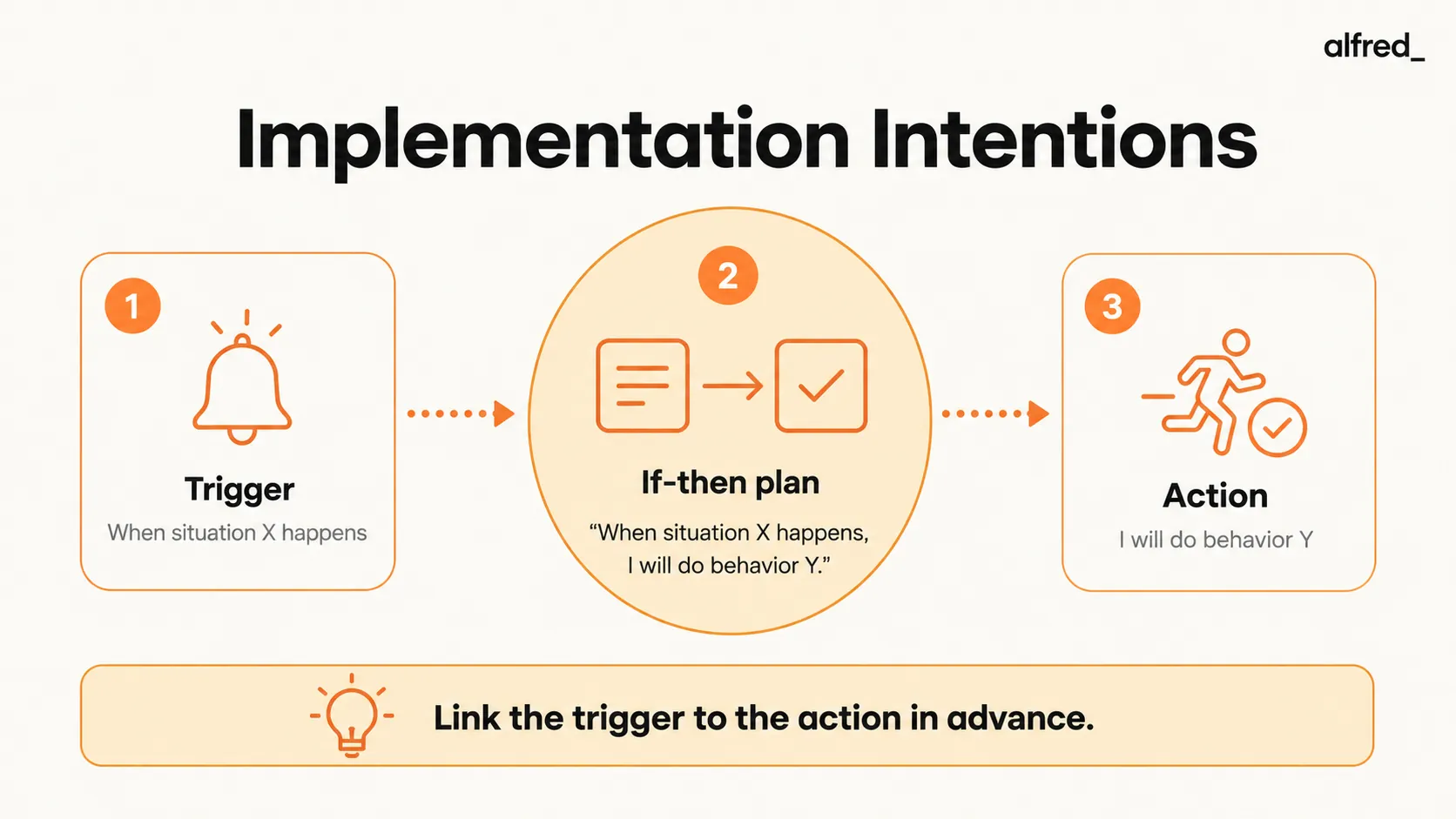
Implementation intentions solve this by pre-loading the bridge. The format is explicit:
“When [situation X] arises, I will perform [response Y].”
Examples in practice:
- “When I sit down with coffee on Monday morning, I will write the weekly status report before opening email.”
- “When I feel the impulse to check Slack during a deep work block, I will write the thought down and return to the document.”
- “When a new meeting request arrives that is not directly tied to my three priorities for the week, I will decline it and offer async.”
The “when” clause specifies a situation, not a time (“at 9am”) but a recognizable state or cue that the brain can detect and respond to automatically. The “I will” clause specifies the exact response, in enough detail that no further decision-making is required when the cue is encountered.
What the Research Shows
Gollwitzer’s 1999 paper in American Psychologist (“Implementation Intentions: Strong Effects of Simple Plans”) established the theoretical framework. The statistical evidence came from the 2006 meta-analysis by Gollwitzer and Sheeran, covering 94 independent studies:
d = 0.65
effect size of implementation intentions on goal attainment across 94 independent studies, a medium-to-large effect among the highest validated in behavior change research
Gollwitzer & Sheeran, Advances in Experimental Social Psychology, 2006The effect is largest for difficult goals, goals involving the suppression of habitual competing behaviors, and goals in domains where people have a history of failing to follow through. These are precisely the categories where implementation intentions are most needed.
The Mechanism: Strategic Automation
Gollwitzer’s explanation for why the format works is called strategic automation. When you form an implementation intention, the mental representation of the specified situation (“Monday morning with coffee”) becomes highly accessible in memory. The situation is tagged as an action cue.
When that situation is subsequently encountered, the tagged cue automatically activates the linked response, without requiring a deliberate decision, willpower deployment, or conscious reminder. The behavior fires like a habit, even though it was not built through repetition. The implementation intention essentially hijacks the habitual action-initiation system for goal-directed behavior.
This is why implementation intentions are particularly effective for goals that require overriding competing habitual responses. “When I feel the urge to check my phone” specifies a real state that the brain detects in real time. The linked response fires before the habitual scroll begins.
What Implementation Intentions Are Not
Implementation intentions are not the same as goal setting, task lists, or scheduling. A task list records what you want to do. An implementation intention specifies the exact situational trigger that will cause you to do it. A calendar block says “time is allocated.” An implementation intention says “when this state arrives, this behavior fires.”
They are also not affirmations or motivational self-talk. The if-then format works through a cognitive mechanism (situational accessibility and automatic response activation), not through emotional priming. They work even for people who do not feel motivated at the time. That is precisely their value.
Spend Your If-Then Plans on Work That Matters
Look closely at the example intentions throughout this piece and a pattern emerges. “When I feel the impulse to check Slack during a deep work block.” “When I sit down with coffee, I will write the report before opening email.” “When a meeting request arrives that is not tied to my priorities, I will decline it.” A striking share of the implementation intentions people actually need are defensive: willpower-efficient patches whose entire job is to hold back the pull of the inbox. The technique works, but it is being spent guarding against a single recurring intruder.
The more durable move is to remove the intruder rather than out-trigger it. alfred_ handles the inbox triage, the routine replies, and the meeting and follow-up noise, so the recurring competing behavior those defensive intentions exist to suppress simply arrives less. You stop needing an if-then plan to resist email forty times a day, because email is no longer sitting there demanding the resistance. That frees your implementation intentions for what they are genuinely best at: locking in the high-value behaviors you want to start, instead of patrolling the ones you want to stop.