


Why Positive Visualization Fails
Oettingen’s initial research finding was counterintuitive enough to require replication across multiple studies before she published it: subjects who engaged in pure positive visualization (vividly imagining a desired outcome as already achieved) showed decreased goal-relevant effort and lower goal attainment compared to control groups who did not visualize.
The mechanism she identified: positive visualization deceives the motivational system. The brain, running on emotional signals, partially registers the positive imagery as evidence that the goal is already achieved. Energy that should fund action instead dissipates into the subjective experience of success. Blood pressure drops. Reported energy decreases. The person feels good and does less.
This is not a marginal effect. Oettingen found it across domains: career aspirations, academic performance, health behavior, and relationship goals. The consistency was sufficient to ground a theory of why positive thinking is genuinely counterproductive rather than merely insufficient.
Mental Contrasting: The Alternative
Oettingen’s research identified a more effective alternative: mental contrasting. Instead of imagining only the positive outcome, mental contrasting asks you to alternate between the positive future (what success looks like) and the current reality (what obstacles stand between you and that future). Holding both present obstacles and desired outcome in mind simultaneously generates sustained motivational energy rather than dissipating it.
The sequence: (1) Imagine the best outcome vividly, (2) Then think carefully about the obstacles (specifically internal ones, not external ones) that stand between you and that outcome. The internal obstacle is the behavior, belief, or habit that is most likely to cause failure.
Mental contrasting without a plan for the obstacle has limited effect. The full intervention is WOOP, which pairs mental contrasting with Gollwitzer’s implementation intentions.
The WOOP Framework
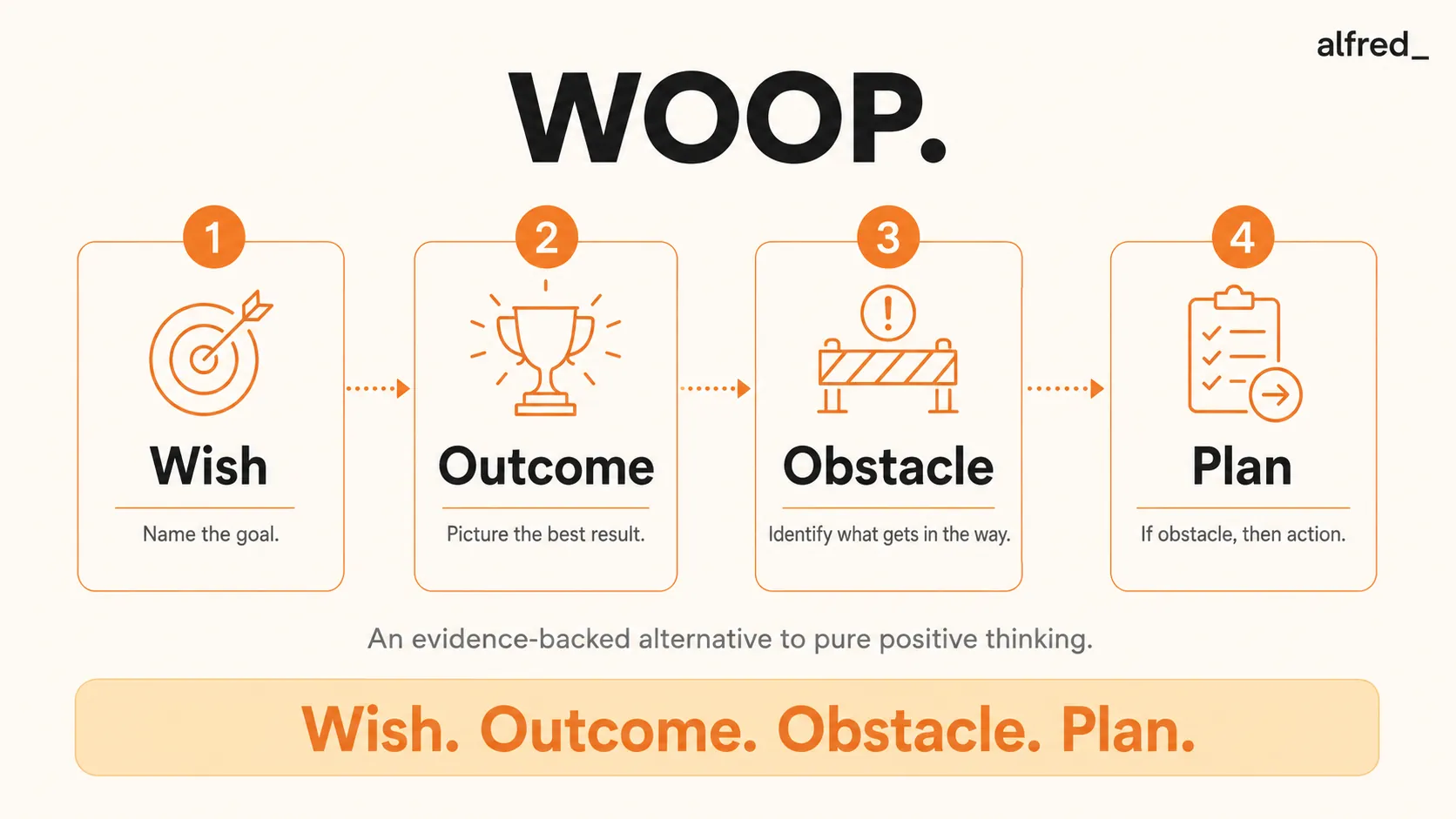
WOOP stands for Wish, Outcome, Obstacle, Plan. Each step has a specific function:
- Wish: A challenging, meaningful, achievable goal. Not a vague aspiration: a specific goal with a defined outcome that can be evaluated.
- Outcome: The best result of achieving the wish. Imagine it vividly: what would it feel like, what would be different. This step generates the motivational pull.
- Obstacle: The single most important internal obstacle. Not “my team isn’t aligned” or “the market is difficult,” but the internal behavior, habit, emotional reaction, or pattern that is most likely to cause failure. “I tend to defer difficult conversations until they become crises.” “I fill my best morning hours with email.”
- Plan: An if-then implementation intention directly addressing the obstacle: “If [the obstacle situation arises], then I will [specific response].”
The complete cycle takes 5–10 minutes. The research shows it is most effective when done in writing, completed in full (not stopping at Outcome), and applied to specific goals rather than general areas of improvement.
The Evidence
A sample of validated findings from Oettingen’s research program and published studies using WOOP:
4.3 vs 1.5 hrs
median hours spent studying toward goals over the three-week measurement period: anesthesiology residents using WOOP vs residents using standard goal-setting, in a randomized 1-month trial
Saddawi-Konefka et al., J Graduate Medical Education, 2017- Participants using WOOP roughly doubled physical activity levels in a 4-month exercise trial versus an information-only control group (Stadler, Oettingen, & Gollwitzer, 2009).
- Improved dietary habits maintained at follow-up, with mental contrasting showing advantage over both pure positive visualization and implementation intentions alone.
- Fifth-graders taught WOOP (MCII) significantly improved report-card grades, attendance, and conduct versus a positive-thinking control group (Duckworth, Kirby, Gollwitzer, & Oettingen, 2013).
- A meta-analysis of WOOP interventions (Frontiers in Psychology, 2021) confirmed positive effects across health, academic, and interpersonal domains.
When WOOP Is Not the Right Tool
Oettingen’s research specifies a condition for when mental contrasting is most effective: the goal must be genuinely achievable. If the goal is not achievable given current circumstances, mental contrasting produces appropriate disengagement: a decision to redirect energy elsewhere. This is a feature, not a bug. WOOP functions as a goal-screening tool as much as a goal-achievement tool.
For goals that are achievable, WOOP outperforms positive visualization, goal intention alone, and implementation intentions alone. The combination of mental contrasting plus implementation intentions is more effective than either component separately.