

You know you should delegate more. Everyone knows this. It’s in every leadership book, every management course, every “how to scale yourself” blog post. Delegate. Empower. Trust your team.
And then Monday morning arrives, your inbox has 47 new messages, and delegating a single task would take 20 minutes of explanation. So you just do it yourself. Again.
This isn’t a discipline problem. It’s an economics problem.
The reason most people don’t delegate is that the handoff cost is too high. Explaining the task takes longer than doing the task. Reviewing the output takes longer than creating the output. Following up on the delegated task takes as much mental energy as the task itself. When the cost of delegating exceeds the cost of doing, rational people don’t delegate.
The question isn’t “should you delegate?” Of course you should. The question is: “how do you reduce the handoff cost until delegating is cheaper than doing?”
How do you delegate effectively?
- Define the outcome, not the process — tell them what done looks like, not how to get there
- Match the delegation level to the person’s experience — new people need instructions, veterans need autonomy
- Set one check-in point, not five — one scheduled update replaces constant monitoring
- Accept 80% quality in exchange for 100% of your time back — perfect is the enemy of delegated
- Start with AI delegation for zero-handoff-cost tasks like email triage and scheduling
The Delegation Economics
Every task you could delegate has two costs: the doing cost (your time to do it yourself) and the handoff cost (your time to explain, review, and follow up). When the handoff cost exceeds the doing cost, delegation feels wasteful.
But this math is wrong because it only looks at a single instance. Factor in repetition and the equation flips.
The delegation math: A task that takes you 15 minutes and costs 30 minutes to hand off seems like a bad trade. But if that task recurs weekly, you’ve spent 30 minutes once to save 15 minutes every week forever. After week two, you’re ahead. After a year, you’ve saved 12 hours.
The people who delegate well aren’t more generous or trusting than the people who don’t. They’re better at seeing the long-term math.
The Five Levels of Delegation
Not all delegation is created equal. Most people default to one of two extremes: either they hand off with no guidance (“figure it out”) or they hand off with suffocating detail (“do exactly this, in this order, and check with me at every step”). Both fail.
Effective delegation matches the level of autonomy to the person’s experience and the task’s stakes.
Level 1: Do exactly this. Full instructions. No judgment required. “Send this exact email to this exact person.” Use this for brand-new team members on zero-stakes tasks where precision matters.
Level 2: Research and recommend. Investigate and come back with options. You make the final call. “Find three vendors, evaluate them against our criteria, and recommend the one you’d choose. I’ll make the final decision.” Use this when you’re building trust on medium-stakes decisions.
Level 3: Decide and inform. Handle it, then let me know what you did. “Schedule the meeting with whoever works. Just tell me when it’s set.” Use this for established relationships, recurring tasks, and time-sensitive items.
Level 4: Decide and act. Handle it completely. No notification required unless something breaks. “Run client scheduling going forward. If something unusual comes up, flag it. Otherwise, I trust your judgment.” Use this for full-trust relationships on routine operations.
Level 5: Own the function. You’re responsible for this entire area. Define the process, make the decisions, handle the exceptions. “You own event planning. Budget, vendors, logistics — all yours.” Use this when you’re truly handing off a function, not just a task.
Most delegation failures happen because the delegator chose the wrong level. Level 1 delegation for an experienced person feels insulting. Level 4 delegation for a new hire feels negligent. Match the level to the person.
The Handoff Framework
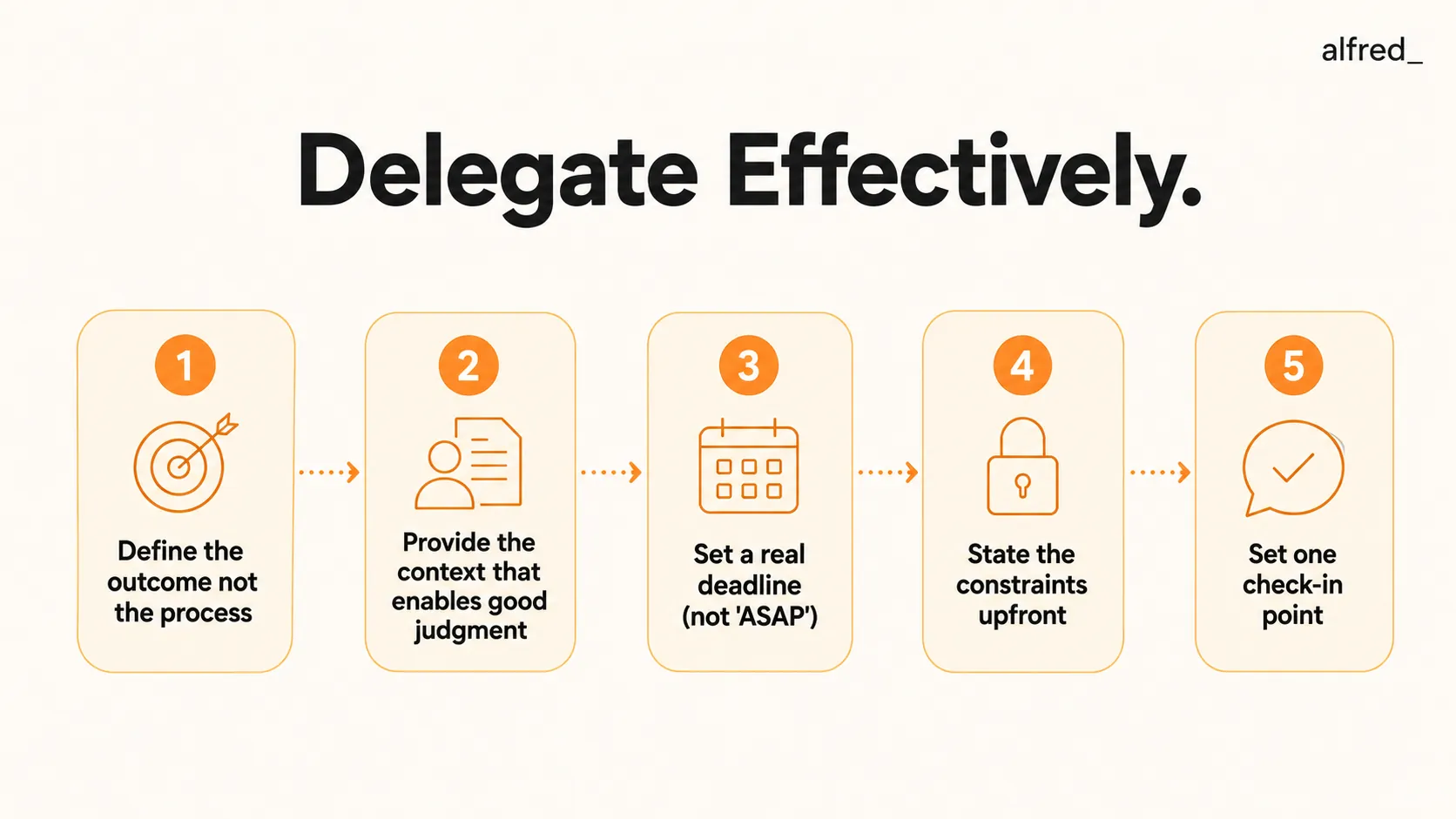
Every good handoff includes five elements. Miss any of them and you’ll end up re-doing the work or micro-managing the process.
Step 1: Define the outcome, not the process
Say what done looks like. Not how to get there. ‘Create a 2-page project brief with timeline and budget estimate for the Greenleaf expansion.’ Not ‘Work on the Greenleaf thing.’ Clear outcomes prevent the ‘is this what you meant?’ cycle.
Step 2: Provide the context that enables good judgment
People make better decisions with context. ‘Rachel needs this for her board meeting Thursday. She values conciseness and specific numbers over narrative.’ Without context, they either guess wrong or ask you 12 clarifying questions — both of which defeat the purpose of delegating.
Step 3: Set a real deadline, not ‘ASAP’
‘As soon as possible’ means different things to everyone. ‘I need a draft by Wednesday 2 PM so I can review before Rachel’s Thursday meeting’ eliminates ambiguity and reduces check-ins. Include why the deadline exists, not just when it is.
Step 4: State the constraints upfront
Budget limits. People not to contact directly. Templates to use. Approvals required. Every unspoken constraint becomes a surprise failure later. State them upfront, even if they seem obvious. ‘Budget cap: $15K. Don’t contact Rachel directly; go through me. Use the brand template.‘
Step 5: Set one check-in point
One. Not five. ‘Send me a progress update Tuesday at noon. If you hit a blocker before then, flag it immediately.’ One defined check-in replaces constant monitoring. It gives them space to work while giving you visibility at the right moment.
What to Delegate First
If you’re not used to delegating, start with tasks that have these characteristics.
Recurring tasks. Anything you do more than twice a month is a delegation candidate. The handoff cost is amortized across many repetitions. Email responses, report generation, scheduling, data entry, status updates.
Tasks with clear outputs. If you can describe what “done” looks like in two sentences, it’s easy to delegate. “A formatted weekly report with sales numbers from Salesforce, sent to the team by Monday 9 AM.” Clear output, clear deadline, clear format.
Tasks below your pay grade. Harsh but true: if you’re paid $150/hour to make strategic decisions and you’re spending 5 hours a week on tasks a $30/hour hire could do, you’re subsidizing low-value work with high-value time. Delegate the tasks that don’t require your specific expertise.
Tasks you dislike. Your energy matters. Delegating tasks that drain you frees up energy for tasks that energize you. This isn’t laziness — it’s resource allocation.
“The cost of doing everything yourself isn’t just time. It’s the ceiling on what you can accomplish. You can’t grow past what one person can do until you learn to let go of what one person shouldn’t be doing.”
The Micromanagement Trap
Most people who struggle with delegation don’t struggle with the handoff. They struggle with what comes after. They hand off the task, then check on it three times, rewrite the output, and conclude that “it’s faster to just do it myself.”
That’s not evidence that delegation doesn’t work. It’s evidence that you’re micromanaging.
Signs you’re micromanaging:
- You ask for updates more than once per task
- You rewrite their work instead of giving feedback
- They CC you on everything “just in case”
- Tasks take longer because they’re waiting for your approval at every step
- You feel anxious when you’re not involved
The fix isn’t to delegate less. It’s to delegate at the right level and then actually step back. Set the check-in point. Wait for it. Review the output. Give feedback (not rewrites). Trust the process.
AI as Your First Delegate
Here’s where the delegation equation changes fundamentally. AI has zero handoff cost.
You don’t explain context to AI — it reads your email history. You don’t train it on your preferences — it learns from your patterns. You don’t schedule check-ins — it reports back when the work is done. You don’t worry about turnover — it doesn’t quit.
The tasks that are hardest to delegate to humans — email triage, scheduling, follow-up tracking, meeting prep — are the easiest to delegate to AI. They’re repetitive, pattern-based, and don’t require relationship nuance.
alfred_ works as that first delegate. It triages your inbox overnight, separating what needs your attention from what doesn’t. It drafts replies to routine messages. It extracts action items from emails and puts them on your task list. It tracks threads you’re waiting on and nudges you when someone hasn’t replied. Every morning, you get a Daily Brief with everything that needs your attention and nothing that doesn’t.
This doesn’t replace delegating to humans. It creates capacity to delegate better. When your inbox isn’t drowning you, you have the mental bandwidth to write that good handoff. When your follow-ups are tracked automatically, you can focus the check-in on quality instead of status.
The delegation sequence: first, delegate routine work to AI (zero handoff cost). Then, use the time and energy you’ve recovered to delegate meaningful work to your team (with proper handoffs). That’s how you scale past the ceiling of one person.
Frequently Asked Questions
What if I’m a solopreneur with no one to delegate to?
You still delegate — to tools, systems, and automation. Email triage to AI. Scheduling to a booking tool. Invoicing to automated software. The delegation framework (outcome, context, deadline, constraints) works the same way when configuring tools as when briefing a person.
How do I delegate when the person keeps doing it wrong?
Usually the instructions are wrong, not the person. Review your handoff: Was the outcome clear? Did you provide context? Were constraints explicit? Fix the handoff before blaming the execution. If it’s truly a skill gap after 3 attempts with clear instructions, invest 30 minutes in direct training.
How do I know what to delegate vs. what to keep?
Delegate anything that: (1) someone else can do at 80%+ of your quality, (2) doesn’t require your unique judgment or relationships, (3) recurs more than twice, or (4) doesn’t energize you. Keep the work that only you can do — strategy, key relationships, creative decisions, and high-stakes judgment calls.
What about tasks that are too complex to explain?
Record yourself doing it once. A 5-minute Loom video becomes the training material for every future handoff. You can also break complex tasks into smaller steps and delegate the steps individually. Complex does not mean undelegatable. It just requires a better instruction format.
How long before delegation actually saves me time?
For simple tasks: immediately after the first handoff. For complex tasks: usually after the 3rd repetition. The first time is an investment. By the 3rd time, they’ve built the pattern and you’re no longer spending time on it at all. For AI delegation, the payback is immediate — there’s no training period for routine tasks like email triage.