

Andy Grove called the one-on-one one of the highest-leverage activities a manager has: ninety minutes of your time can raise the quality of your report’s work for two weeks. Yet most 1:1s get treated as a status update that could have been an email, or skipped the moment the week gets busy, which is exactly when they matter most. The problem is that almost no one is taught how to run one. Here is Grove’s framework for 1:1s that surface real problems before they become crises and build the trust that makes everything else easier.
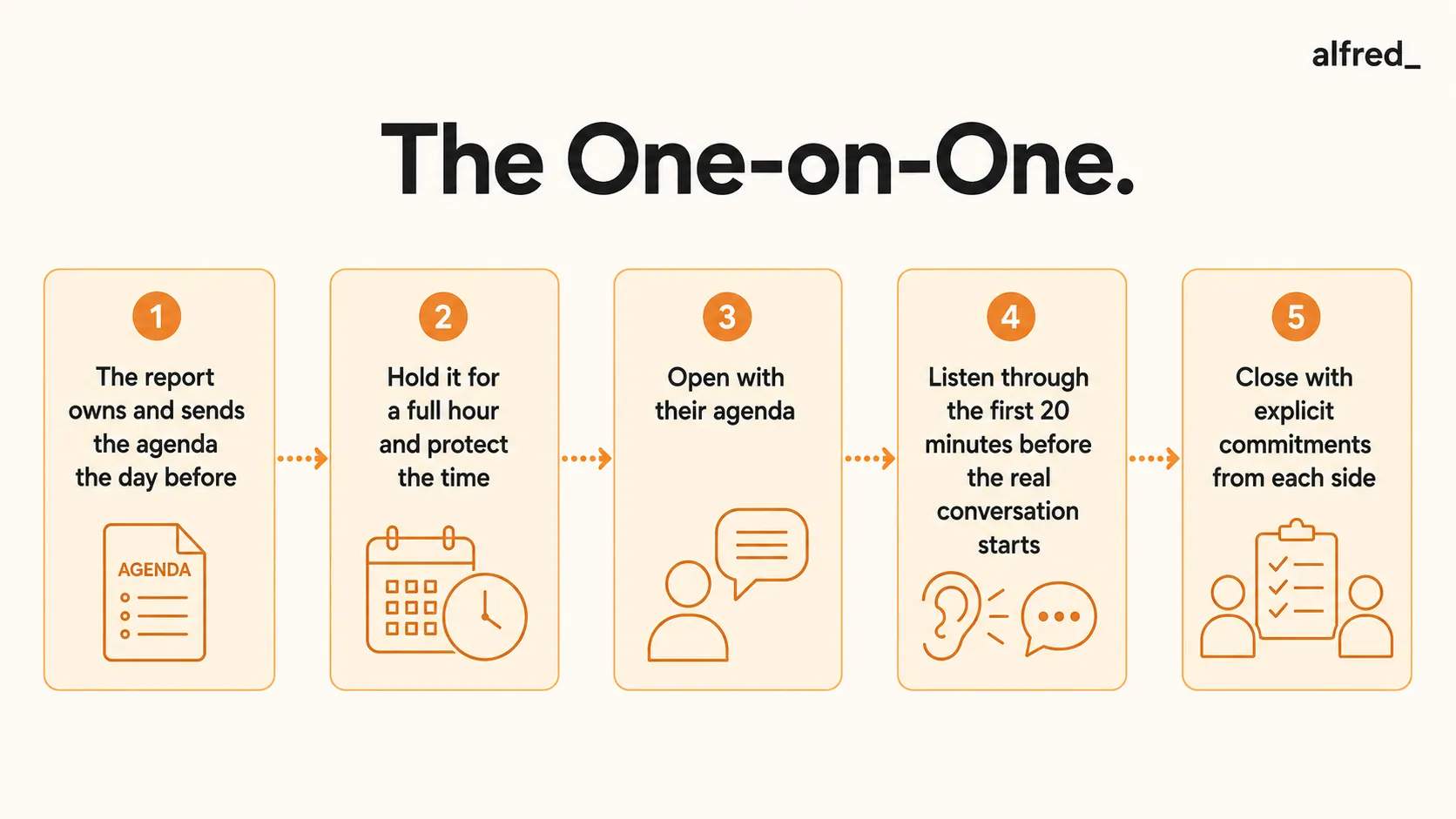
Grove’s One-on-One Framework: The Definitive Guide
Andy Grove devoted an entire chapter of High Output Management to the one-on-one meeting, which tells you how seriously he took it. His core argument: the one-on-one is primarily a teaching and information-gathering vehicle, and it is the most important recurring activity a manager performs.
Three structural rules from Grove that most managers get wrong:
- The meeting belongs to the subordinate, not the manager. “It is the subordinate’s meeting.” The subordinate owns the agenda, sets the topics, and drives the conversation. The manager’s job is to listen, ask clarifying questions, and teach, not to deliver status updates or redirect to their own priorities.
- Minimum 1 hour. “Anything less tends to make the subordinate confine himself to simple things that can be handled quickly.” The real topics, the ones that matter, surface around the 20-30 minute mark. A 20-minute one-on-one cuts off exactly when it becomes valuable.
- The subordinate prepares and sends the agenda in advance. This discipline forces the subordinate to think ahead about what’s on their mind, and it gives the manager context before the meeting so they can prepare rather than react.
“How often you monitor should not be based on what you believe your subordinate can do in general, but on his experience with a specific task and his prior performance with it.”, Andy Grove, High Output Management
What Should Be On the Agenda
Grove’s recommended topics for the one-on-one aren’t a rigid checklist. They’re categories that should be covered at different frequencies across the recurring meeting relationship:
Grove’s One-on-One Topic Categories
- What happened since last meeting: Accomplishments, obstacles encountered, significant news. This is the factual update layer.
- What’s coming up: Upcoming challenges, potential problems that are nagging, decisions on the horizon. This is where problems are preventable.
- Skills or knowledge needed: What would help them do their job better right now? What are they trying to learn?
- Organizational communication: What’s happening in the company that affects their work, their team, their career?
- Career development: Not every meeting, but regularly. Where are they going? What are they building toward?
- Open floor: What else is on their mind? This is where the real issues surface, the ones they didn’t feel safe raising in the agenda.
Task-Relevant Maturity and Your One-on-One Style
Grove’s Task-Relevant Maturity framework applies directly to how you run one-on-ones with different team members, or even with the same team member across different topics. TRM is not about seniority or general competence. It’s about experience and prior performance on this specific type of work.
TRM-Based One-on-One Styles
- Low TRM team member: More structured one-on-ones. Focus on task-level topics. Provide more direction and context. Check in on specific deliverables. Ask “what are you planning to do next?” and be prepared to provide detailed guidance if the answer isn’t solid.
- Medium TRM team member: Dialogue-heavy one-on-ones. Coaching orientation. “What do you think you should do?” before “here’s what I would do.” Explore options together. Provide emotional support, as medium TRM is where self-doubt peaks.
- High TRM team member: Light-touch one-on-ones. Agree on objectives. Hear their update. Ask what they need from you. Trust their judgment on execution. Your job is to remove obstacles, not to monitor closely.
The critical point Grove makes: you may have a 10-year veteran on your team who has high TRM for their core domain but low TRM for a new project type or a new organizational challenge. Treating them as high TRM across the board, simply because of their seniority, is a management failure. The right calibration is always task-specific, not person-specific.
Walsh’s Teaching Model Applied to One-on-Ones
“Great leaders are, above all, great teachers.”, Bill Walsh, The Score Takes Care of Itself
Bill Walsh’s coaching philosophy at the San Francisco 49ers was built around a simple conviction: his primary job was teaching, and teaching was the multiplier on everything else. The same principle applies to management one-on-ones.
The one-on-one is the primary teaching vehicle between a manager and a direct report. Not for lectures or instruction, but for Socratic development: asking questions that help the person work through their own thinking before providing the manager’s perspective. The sequence matters: ask before telling. “What do you think you should do?” before “here’s what I would do.” This develops judgment, not just compliance.
Walsh distinguishes between delegation (releasing work to someone) and abdication (releasing work without preparation or teaching). The one-on-one is where the teaching happens that makes delegation responsible rather than reckless. Without it, you’re not delegating. You’re abdicating and then wondering why the work comes back undone.
Step-by-Step: Run a One-on-One That Actually Develops People
1. Establish the Format: Subordinate Owns and Sends Agenda the Day Before
Set the expectation explicitly in your first one-on-one: “This is your meeting. I want you to send me an agenda the evening before. You set the topics. I’ll be prepared.” This may feel awkward at first for team members who are used to the manager running the meeting. Be patient. The first two or three one-on-ones may be stilted. That’s normal. It normalizes over time.
2. Hold for Minimum 1 Hour. Protect This Time Above Almost Everything.
Grove’s 1-hour minimum is non-negotiable. Thirty-minute one-on-ones produce thirty-minute conversations, surface-level updates that don’t surface the issues that matter. Protect this time from cancellation aggressively. Canceling a one-on-one sends a clear signal: you are not a priority. The cumulative effect of repeatedly canceled one-on-ones is disengagement and silence precisely where you need candor.
3. Open with Their Agenda. Resist the Urge to Redirect.
Start from the first item on the agenda they sent. Your topics as manager come after theirs. If their agenda doesn’t include something you need to cover, add it at the end, not at the beginning. Redirecting immediately to your priorities communicates that this meeting is actually yours, which defeats the psychological safety that makes one-on-ones work. The meeting is not for your updates. It’s for their development.
4. Listen Through the First 20 Minutes Before the Real Conversation Starts
The 20-30 minute mark is where surface topics naturally give way to real ones. Grove identifies this as the “heart-to-heart” moment: the issues the person was reluctant to lead with but will raise once sufficient trust and warmth has been established in the conversation. Stay in listening mode early. Ask clarifying questions. Don’t rush to solutions. The valuable conversation is approaching; creating the conditions for it is the manager’s work in the first twenty minutes.
5. Close with Explicit Commitments: What Will Each of You Do Before Next Time?
Before ending: “What are we each going to do before our next meeting?” Name them. Write them down. The follow-through on these commitments is what builds trust in the one-on-one system over time. Commitments that disappear between meetings teach the person that the one-on-one is a place for nice conversation, not for things that actually happen. Use alfred_ to track any commitments that are assigned via follow-up email. It monitors the thread and flags stale items.
One-on-One Agenda Template
Here is a sample agenda a well-coached subordinate might send the evening before their one-on-one:
One-on-One Agenda: [Name] / [Manager] - [Date] UPDATES (5-10 min) - Completed: Q2 competitive analysis draft, sent to team Thursday - In progress: Client onboarding for Apex account (on track for March 3) - Blocked: Waiting on legal review for contract amendment (flagged 2 weeks ago) TOPICS I WANT TO DISCUSS (30-40 min) 1. The Apex onboarding. I'm concerned about our timeline given the integration complexity. Want to pressure-test the plan. 2. The team dynamic question. There's tension between two engineers that I've been trying to manage. Getting worse. 3. Career question. I've been thinking about whether product management might be a path worth exploring. Wanted to get your perspective. WHAT I NEED FROM YOU - A decision on the legal review escalation (can you push internally?) - Your read on the team tension situation ANYTHING ELSE - Open floor ## Common One-on-One Failures Too short (20-30 min): Cuts off before the valuable conversation starts. Surface-level topics only. Real issues go unaddressed. Manager dominates with their agenda: Undermines psychological safety. Person learns to save real concerns for never. Cancelled when manager is busy: Signals one-on-ones are optional, not foundational. Disengagement follows. No follow-through on commitments: Erodes trust in the system. Person stops raising issues because nothing happens. Only discussing active work: Neglects development, career, and the relationship itself, the dimensions that produce long-term engagement. ## How alfred_ Supports One-on-Ones The most important follow-through mechanism for one-on-ones is tracking the commitments made in them. Commitments that aren’t tracked disappear, and disappeared commitments erode the entire value of the meeting over time.
When you follow up on a one-on-one commitment via email (“As we discussed, I’ll have the project plan to you by Thursday”), alfred_ monitors that thread. If the deadline arrives without a response or delivery, alfred_ surfaces it. You don’t need to rely on memory or manual calendar reminders to follow through on what you committed to in the meeting.
alfred_ also helps with the post-meeting summary email: “Here’s what we discussed and what we each committed to.” This email creates a shared written record of commitments that both parties can refer back to, which is one of the highest-leverage follow-through mechanisms available. Use alfred_ to draft this email immediately after the one-on-one while the conversation is fresh.