

Written feedback is easy to send and easy to get wrong. The same message that would land fine across a desk can read as cold, ambiguous, or cutting once it is stripped of tone and sitting in someone’s inbox to be reread at 9pm. Most people respond by either avoiding written feedback entirely or firing it off without a structure, and both fail. The skill is knowing which feedback belongs in writing at all, and then writing it so it develops the person instead of bruising them. Here is how.
When Written Feedback Works (and When It Doesn’t)
Written feedback has a specific domain where it excels. Using it outside that domain, for situations that require dialogue, emotional attunement, or real-time calibration, produces the failures that give feedback emails their bad reputation.
Written Feedback Works For:
- Positive reinforcement of specific behaviors. Written recognition is specific, immediate, and creates a record the recipient can return to. It doesn’t require dialogue; it requires acknowledgment.
- Feedback on written work or deliverables. When you’re giving feedback on a document, report, or presentation, written feedback is the natural medium; it’s directly referenceable against the work.
- Post-meeting or post-project summary of observations. A written summary after the fact gives the recipient time to process without the pressure of responding in the moment.
- Reinforcing a verbal conversation in writing. Following up a live feedback discussion in writing ensures shared understanding and creates a reference document.
- Feedback that needs a paper trail. Performance documentation, pattern-of-behavior records, or formal feedback processes require written form.
Written Feedback Does Not Work For:
- Complex developmental feedback requiring dialogue. When the feedback involves a pattern of behavior, a relationship dynamic, or significant performance concerns, the recipient needs to be able to respond, clarify, and be heard in real time.
- Sensitive personal topics where tone matters more than content. Writing removes the paralinguistic signals that carry emotional information. For sensitive situations, tone is often what determines whether feedback lands constructively or defensively.
- Situations where you need to understand the person’s emotional state first. Some feedback conversations need to start with listening, not delivering. Email is a one-direction push; it doesn’t let you calibrate before you speak.
“Written communication forces clarity,” but some situations need verbal communication to preserve the relationship. Jeff Bezos’s principle, applied.
Walsh’s Standard of Performance Applied to Feedback
Bill Walsh built a communication culture at the 49ers that extended to every form of organizational communication, not just play-calling. His Standard of Performance for communication included: logical sequential structure, appropriate specificity, positive language as the default register, and open and substantive communication especially under stress.
Applied to feedback emails, Walsh’s standard produces four requirements. Every piece of feedback should be structured in the sequence of observation, impact, and request, not in the reverse order that feels more comfortable to the giver. It should be specific enough to be actionable: the recipient should be able to change something concrete in their next performance based on the feedback. It should frame development as growth rather than failure: the default language should be about what more looks like, not what worse looks like. And it should be substantive even when the news is difficult. Soft feedback that softens the message into meaninglessness fails the communication standard.
“Let talented members of your organization know you believe in them. Great leaders are, above all, great teachers.”, Bill Walsh, The Score Takes Care of Itself
Walsh believed great leaders are, above all, great teachers. Written feedback is one of the most scalable teaching tools a manager has: it’s asynchronous, referenceable, and forces the clarity that casual verbal feedback often lacks.
The SBI Framework for Written Feedback
Situation-Behavior-Impact is the most durable written feedback structure because it grounds every feedback statement in observable reality rather than interpretation. The three elements work together to prevent the two most common feedback failures: vagueness (“you need to communicate better”) and character attribution (“you’re not a team player”).
The SBI Structure
- Situation: Describe the specific context, when and where the behavior occurred. “In last Tuesday’s client presentation” not “generally” or “sometimes.” Specificity anchors the feedback in a shared reality the recipient can verify.
- Behavior: Describe the observable behavior: what you actually saw or read. “You presented the revised projections without mentioning the assumptions that changed since the last meeting” not “you were careless with the data.” One is observable; the other is a judgment.
- Impact: Describe the effect of that behavior on the team, the project, the client, or you. “The client asked three clarifying questions that extended the meeting by 30 minutes and left them uncertain about the Q3 forecast.” Concrete and verifiable, not “it made us look bad.”
The SBI framework also makes positive feedback significantly more useful. “Great presentation” is pleasant but not instructive. “In the client pitch on Thursday (Situation), you opened with the client’s stated problem before showing the solution (Behavior); the room’s energy shifted visibly, and the client said it was the first vendor who’d led with their perspective (Impact)” is feedback someone will remember and repeat.
Bezos’s Clarity Test for Feedback
Jeff Bezos’s discipline around written communication provides a direct test for feedback quality: “When you force someone to write their thinking down, you force them to clarify it.” Apply this to feedback before sending: Is my observation specific and behavioral? Is the impact clear and concrete? Is the request or forward-looking question actionable?
If the answer to any of these is no, the feedback isn’t ready to send: it’s still fuzzy thinking. The uncomfortable truth is that most feedback impulses, before they’re written down and refined, are fuzzy. “She needs to be more proactive” is a feeling, not a feedback statement. Writing it down, forcing yourself to identify the specific situation, the specific behavior, and the specific impact, often reveals that you don’t yet have the clarity to give useful feedback. That’s valuable information: it means you need to observe more before you speak.
“You can hide a lot of sloppy thinking behind bullet points.”, Jeff Bezos. This applies to feedback equally: vague bullet-pointed feedback hides the absence of clear observation.
Positive Feedback by Email: Often Overlooked, High Leverage
Andy Grove identified the concept of high-leverage activities in High Output Management: actions that affect many people or affect someone for a long time. A specific, well-written piece of positive feedback is a high-leverage activity. It costs 10 minutes to write and can motivate someone for months.
Most managers underinvest in written positive feedback because it feels unnecessary: “they know I think they did well.” They often don’t. And even when they do, the explicit articulation of what specifically they did well and why it mattered is the signal that turns good performance into a pattern the person will consciously repeat.
Grove’s leverage principle applied: if a piece of written recognition takes 10 minutes and increases someone’s motivation and performance for the next three months, the leverage ratio is enormous. If a piece of corrective feedback prevents a pattern from repeating and preserves a client relationship, the leverage is equally large. Written feedback is consistently underused as a high-leverage management tool.
3.6x
more likely to be motivated to do outstanding work: employees whose manager gives daily feedback vs. annual feedback
Step-by-Step: Write Feedback That Actually Helps
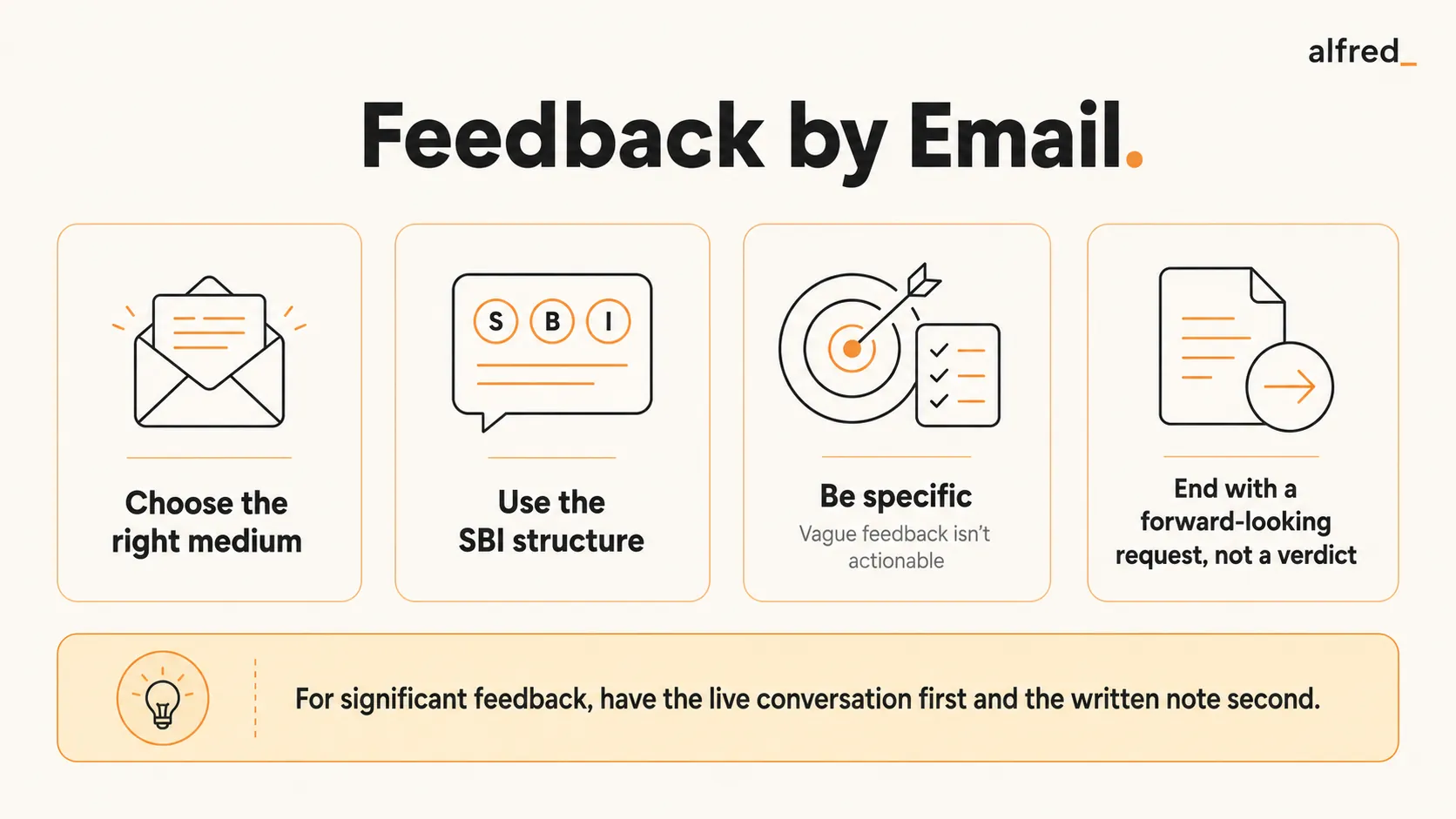
1. Choose the Right Medium
Before writing anything, decide: is this feedback suited to writing, or does it need live dialogue first? Apply the test: Does this feedback require me to understand the recipient’s emotional state or perspective before delivering it? If yes, start with a conversation. Does this feedback involve a pattern of serious performance concerns? If yes, have the conversation first and use writing to confirm. If the feedback is specific, behavioral, and either positive or tied to a concrete deliverable, email is appropriate.
2. Use the SBI Structure
Write the three elements in sequence: Situation (when and where), Behavior (what you observed, specific and behavioral rather than interpretive), Impact (the concrete effect). Don’t write the impact first and work backward; write the observation first, then its meaning. This sequence mirrors how you actually experienced it, and it mirrors how the recipient will be able to verify it.
3. Be Specific: Vague Feedback Is Not Actionable
Apply Bezos’s clarity test to every sentence: “Is this specific and behavioral?” “Great work on the proposal” fails. “The executive summary in your proposal led with the client’s problem before the solution; the partner group said it was the clearest framing they’d seen from a new associate” passes. The second gives the recipient something concrete to repeat. The first gives them a feeling with no instructional value.
4. End with a Forward-Looking Request or Question, Not a Verdict
Walsh’s teaching orientation applies here: feedback is not a judgment, it’s an instruction. Close with what the next performance looks like: “Going forward, I’d like you to flag changes to assumptions before the client presentation rather than after” is actionable. “This shouldn’t happen again” is a verdict. For developmental feedback, a question often works better than a directive: “What would help you catch this kind of change before it goes to the client?” invites reflection rather than defensiveness.
5. For Significant Feedback: Live Conversation First, Written Follow-Up Second
For anything more serious than routine positive recognition or deliverable-specific notes, have the live conversation first. The email that follows serves two purposes: it confirms shared understanding (“here’s what we discussed and agreed”), and it creates a record. The written follow-up after a verbal feedback conversation is one of the most underused management practices: it prevents the situation where the giver and receiver walk away with different understandings of what was said and what was agreed.
Feedback Email Templates
Positive Reinforcement: Specific Behavior
Subject: [Name]: [Project/Meeting] this week [Name], I wanted to flag something specific from [Tuesday's client call / the Q3 proposal / etc.]. When [specific situation], you [specific behavior: what you observed]. The impact was [concrete effect on client, team, or project]. That's the kind of [skill/approach] that [why it matters in the longer term / what it signals about their development]. [Your name] ### Developmental Feedback on a Deliverable Subject: Feedback on [Document/Deliverable Name] [Name], I reviewed [the report / the proposal / the analysis] and have some specific feedback. In [Section X], [specific behavior: what you observed in the document]. The impact of this framing is [what the reader experiences or misses as a result]. For the revised version, I'd recommend [specific, actionable change]. This would [specific effect of the change]. A couple of smaller notes below. Happy to talk through any of this; let me know. [Your name] [Specific notes in line or as numbered list] ### Post-Project Feedback Summary Subject: Feedback on [Project Name] [Name], Now that [project] has wrapped, I wanted to share some observations while they're fresh. What worked well: [Specific behavior] in [specific situation]: [impact]. This is something to carry forward. What to develop: [Specific behavior] in [specific situation]: [impact]. Going forward, [specific forward-looking request]. Overall: [One sentence synthesis of what this project showed about their development]. Good work on [project]. [One specific accomplishment to name explicitly]. [Your name] ### Written Follow-Up After a Verbal Feedback Discussion Subject: Follow-up from our conversation today [Name], Following up on what we discussed this afternoon to make sure we're aligned. What we covered: - [Key feedback point 1] - [Key feedback point 2] What we agreed: - [Specific agreed action] by [date] - [Second agreed action if applicable] I'm available if you want to talk through any of this further. Looking forward to seeing [specific forward-looking behavior or outcome]. [Your name] ## What NOT to Do in Feedback Emails ### The Sandwich Method in Writing The feedback sandwich (positive, negative, positive) comes across as confusing rather than diplomatic in writing. Without vocal tone and facial expression, the softening cues don’t land the same way. The reader often comes away uncertain about which element was the real message. Walsh’s communication standard: be clear. If there’s a correction to make, make it clearly; don’t bury it.
CC’ing the Manager on Developmental Feedback
CC’ing a manager on corrective or developmental feedback is punitive signaling, not developmental communication. If the feedback is serious enough to require a manager’s visibility, have a conversation that explicitly includes the manager. Don’t create an email paper trail that puts the recipient on defense before they’ve had a chance to respond.
Using Email to Avoid a Difficult Live Conversation
The most common misuse of written feedback: sending an email because the conversation feels uncomfortable. The discomfort is usually information. It means the feedback is significant enough to warrant real dialogue. Email that substitutes for a needed conversation produces worse outcomes than either option alone.
Writing Feedback While Emotionally Activated
Sophie Leroy’s research on attention residue applies here: even brief emotional activation from a frustrating situation leaves cognitive residue that degrades the quality of subsequent writing. Feedback written in the immediate aftermath of a frustrating interaction tends toward judgment and verdict rather than observation and instruction. Write it later, review it again before sending, and apply Bezos’s clarity test cold.
alfred_’s drafting capabilities can help you get a first version of feedback or follow-up emails out of your head quickly; then you can refine for tone and specificity before sending.