


Origins: From the Loom Factory to the Assembly Line
The Five Whys technique was developed by Sakichi Toyoda, the Japanese inventor and industrialist who founded Toyota Industries. Toyoda built his career on automatic looms, and his approach to machinery was defined by a single obsession: when something breaks, understand exactly why it broke before attempting a fix. He developed the practice of asking “why” repeatedly during the early twentieth century as part of his problem-solving discipline on the factory floor.
The method was later formalized and popularized by Taiichi Ohno, the industrial engineer considered the father of the Toyota Production System (TPS). Ohno integrated the Five Whys into TPS as a core tool for continuous improvement, or kaizen. In his 1988 book on the Toyota Production System, Ohno described the Five Whys as the basis of Toyota’s scientific approach: by repeating “why” five times, the nature of the problem and its solution become clear. The technique became central to how Toyota handled defects, equipment failures, and process inefficiencies on its assembly lines.
What made the method distinctive was not its sophistication but its insistence on depth. Most organizations respond to problems by addressing the first explanation that surfaces. A machine broke down, so they repair the machine. Deliveries were late, so they expedite the next shipment. The Five Whys forces teams past these surface-level fixes to the structural conditions that created the problem in the first place. Toyota’s insight was that a problem you fix at the symptom level will recur, while a problem you fix at the root cause level stays fixed.
Five iterations
Ohno observed that five rounds of 'why' typically reached the systemic cause. Fewer than five and you are likely still treating a symptom. More than five and the causal chain usually becomes too abstract to act on. Five is a heuristic, not a rigid rule, but it reflects decades of practical experience on Toyota's factory floors.
Taiichi Ohno, Toyota Production System: Beyond Large-Scale Production (1988)How the Five Whys Works: A Step-by-Step Walkthrough
The method is straightforward. You start with a clearly defined problem, then ask “why” that problem occurred. The answer becomes the basis for the next “why.” You continue until you reach a cause that is systemic, structural, or process-related, something you can actually change to prevent recurrence.
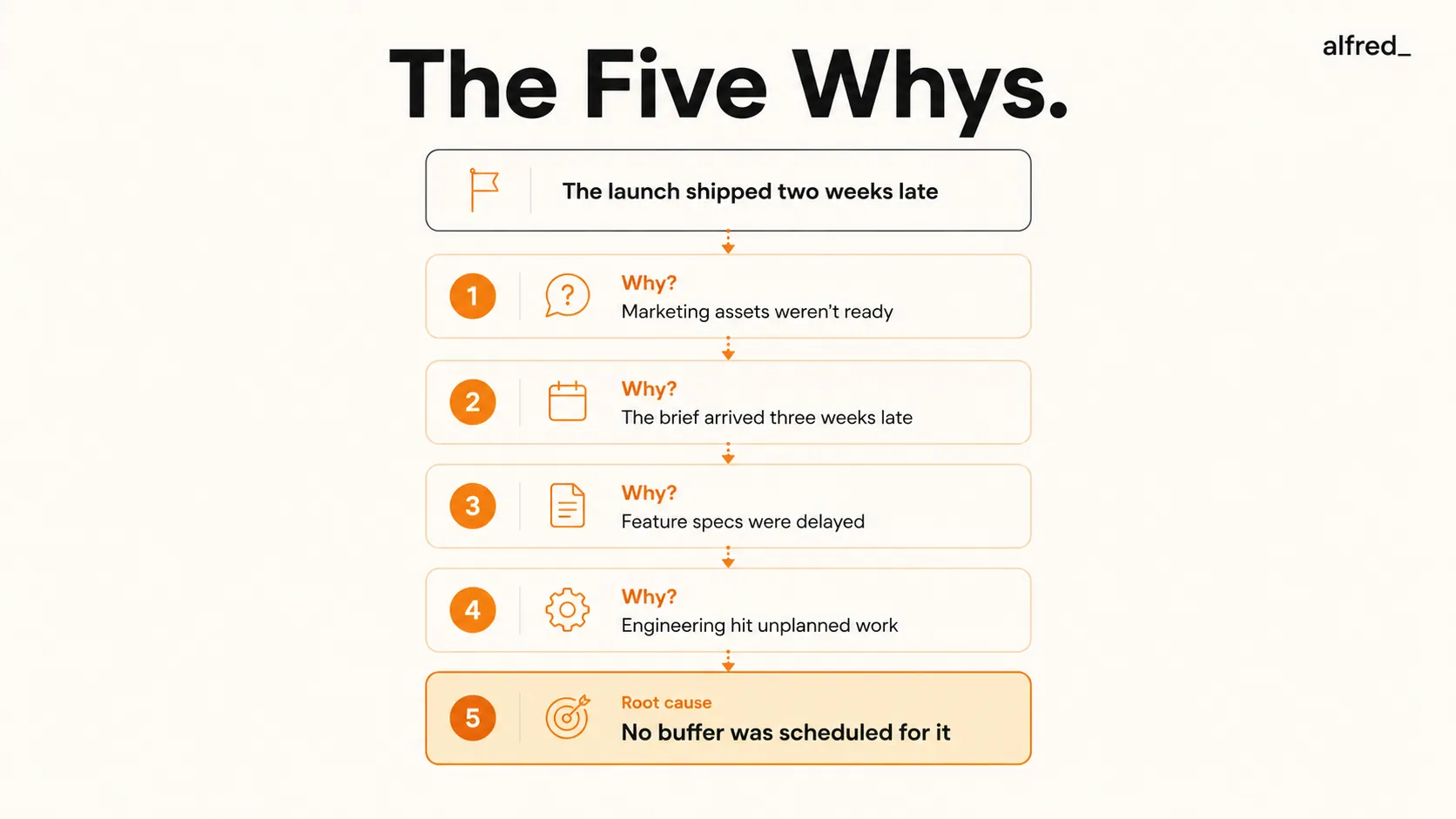
Here is a concrete example. A marketing team missed a product launch deadline by two weeks, and leadership wants to understand what happened.
1. Why was the product launch two weeks late?
Because the marketing assets were not ready by the original deadline.
2. Why were the marketing assets not ready?
Because the copywriter received the product brief three weeks after the project kicked off.
3. Why was the brief delivered three weeks late?
Because the product manager was waiting on finalized feature specifications from the engineering team.
4. Why were the feature specs delayed?
Because the engineering lead was pulled into a critical bug fix for an existing product during the same sprint.
5. Why was there no buffer for unplanned engineering work?
Because the cross-functional launch timeline assumed 100% engineering availability with no slack for reactive work.
Notice what happened across those five questions. The first answer (“marketing assets were not ready”) sounds like a marketing problem. By the fifth answer, the root cause is a planning and resource allocation problem: the launch timeline had no buffer for the unplanned work that is a near-certainty in any engineering organization. The fix is not to tell the copywriter to work faster. The fix is to build slack into cross-functional timelines.
This is the characteristic pattern of a well-executed Five Whys analysis: the root cause is almost never in the same department, function, or category as the visible symptom. If your root cause looks the same as your symptom, you probably have not gone deep enough.
When to Use the Five Whys (and When Not To)
The Five Whys is most effective for problems that are contained enough to trace through a single causal chain. It works well for operational failures (a delivery was late, a system went down, a process produced an error), quality defects, recurring customer complaints, and team-level productivity breakdowns. Its simplicity is its greatest strength: you can run a Five Whys analysis in a 30-minute meeting with a whiteboard.
The method is less appropriate for highly complex problems that have multiple independent root causes. If a product is failing in the market, there may be pricing, positioning, competition, and product quality issues operating simultaneously, and a single causal chain cannot capture that complexity. For these situations, more sophisticated methods like fishbone diagrams (Ishikawa), fault tree analysis, or systems mapping may be more appropriate. The Five Whys assumes a roughly linear causal chain; when causes branch significantly, the method can oversimplify.
The Five Whys is also not a substitute for data. If the answer to any “why” in the chain is uncertain or contested, the analysis needs evidence before proceeding. Guessing at causes and then drilling into those guesses produces confidently wrong root cause identification, which is worse than no analysis at all because it directs corrective action at the wrong target.
94% systemic
W. Edwards Deming estimated that roughly 94% of problems and opportunities for improvement belong to the system (the responsibility of management), and only about 6% to special causes such as individual workers. The Five Whys is designed to reach these systemic causes by pushing past the individual-level explanations that teams naturally gravitate toward.
W. Edwards Deming, Out of the Crisis (1986)Five Mistakes That Break the Five Whys
The Five Whys method is simple enough that it is easy to do badly. These are the failure modes that most frequently undermine the analysis.
Stopping too early. The most common mistake. People ask “why” two or three times, arrive at a plausible-sounding explanation, and stop. The result is a fix aimed at a symptom rather than a root cause. If you find yourself identifying the same category of root cause repeatedly across different Five Whys analyses (“communication breakdown,” “lack of resources,” “timeline was too aggressive”), you are probably stopping before reaching the structural conditions that create those recurring patterns.
Asking leading questions. A leading Five Whys sounds like: “Why did the project fail? Because the team didn’t follow the process. Why didn’t they follow the process? Because they weren’t trained.” This chain has a predetermined conclusion baked into the first question. Genuine Five Whys analysis requires open-ended inquiry where each answer is based on observable facts, not assumptions about who or what is to blame.
Conducting the analysis without the right people in the room. If the people closest to the problem are not participating, the answers to “why” are speculative. A manager guessing at why a frontline process failed will produce different (and less accurate) answers than the people who actually work within that process every day. Toyota’s practice was to go to the gemba, the actual place where work happens, and conduct the analysis with the people doing the work.
Landing on people instead of systems. If your root cause is “John made a mistake” or “the team was careless,” you have not reached a root cause. People make mistakes because systems allow mistakes to happen. A true root cause identifies the process gap, missing check, design flaw, or information deficit that made the human error possible or likely. The question is not “who failed?” but “what about our system made this failure predictable?”
Treating five as a magic number. Five is a useful heuristic, but some problems require three iterations and others require seven. The goal is not to hit exactly five. The goal is to reach a cause that is (a) systemic rather than symptomatic, (b) within your control to change, and (c) specific enough to act on. If you reach that in three questions, stop. If you need seven, keep going.
The Five Whys for Personal Productivity
The technique is not limited to organizational problems. It is equally powerful for individual productivity breakdowns, where most people treat symptoms (feeling overwhelmed, missing deadlines, working late) without investigating the structural causes.
Consider a professional who is chronically behind on their most important work. A typical response is to try harder, wake up earlier, or buy a new productivity app. The Five Whys produces a different kind of answer:
1. Why am I always behind on strategic work?
Because I spend most of my day in meetings and responding to messages.
2. Why do meetings and messages consume most of my day?
Because I accept every meeting invitation and respond to every message in real time.
3. Why do I accept every meeting and respond immediately?
Because I have no explicit criteria for which meetings require my presence and no set times for batching email.
4. Why haven’t I set meeting criteria or email boundaries?
Because I’ve never audited how my time is actually allocated, so the cost of saying yes to everything is invisible.
5. Why is time allocation invisible?
Because I have no system for tracking where my hours go, so reactive work crowds out strategic work without anyone noticing, including me.
The root cause is not a lack of willpower or discipline. It is the absence of a feedback system: without visibility into how time is actually spent, there is no basis for making better allocation decisions. The solution is not motivational; it is structural. Build the feedback loop, and the behavior changes follow naturally.
This is the pattern that repeats across personal productivity issues. “I’m not getting enough sleep” traces back to a missing evening boundary. “I keep missing deadlines” traces back to a task management system that does not surface priorities. “I’m burned out” traces back to a workload that exceeds capacity because nobody, including the person themselves, has measured the gap. The Five Whys consistently redirects attention from willpower to systems.
“Having no problems is the biggest problem of all.”
Taiichi Ohno, architect of the Toyota Production System. Ohno’s point was that problems are information. An organization that cannot see its problems cannot improve. The Five Whys is a tool for making problems visible at the level where they can actually be solved.
Making the Five Whys a Habit
The Five Whys works best as a reflex rather than a formal event. Toyota did not convene special committees to run Five Whys analyses. Frontline workers applied the technique as part of their daily work whenever something went wrong. The same principle applies in knowledge work: when a deadline slips, a customer complains, or a process breaks, the Five Whys should be the default first response rather than a retrospective exercise conducted weeks later when details have faded.
Practical implementation is lightweight. Keep a running document (a notebook, a shared doc, a note in your task manager) where you log Five Whys analyses. Each entry takes five minutes: state the problem, list the five whys, identify the root cause, and write down the corrective action. Over time, this log becomes a map of your recurring systemic issues, and the patterns that emerge across multiple analyses are often more valuable than any single root cause.
Teams that use the Five Whys consistently report a shift in how they think about problems. Instead of asking “who messed up?” the default question becomes “what about our process made this outcome likely?” That shift, from blame to systems thinking, may be the most valuable long-term outcome of adopting the method, more valuable than any individual root cause it uncovers.