


The Core Insight
Eliyahu Goldratt was a physicist before he became a management theorist. The Goal (1984), written as a business novel, presents a manufacturing plant manager named Alex Rogo who has 90 days to turn around a failing factory. The intellectual core of the book is simple and radical: at any given moment, a system has exactly one binding constraint. Everything else is non-constraint.
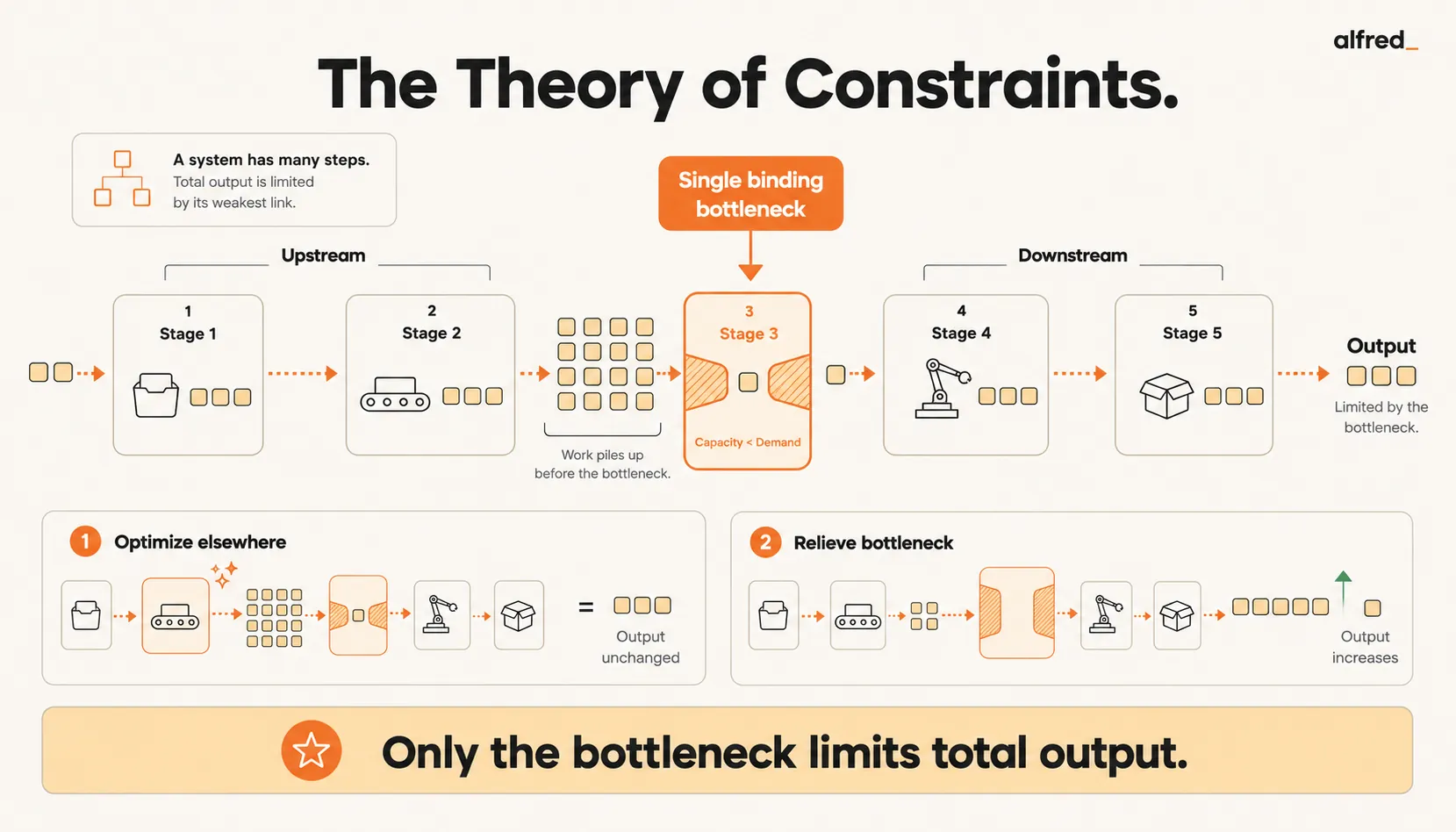
The implication is severe. If you improve the throughput of a non-constraint process, you have improved nothing about the total system’s output. The work just piles up faster at the bottleneck. You have consumed resources, energy, and capital to produce zero gain, and in some cases made things worse by adding inventory pressure upstream of the constraint.
The natural management instinct (identify the weakest-looking part of the organization and improve it) is reliable only if the weakest-looking part and the binding constraint are the same thing. They often are not.
The Five Focusing Steps
Goldratt’s systematic method for applying TOC to any system:
- Identify the constraint. Find the single resource, process, policy, or person that limits total system output. In manufacturing, this is often a physical bottleneck such as a machine or a workforce capacity limit. In knowledge work, it is often invisible and political: an approval gate, a single executive’s decision bandwidth, or a standing meeting structure that serializes work that could run in parallel.
- Exploit the constraint. Before adding resources, squeeze maximum output from the existing constraint. Stop wasting the constraint’s capacity on anything that doesn’t contribute to system output. If the bottleneck is a specific person’s time, audit what they are currently doing. Every non-critical meeting, email triage, or administrative task they perform is throughput lost.
- Subordinate everything else to the constraint. Every non-constraint process should be structured to keep the constraint fully fed and never idle. This is counterintuitive: it means intentionally allowing non-constraint resources to run below maximum utilization in order to ensure the constraint never waits.
- Elevate the constraint. If exploitation and subordination are not sufficient, invest in expanding the constraint’s capacity: hire, automate, restructure, or acquire.
- Return to step 1. Fixing one constraint reveals the next. This is not failure; it is the system working correctly.
The Knowledge Work Problem
TOC was developed in manufacturing, where constraints are visible. The challenge for knowledge work is that constraints are often hidden by local productivity metrics that mask system-level dysfunction.
A common scenario: an executive team of six people, all operating at high utilization. Everyone appears busy and productive. Work is getting done. But all major decisions wait on one person, typically the CEO or a key functional leader, whose calendar is the actual system constraint. Their approval is required before each initiative moves to the next stage.
Applying TOC to this situation looks unusual: the most valuable action is not optimizing the six high-utilization team members. It is auditing every hour in the decision-maker’s week and removing everything that is not critical throughput. This is the “exploit the constraint” step: protect the bottleneck’s capacity before doing anything else.
Other common knowledge work constraints: code review bandwidth in software teams, legal or compliance review for any client-facing work, a standing weekly meeting that serializes decisions that could otherwise happen asynchronously.
The Productivity Trap
Goldratt’s insight about local optimization versus system optimization cuts against a deep organizational tendency. Managers are rewarded for the performance of their own team or function, and improving that performance is what they know how to do. TOC says this is often counterproductive if the improved function is not the constraint.
Manufacturing implementations of TOC have produced throughput improvements of 40–100% without adding resources, by focusing exclusively on the constraint rather than optimizing all parts equally. The same principle applies to knowledge work: the question is never “where can I improve?” but “where is the constraint, and how do I address it first?”