


Most teams finish a project, feel vaguely that some things went well and some did not, and move on. The lesson, if there was one, evaporates by the next sprint. The same mistake shows up again a quarter later wearing slightly different clothes. The US Army faced a higher-stakes version of this problem and built a fix so durable it became the model for nearly every retrospective and post-mortem in use today: the After Action Review, four questions asked after every significant event. Here is where it came from, the exact structure, and the one failure mode that quietly turns it into a paperwork ritual.
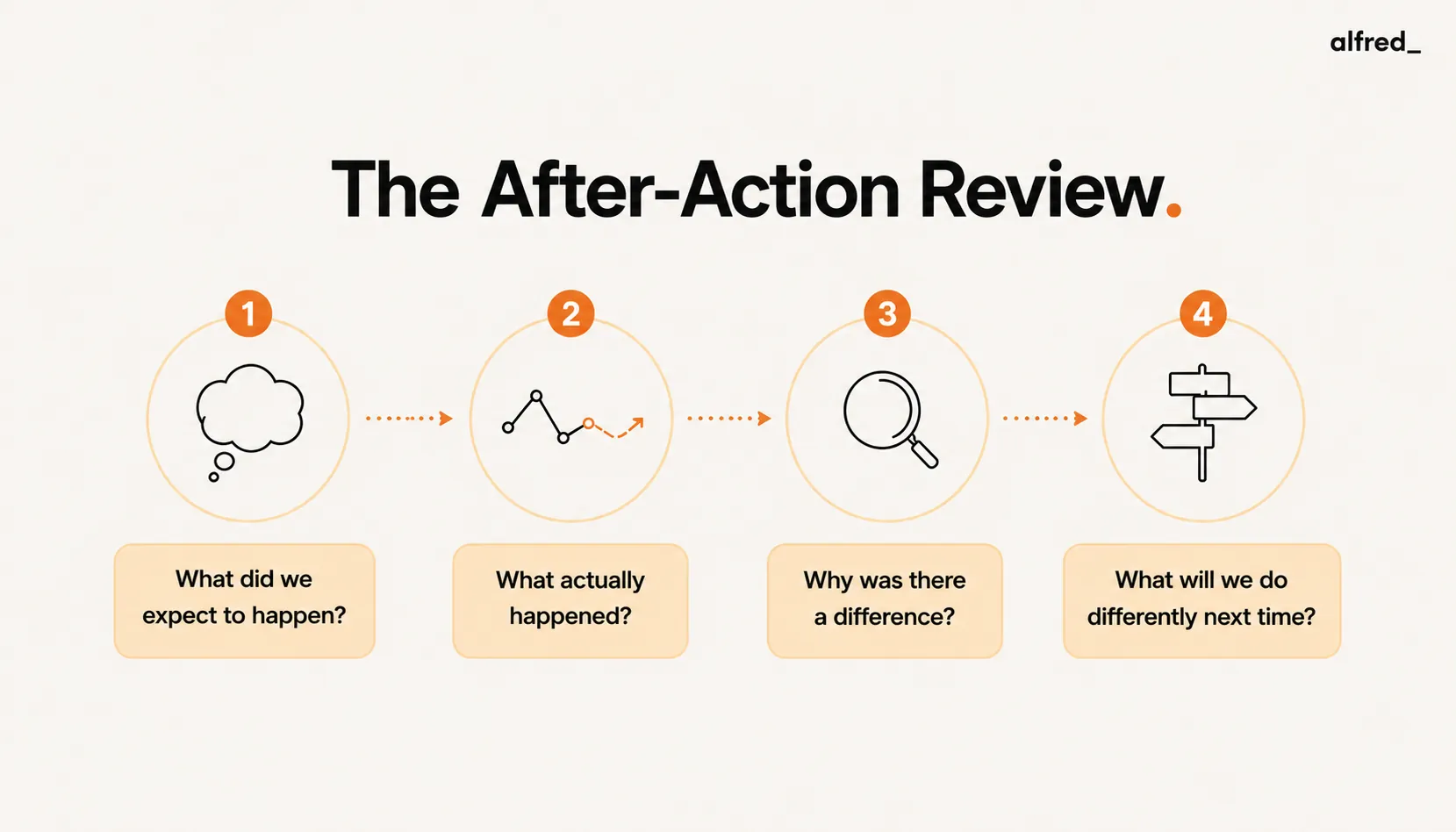
Origins: From Yom Kippur to Fort Irwin
The US Army developed the After Action Review in response to performance analysis conducted after the 1973 Yom Kippur War between Israel and the Arab coalition. Analysis of US Army training and readiness identified significant gaps between how units planned to perform and how they actually performed under combat conditions. The Army began developing systematic methods for closing this gap.
The National Training Center at Fort Irwin, California was activated in October 1980. Its first full training rotations began in 1981–1982. The NTC provided a realistic training environment where units rotated through exercises against a permanent opposing force (OPFOR), with the specific goal of surfacing performance gaps that could be addressed through the AAR process. The NTC made the AAR a central feature of Army training doctrine, which was later formalized in training manuals including FM 7-0 and FM 7-1.
Four questions
The AAR structure is four questions applied after every significant event: (1) What was supposed to happen? (2) What actually happened? (3) Why was there a difference? (4) What should we sustain or improve? The simplicity is intentional, because complex formats would reduce usage frequency.
US Army After Action Review, FM 7-0 and FM 7-1. National Training Center at Fort Irwin, California.The Four-Question Structure
The AAR structure is deliberately simple: four questions applied after every significant event, by the participants themselves rather than by outside observers.
- What was supposed to happen? This question surfaces the intent: the plan, the expected outcome, the standard being measured against. It is necessary because teams often have different understandings of what success looked like, and the gap between actual and intended cannot be examined without a shared reference.
- What actually happened? A factual account of what occurred: not evaluative, not attributive, but descriptive. The Army emphasizes that this phase should be treated as evidence collection: what were the observable events, in what sequence, with what consequences? Premature evaluation at this stage contaminates the factual account.
- Why was there a difference? Causal analysis: what factors explain the gap between intended and actual? This is where root causes are identified, not just symptoms. The Five Whys technique is often used here to prevent stopping at surface-level explanations.
- What should we sustain or improve? Action items in two categories: what worked that should be explicitly repeated, and what didn’t work that requires change. Both are important, since sustain items are as valuable as improvement items, because they document what to replicate.
A critical feature of the Army AAR is rank irrelevance: the review is conducted by all participants, and any participant can identify what went wrong regardless of who made the relevant decision. The review does not protect decisions based on who made them. This feature requires psychological safety to function. It works in the Army because it is structurally required, not optional.
Professional Applications
- Project post-mortems and retrospectives. The AAR format is the model for agile retrospectives and project post-mortems. The four-question structure focuses the review on specific, actionable gaps rather than general impressions of how the project went. The most common failure mode of organizational post-mortems, attributing outcomes to individual performance rather than systemic factors, is countered by the question structure, which drives toward causal factors rather than blame attribution.
- Individual performance reviews. The AAR structure applies to individual performance conversations: What was the plan? What happened? Why the difference? What changes? This framing removes the evaluative loading from performance discussions by treating them as evidence analysis rather than judgment. It also applies to self-reflection: a brief personal AAR after each significant presentation, meeting, or project completion builds a systematic learning practice from experience.
- Meeting debriefs. Brief AARs after important meetings (particularly those with complex stakeholders or significant decisions) close the feedback loop that most organizations leave open. Two minutes of structured reflection (What was intended? What happened? Why the gap? What changes next time?) converts a completed meeting from a one-time event into a learning data point.
Closing the Loop the AAR Leaves Open
Every version of the AAR fails the same way. The four questions get asked, the gap gets named, the “what to change” items get written down, and then nothing tracks them. The next event arrives and the same lesson has to be relearned. The review was never the hard part. Following through on it is.
This is the gap alfred_ is built to close. It reads the threads and meetings the action items live in, pulls out the commitments and follow-ups, and turns them into tracked tasks instead of notes that die in a doc. When the next sales call or project kickoff comes around, the changes you decided on last time are in front of you, not buried in a forgotten retrospective file. The AAR gives you the lesson. alfred_ makes sure it actually changes what happens next.