


The Research
Hengchen Dai, Katherine Milkman, and Jason Riis studied when people are most likely to pursue goal-directed behavior, specifically whether the timing relative to temporal landmarks predicts aspirational action. Their 2014 paper, “The Fresh Start Effect: Temporal Landmarks Motivate Aspirational Behavior,” was published in Management Science.
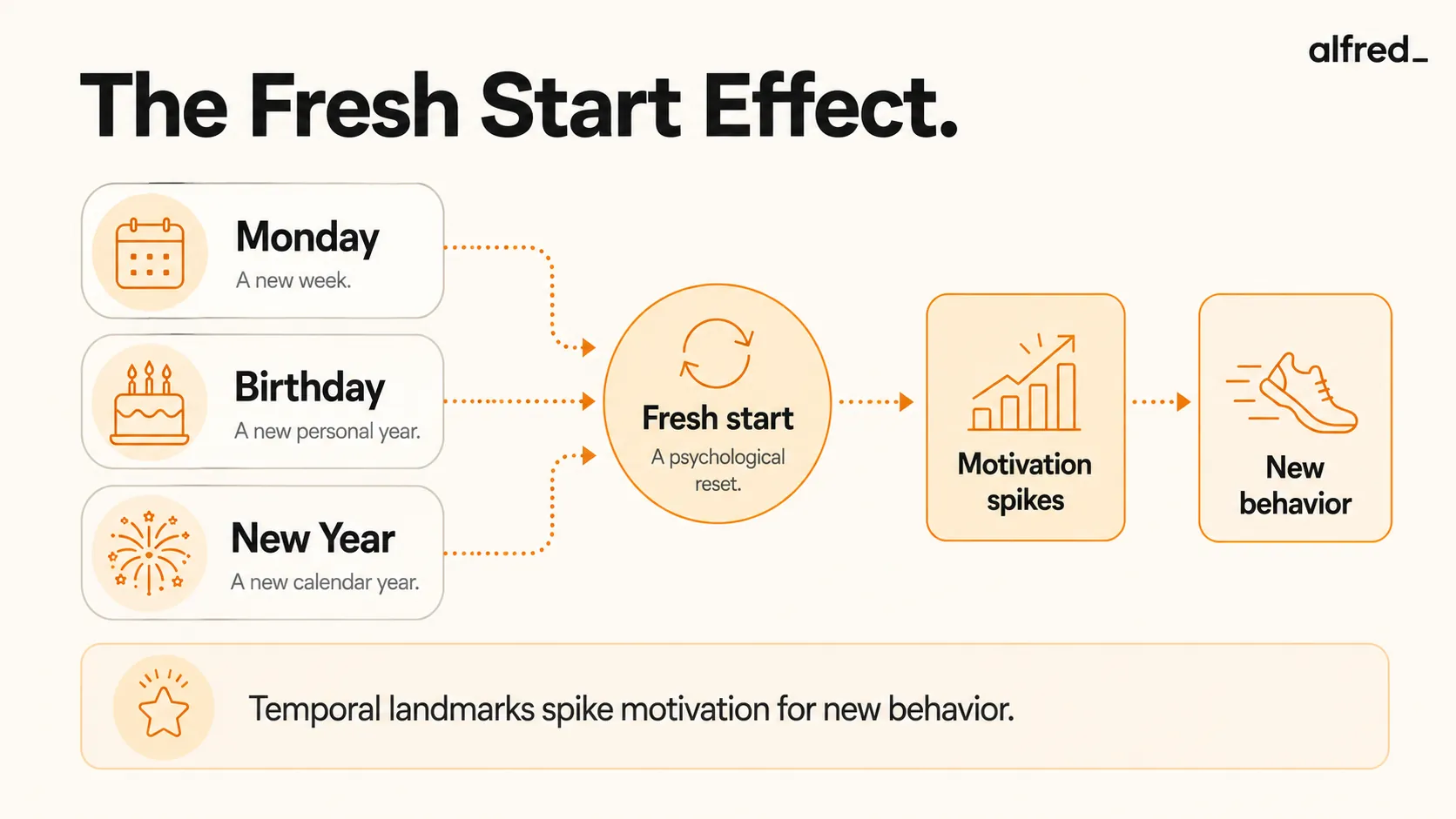
The evidence they assembled across multiple studies and data sources:
- Google searches for “diet” spike on January 1st, the first of every month, and on Mondays, not randomly distributed through the week or year.
- Gym visit rates increase measurably at temporal landmarks: New Year’s Day, the start of new weeks, birthdays, and post-holiday returns.
- Commitment contract sign-ups (people voluntarily committing to goals with financial stakes) cluster at temporal landmarks, especially the start of the week and the start of the month.
- The patterns hold for both conventional landmarks (New Year’s, Monday) and personally significant ones (birthdays, work anniversaries).
The Mechanism: Psychological Discontinuity
Temporal landmarks work by creating a psychological rupture: a felt separation between “past me” and “present me.” This rupture has two effects that reinforce each other:
Reduced identification with past failures
When a person identifies a temporal landmark, their sense of self shifts. Past failures (missed workouts, ignored priorities, broken habits) are mentally assigned to the “old chapter.” The landmark creates a perceptual boundary that makes it psychologically easier to believe the pattern can be different going forward. This is not delusional; it is a real reduction in the weight of past behavior on current self-perception.
Activation of big-picture thinking
Temporal landmarks also shift cognitive mode. At the start of a new period, people think more abstractly about who they want to be and what they want to accomplish, rather than concretely about the immediate task in front of them. This big-picture mode is associated with higher goal commitment and better alignment between stated priorities and actual behavior.
The Most Important Finding: Any Landmark Works
The conventional wisdom would predict that only socially significant landmarks (New Year’s Day, birthdays) produce the effect. The research shows that any personally meaningful temporal marker triggers it, including ones that the person assigns significance themselves.
This means the Fresh Start Effect is not a passive phenomenon you wait for. It is a tool you can deploy deliberately. The first Monday of a new quarter, the first day after a major project wraps, the day after returning from a conference, the start of a new fiscal year that your organization treats as meaningful: all of these function as legitimate fresh starts if you engage with them as such.
The practical implication: if you want to launch a new habit, reset a relationship with a key person, or start a difficult initiative, timing the launch to coincide with a personally meaningful temporal landmark is a legitimate behavioral strategy, not superstition.
The Limits
The Fresh Start Effect generates motivation and commitment at the moment of the landmark. It does not guarantee follow-through, which requires structural support (implementation intentions, system design, accountability). Research consistently shows that New Year’s resolutions, for example, fail at high rates not because the motivation at January 1st was fake but because no structural support was built to sustain behavior past the initial surge.
The research-backed combination: use a temporal landmark to initiate a behavioral change, and pair the launch with concrete implementation intentions (if-then plans) that specify exactly when, where, and how the new behavior will occur. The landmark provides the motivational uplift to commit; the implementation intentions provide the mechanism to follow through.