


Wegner’s Original Concept
Daniel Wegner introduced transactive memory systems in “Transactive Memory: A Contemporary Analysis of the Group Mind,” a chapter in Mullen and Goethals’s edited volume Theories of Group Behavior (Springer, 1987). The concept built on the observation that intimate relationships, particularly long-term couples, function as shared memory systems. Each person stores information in domains they are responsible for, and both can access information from domains their partner manages by simply asking.
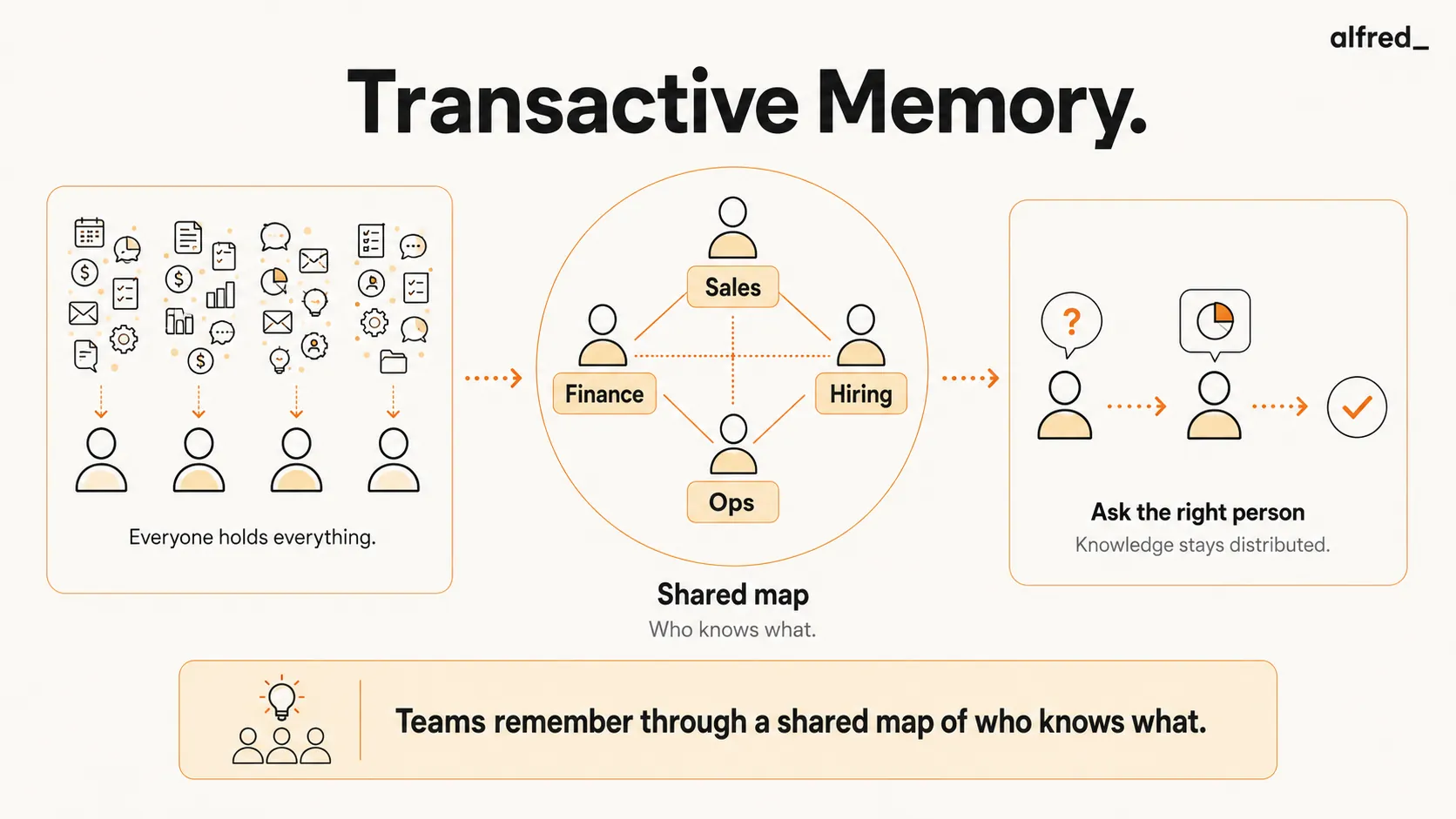
The extension to organizational teams is direct: in any team that has worked together long enough, members develop differentiated knowledge domains, where one person is the technical expert, another manages client relationships, and a third understands the regulatory landscape, along with a shared meta-cognitive awareness of who holds what knowledge. This shared awareness allows the team to function as a cognitive system significantly more capable than any individual member.
Wegner’s insight was that the important unit of memory in groups is not what any individual knows, but the distributed system of who knows what and how knowledge is accessed when needed. A team that doesn’t know what its members know is not extracting the value of their collective expertise, even if that expertise is objectively present.
Lewis’s Measurement and Findings
The first validated measurement instrument for transactive memory systems in organizational teams was developed by Kyle Lewis in “Measuring Transactive Memory Systems in the Field: Scale Development and Validation,” published in the Journal of Applied Psychology in 2003 (Vol. 88, No. 4, pp. 587–604). Lewis identified three distinct dimensions of TMS:
- Specialization. The degree to which team members have differentiated, non-overlapping knowledge domains. A team where everyone knows everything is low in specialization; a team where each member is the recognized expert in a distinct domain is high in specialization. High specialization means the team’s total knowledge exceeds what any individual holds.
- Credibility. The degree to which team members trust each other’s expertise in their respective domains. Specialization without credibility is inert. If team members doubt each other’s expertise, they will fail to consult each other efficiently or will duplicate effort to verify what they’re told. Credibility is what makes specialization actionable.
- Coordination. The degree to which team members communicate effectively and coordinate their knowledge contributions without interference, duplication, or loss. High coordination means the team accesses the right expertise at the right moment with low friction; poor coordination means relevant expertise is slow to surface or duplicated.
Lewis then applied this measurement framework in a longitudinal study published in Management Science in 2004 (Vol. 50, pp. 1519–1533). Teams with stronger TMS, across all three dimensions, performed significantly better than teams with weaker TMS, even when controlling for individual member ability and prior experience.
Professional Implications
- Onboarding new team members. When a team gains a new member, the TMS partially resets. The new member must develop awareness of who knows what, build credibility with existing members, and learn the coordination norms. Onboarding processes that focus only on task knowledge miss the equally important meta-cognitive layer: introducing new members to who on the team holds which expertise domains, and vice versa.
- Team turnover costs. TMS research explains why high team turnover is more costly than individual replacement costs suggest. When an experienced member leaves, they take not just their knowledge but their function in the transactive system. Their knowledge domain becomes unmanaged, and the team’s shared awareness of who knows what becomes partially obsolete. The full cost of turnover includes the time needed to rebuild the three TMS dimensions with any replacement.
- Remote and distributed teams. The credibility and coordination dimensions of TMS are harder to build in distributed teams, because the informal interactions that build awareness of others’ expertise, such as observing each other in meetings, informal hallway conversations, and collaborative problem-solving, are reduced. Explicit knowledge-sharing structures, deliberate introductions of expertise during onboarding, and recorded work artifacts that make each member’s knowledge domain visible substitute partly for the informal TMS-building that co-location enables.