


The Model
Joseph Luft and Harrington Ingham developed the framework at the Western Training Laboratory at the University of California, Los Angeles in 1955, originally presented in the Proceedings of the Western Training Laboratory in Group Development. The name is a portmanteau of their first names. Luft expanded the model in Of Human Interaction (1969).
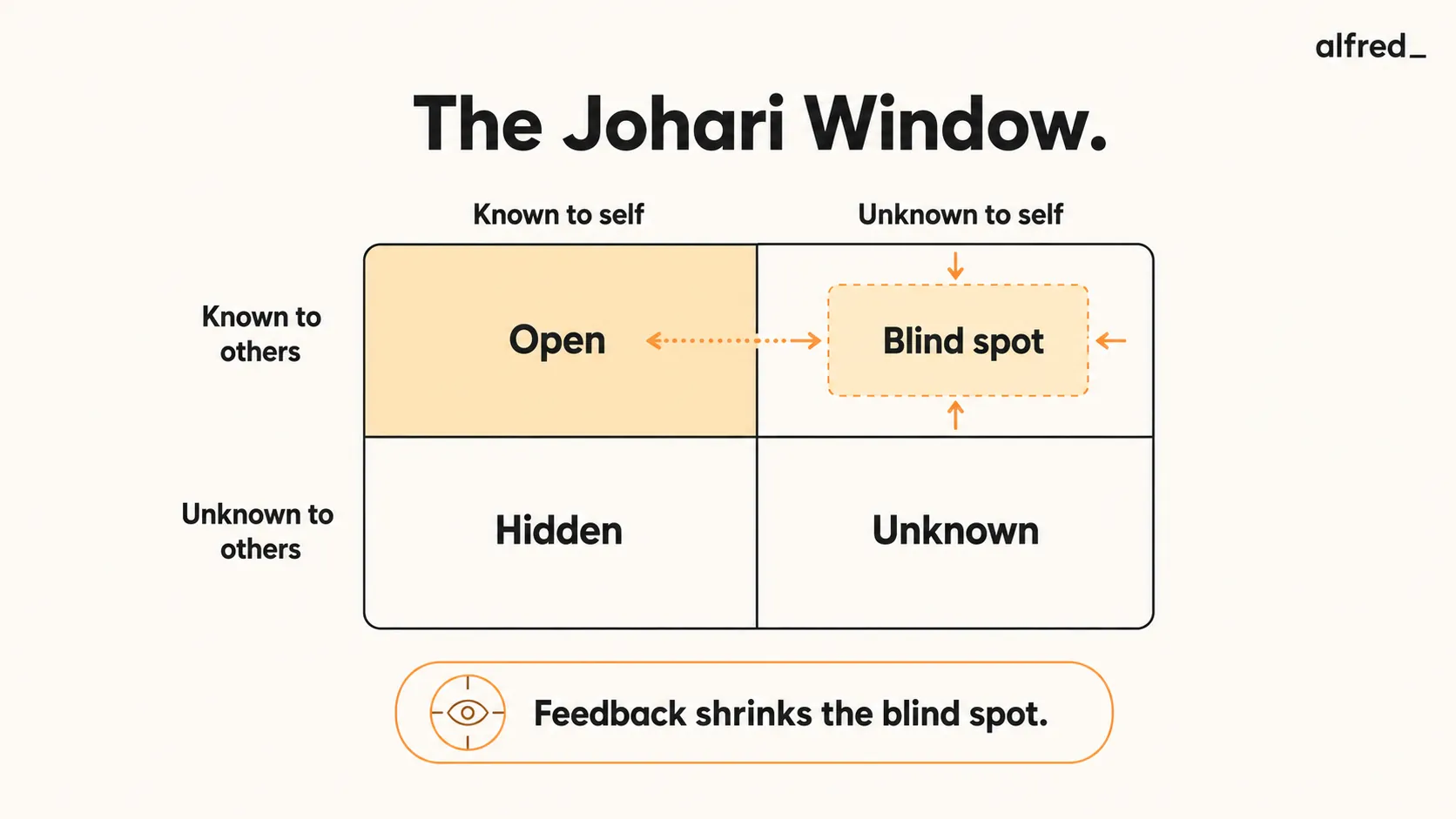
The framework maps self-knowledge and others’ knowledge onto a 2×2 matrix, producing four quadrants:
- Open (Arena). Known to self and known to others. The shared space of acknowledged strengths, behaviors, and characteristics. Expanding this quadrant is the goal of effective communication and trust-building: the more that is in the Open quadrant, the more efficiently a team can operate.
- Blind Spot. Unknown to self, known to others. The behaviors you exhibit, the impact you have, the patterns colleagues have learned to expect, that you have no awareness of. This is the most professionally consequential quadrant and the hardest to address, because the definition of a blind spot is that normal self-reflection cannot reveal it.
- Facade (Hidden). Known to self, hidden from others. Information, feelings, or behaviors deliberately or habitually not disclosed. Some facade is appropriate; excessive facade creates distance and limits the trust necessary for collaboration.
- Unknown. Neither self nor others have awareness. Latent capacities, undiscovered behaviors, potential that hasn’t been tested. Some of this quadrant is accessible through new experiences and challenges.
Important caveat: the Johari Window is a conceptual framework, not an empirically tested theory with randomized controlled trials. Its value is as a vocabulary and diagnostic structure, not as a predictive model with validated effect sizes.
The Research on Self-Awareness Gaps
While the Johari Window itself is a framework, the underlying phenomenon (that self-assessments of professional behavior diverge systematically from peer assessments) is well-documented.
Atwater and Yammarino (1992) in Personnel Psychology found that self-ratings and peer ratings of leadership behavior diverge consistently and in predictable directions. High performers tend to be modestly self-critical (self-rating slightly below peer rating). Overestimators, those whose self-ratings significantly exceed peer ratings, show lower performance outcomes and are more likely to derail at senior levels.
The 360-degree feedback industry exists precisely because blind spots are the norm, not the exception. Research consistently shows that without structured feedback mechanisms, executives develop increasingly divergent self-assessments, both because they receive less candid feedback as they become more senior and because their power position creates social pressure toward agreeable rather than accurate responses from colleagues.
Shrinking the Blind Spot
The Johari Window’s practical prescription for the Blind Spot is feedback: asking for and receiving information from others about how your behavior is perceived and what impact it has. Two conditions make this more likely to actually produce useful information:
- Psychological safety in the feedback relationship. People provide honest blind-spot information only when they believe the recipient can receive it without defensiveness or retaliation. Asking for feedback without having created a relationship of trust first produces polished, safe, and useless responses.
- Specificity of request. “How am I doing?” produces generic responses. “When I present to the team, what do you notice about how others respond?” is specific enough to elicit behavioral observation rather than general evaluation. Specific requests enable the provider to give behavioral rather than character-level feedback, which is both more accurate and more actionable.
Pattern-based data, across multiple interactions and from multiple sources, is more reliable than any single feedback conversation. Behavioral patterns visible in communication logs, response time distributions, and recurring deferrals can surface blind spots that individual conversations miss.