

The Foundational Research
John Darley and Bibb Latané conducted their classic bystander intervention experiments in 1968, published in the Journal of Personality and Social Psychology (8(4), 377–383). The experiments were motivated by the 1964 Kitty Genovese case, in which 38 apparent witnesses to an attack were reported to have not intervened or called police.
85% vs 31%
participants who intervened during a staged medical emergency over an intercom: 85% of solo observers acted; only 31% when participants believed 4 others were also listening. Adding 4 bystanders reduced intervention by 54 percentage points.
Darley & Latané (1968), Journal of Personality and Social Psychology, 8(4)Participants sat in individual booths and participated in what they believed was a group discussion about college life. One participant (a confederate) began describing having seizures and then fell silent. Participants who believed they were the only listener intervened 85% of the time. Participants who believed 4 other people were also listening intervened only 31% of the time.
The reduction was not due to confusion about who to call or how to help. The path to intervention was identical in all conditions. The reduction was purely due to the psychological effect of believing others were present.
Two Mechanisms
Darley and Latané identified two distinct mechanisms producing the bystander effect:
- Pluralistic ignorance. When the situation is ambiguous, people look to others for behavioral cues. If no one is acting, each person interprets the group’s inaction as evidence that the situation doesn’t require action, even when each individual privately feels the situation is serious. The group signal of inaction normalizes non-response.
- Responsibility diffusion. When multiple people are present, the responsibility for acting is perceived as shared. Each person’s felt obligation is inversely related to group size: with 5 bystanders, each feels they bear approximately one-fifth of the total responsibility. At sufficient group size, individual felt responsibility drops below the threshold that motivates action.
The Professional Analog
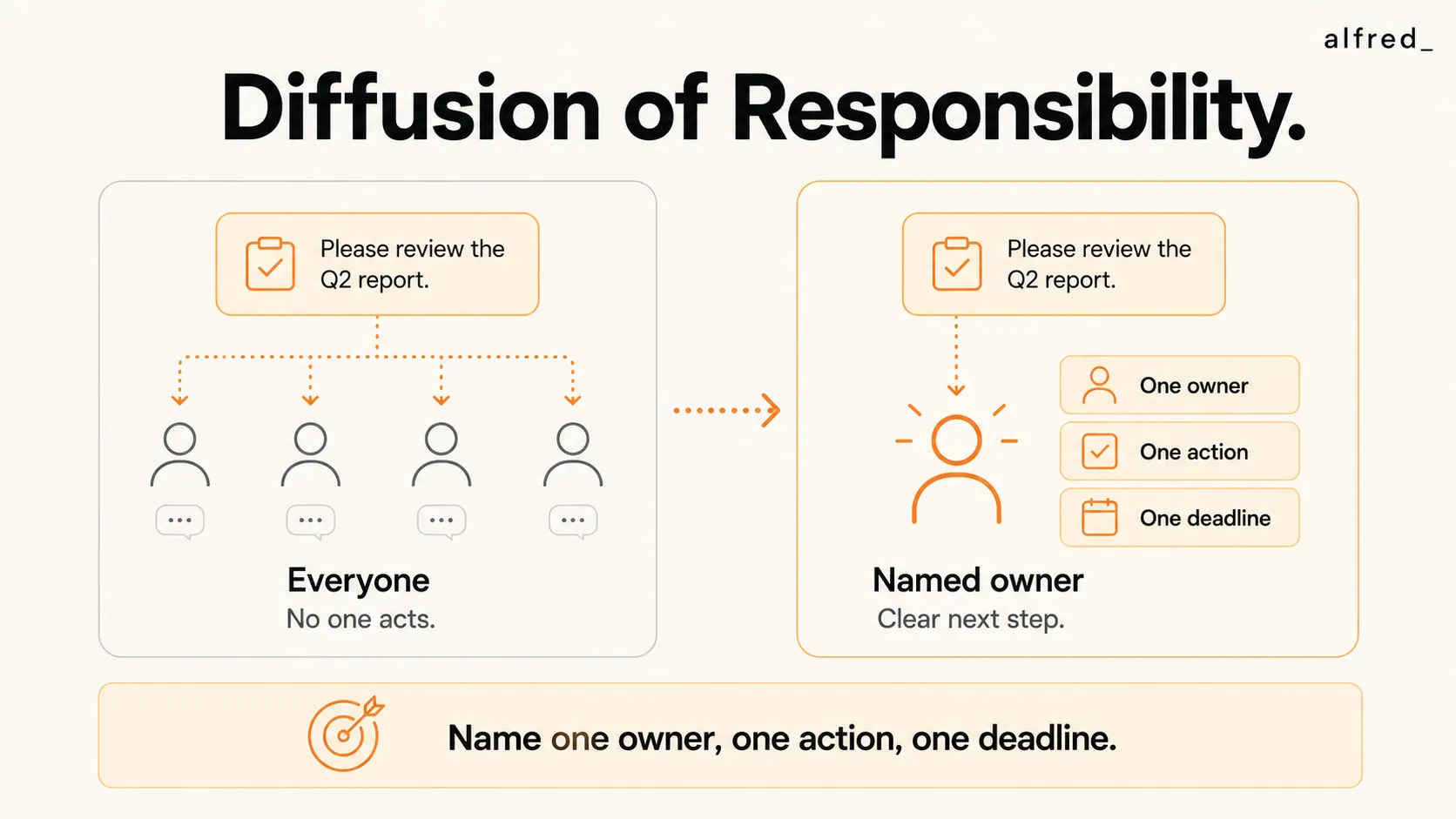
The reply-all email chain with 15 recipients is structurally identical to the bystander experiment: a situation requiring action, with responsibility distributed across a group, where each individual’s felt obligation is diffused by the presence of others.
Pluralistic ignorance operates in the email context: when no one has responded, the silence is interpreted as evidence that no response is urgently required, which inhibits individual response, which deepens the silence. Each recipient updates their assessment based on the group inaction, even though each person’s inaction is itself based on observing the same pattern.
The fix is mechanistically well-established: eliminate the diffusion. Responsibility is not diffused when it is explicitly named. The same research that documented the bystander effect also showed that direct address eliminates it. “You in the blue jacket, call 911” produces immediate action from an individual who was standing with a group of inert bystanders seconds earlier. The mechanism is the same in professional contexts.
The Structural Fix
Three elements eliminate diffusion in group communication:
- Name one person. “Marcus, can you handle this?” is exponentially more effective than “Team, can someone handle this?” The named individual has full, undiffused responsibility. The unnamed group has diffused, shared responsibility that no individual will reliably convert into action.
- Specify one action. Vague requests diffuse responsibility along a second dimension: ambiguity about what acting means. “Please address this” requires each recipient to first determine what addressing it entails, introducing a second decision that provides an additional exit ramp from action.
- Set one deadline. Without a deadline, the urgency of the request decays with each passing day of the group’s inaction, which the pluralistic ignorance mechanism interprets as evidence that the request was not urgent.