

Psychology

Adams' Equity Theory:
The Psychology Behind Quiet Quitting

Employees don't evaluate their compensation in isolation. They compare it to what others receive for comparable effort. When that comparison produces a perceived imbalance, regardless of whether their compensation is objectively adequate, specific and predictable behavioral responses follow.

Feb 19, 20266 min read
Quick Answer

What is equity theory in psychology?

  • Workers compare their Input/Outcome ratio (effort, skills, loyalty vs. pay, recognition, autonomy) to a reference other
  • When ratios are perceived as unequal, inequity tension motivates behavior to restore balance
  • Responses to underpayment inequity: reduce effort (quiet quitting), demand more, change comparison, or leave
  • Underpayment produces anger, which is more behaviorally consequential than overpayment guilt

Adams published equity theory in 1963 in the Journal of Abnormal and Social Psychology and expanded it in 1965. The behavioral predictions have robust multi-study support.

The Core Model

Adams published the equity theory framework in 1963 in the Journal of Abnormal and Social Psychology ("Toward an understanding of inequity") and expanded it in 1965 in Advances in Experimental Social Psychology ("Inequity in social exchange").

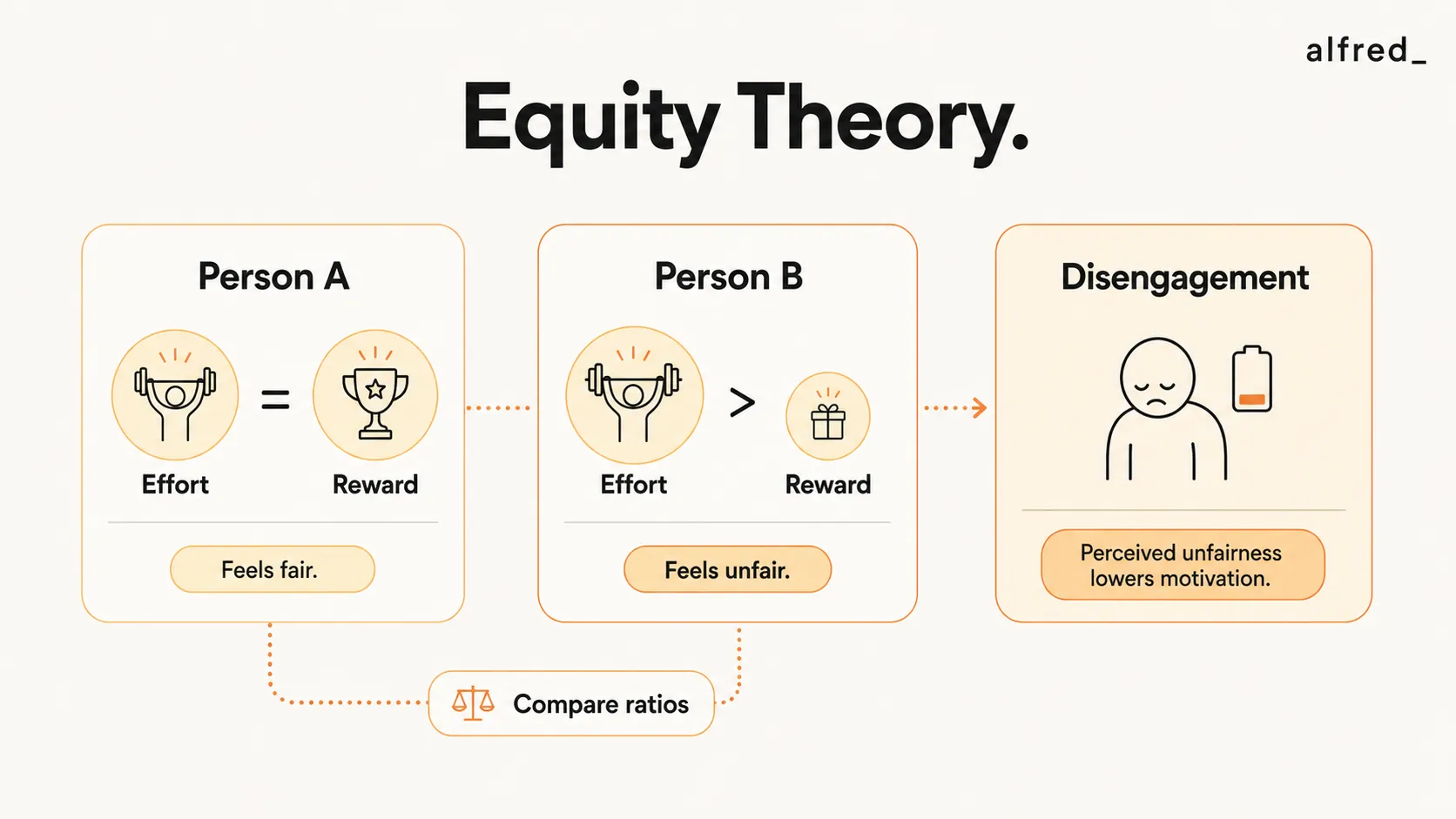
The central proposition: workers compare their Input/Outcome ratio to a reference other (a peer, a predecessor, an industry benchmark). Inputs include everything the worker brings: effort, skills, experience, loyalty, and tenure. Outcomes include everything received: compensation, recognition, autonomy, status, and interesting work.

When the ratios are perceived as equal, the worker experiences equity and continues current behavior. When the ratios are perceived as unequal, whether the worker is getting more or less than the reference, inequity produces tension that motivates behavior to restore balance.

Responses to Inequity

Adams identified six possible responses to perceived inequity, and research has confirmed that workers move through these in roughly predictable order:

  • Reduce inputs. Work less hard. The most common initial response to perceived underpayment. The worker recalibrates effort to match what the perceived outcome warrants. This is exactly what "quiet quitting" describes: reducing effort to match perceived outcomes rather than the job description.
  • Increase outcomes. Ask for a raise, take resources, claim credit, reduce unpaid contributions. Workers who believe they're underpaid may begin charging for previously free advice, reducing pro bono effort, or negotiating more aggressively on scope.
  • Cognitively distort inputs or outcomes. Decide that the reference other actually works harder than previously thought, or that one's own outcomes include non-monetary benefits not previously counted. This is rationalization, a psychological resolution that doesn't require any behavioral change.
  • Change the reference other. Switch comparison to someone who makes the current situation look equitable. This is a pure cognitive adjustment.
  • Leave the field. Change jobs, quit, transfer. When inequity is severe and the other responses have failed or are unavailable, departure is the final equity-restoration mechanism.

Try alfred_

See what this looks like in practice

alfred_ applies these principles automatically — triaging your inbox, drafting replies, extracting tasks, and delivering a Daily Brief every morning. Theory becomes system. $24.99/month. 30-day free trial.

Try alfred_ free

Underpayment vs. Overpayment

Adams predicted that overpayment inequity (receiving more than the reference other for equal inputs) would also produce tension and behavioral adjustment. The empirical research supports this but with an important asymmetry: underpayment produces anger, which is a more powerful behavioral motivator than overpayment guilt. Workers who feel underpaid take action; workers who feel overpaid more often engage in cognitive distortion (deciding they actually contribute more than the reference other) rather than sustained behavioral change.

The practical implication: the damage from perceived underpayment, in effort, engagement, and retention, is substantially larger than the temporary productivity boost that may follow perceived overpayment. Managing pay equity is not just a fairness question; it is a performance question.

What Workers Actually Compare

"Inputs" and "outcomes" are broader than most managers account for. Inputs include not just effort and skill but perceived sacrifice, loyalty, tenure, and social standing contributed to the organization. Outcomes include not just salary but autonomy, interesting assignments, visibility, recognition, and treatment quality.

This matters because a worker may feel underpaid even when salary is market-competitive, if they perceive that a colleague with lower tenure is assigned to more interesting projects. The compensation comparison is one data point in a much wider equity calculation.

Frequently Asked Questions

If an employee is paid market rate, can they still experience equity-driven disengagement?

Yes, and this is one of the most common management misdiagnoses. Equity perception is relative, not absolute. A market-rate salary doesn't prevent disengagement if the worker compares their outcome/input ratio to a visible peer who appears to receive more interesting assignments, more recognition, more autonomy, or more flexible treatment for similar effort. The inequity is real in its behavioral consequences even when it is not real by any objective external benchmark. This is why compensation alone cannot solve engagement problems: engagement is driven by the full input/output ratio, not just the monetary outcome.

How does equity theory apply to solo professionals and founders, not just employees?

Solo professionals and founders make equity comparisons too, against peers in their field, against clients they observe, against their own prior role. The most common manifestation: when administrative overhead (input) rises without commensurate increase in billable output (outcome), the input/outcome ratio deteriorates and produces the same disengagement responses: reduced effort on non-billable work, reluctance to take on additional clients, cognitive rationalization that the work isn't worth it. This is why reducing administrative overhead isn't just a time question; it directly restores the input/output ratio that sustains engagement.

What is the practical managerial response when equity theory predicts disengagement?

The diagnostic is to understand which specific comparison is driving the perception of inequity and whether the inputs and outcomes in that comparison are accurately perceived. Often they are not: the reference other's full input load is not visible, and the manager's full outcome offer (including non-monetary elements) is not communicated. Making inputs and outcomes more transparent, through clear criteria for assignments, recognition, and development opportunities, reduces the information asymmetry that feeds inequity misperception. Where genuine inequity exists, the only real solution is restoring the ratio: through outcome increases, or honest conversations about input expectations.

Try alfred_

Restore the input/output balance.

When administrative overhead consumes more professional time than it should, raising input without increasing output, the equity calculation degrades. alfred_ reduces email and coordination overhead, directly improving the ratio that sustains professional engagement. $24.99/month.

Try alfred_ Free