


The Rope-Pulling Experiments
Maximilien Ringelmann conducted rope-pulling experiments between 1882 and 1887, with results published in 1913. The setup was simple: measure the force individuals could exert pulling a rope, then measure the force produced when pulling in groups.
49% efficiency
8-person teams achieved only 49% of summed individual maximums in Ringelmann's rope-pulling experiments; 2-person teams achieved 93% and 3-person teams 85%, showing progressive degradation with group size
Ringelmann (1913)The efficiency decrease was progressive and substantial. Two-person teams: 93% of summed individual capacity. Three-person teams: 85%. Eight-person teams: 49%. As group size increased, each additional person contributed progressively less than their individual capacity, and total group output grew more slowly than adding members would predict.
Two mechanisms could explain this: coordination loss (people get in each other’s way, effort is not synchronized) and motivational loss (people simply try less hard). Distinguishing these required a more sophisticated experimental design.
The Motivational Proof
Latané, Williams, and Harkins (1979) published “Many Hands Make Light the Work: The Causes and Consequences of Social Loafing” in the Journal of Personality and Social Psychology (37(6), 822–832). Their key methodological innovation: they used blindfolds and headphones to separate the psychological perception of group performance from the actual performance conditions.
Participants were asked to cheer or clap as loudly as possible. In the critical condition, subjects wore headphones masking external sound and were told they were cheering alongside others, though they were actually performing alone. In another condition, they believed they were alone but were actually in groups.
Result: subjects who believed they were in groups exerted less effort, regardless of whether they actually were. Subjects who believed they were alone exerted more effort, regardless of whether they actually were. The effect was purely motivational: the perceived presence of others reduced individual effort independently of any actual coordination or interference.
What Eliminates Social Loafing
Research on social loafing remediation has identified three conditions that reliably eliminate or substantially reduce the effect:
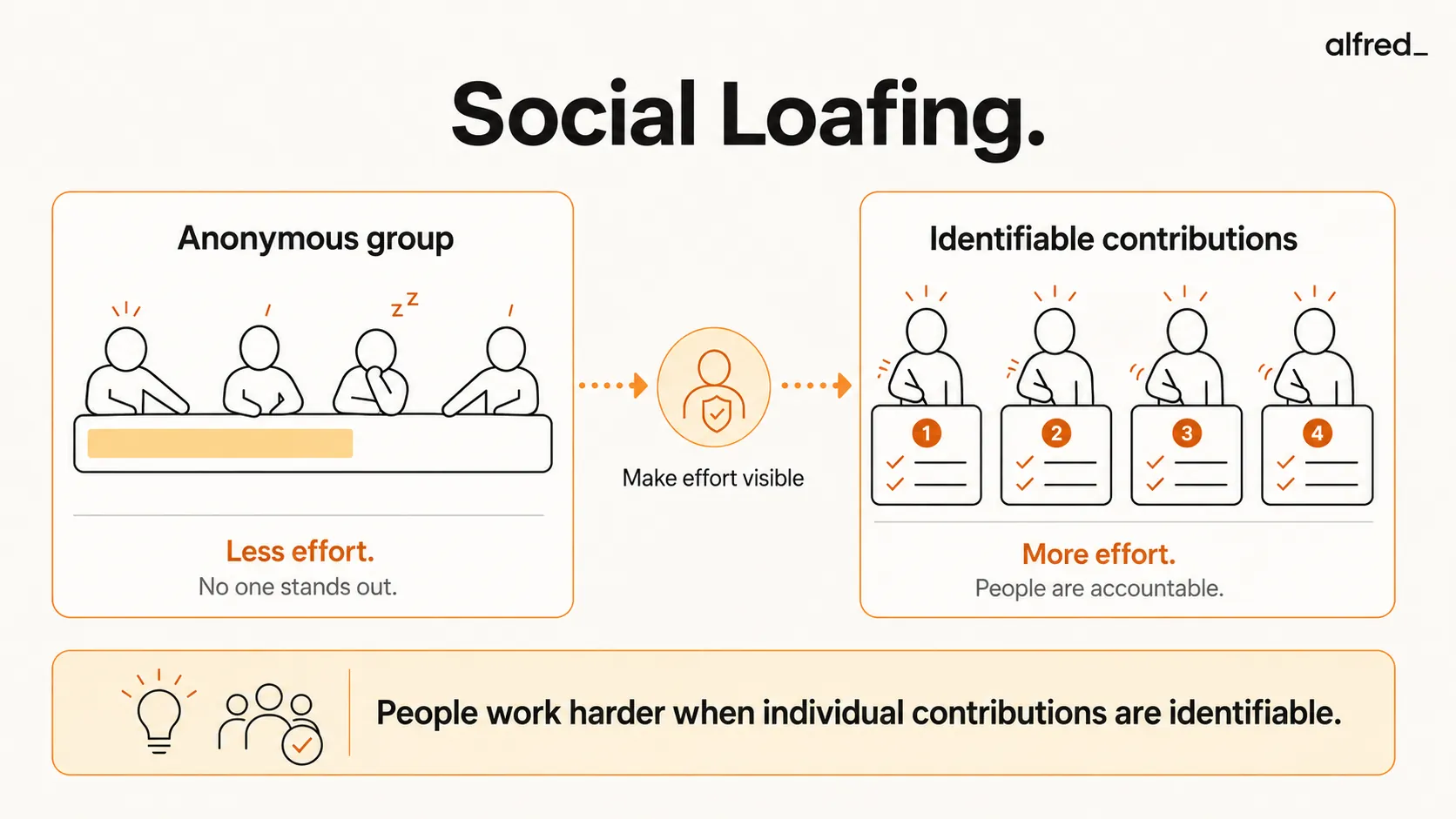
- Individual identifiability. When individual contributions are visible and attributed, effort increases to match what the individual would exert alone. The loafing mechanism requires anonymity in the collective output. Named contributions, visible individual metrics, and explicit attribution restore the accountability that anonymity removes.
- Unique contribution. When an individual’s contribution is perceived as essential and non-replaceable (when no one else can provide what they provide), loafing decreases. This is why specialists maintain higher effort in group settings than generalists: their unique contribution is visible and cannot be diffused.
- Small, cohesive groups. The social loafing effect is substantially weaker in small groups with strong interpersonal relationships. The social cost of visible loafing (disappointing specific people you know and care about) counteracts the motivational diffusion that larger, more anonymous groups produce.
The Professional Analog
The reply-all email chain is the professional equivalent of Ringelmann’s rope: a shared output with distributed, anonymous inputs where individual contributions are invisible and responsibility is diffuse. As the chain grows, the probability that any individual member owns the resolution approaches zero.
The structural fix is the same as the laboratory fix: individual identifiability. Converting a reply-all chain into named, specific action items (Person X will do Y by Z) restores the individual accountability that the group format dissolved. This is not a motivational intervention; it is a structural one. People are not lazy in reply-all chains; they are responding predictably to a structure that reduces the visibility and attribution of individual effort.