


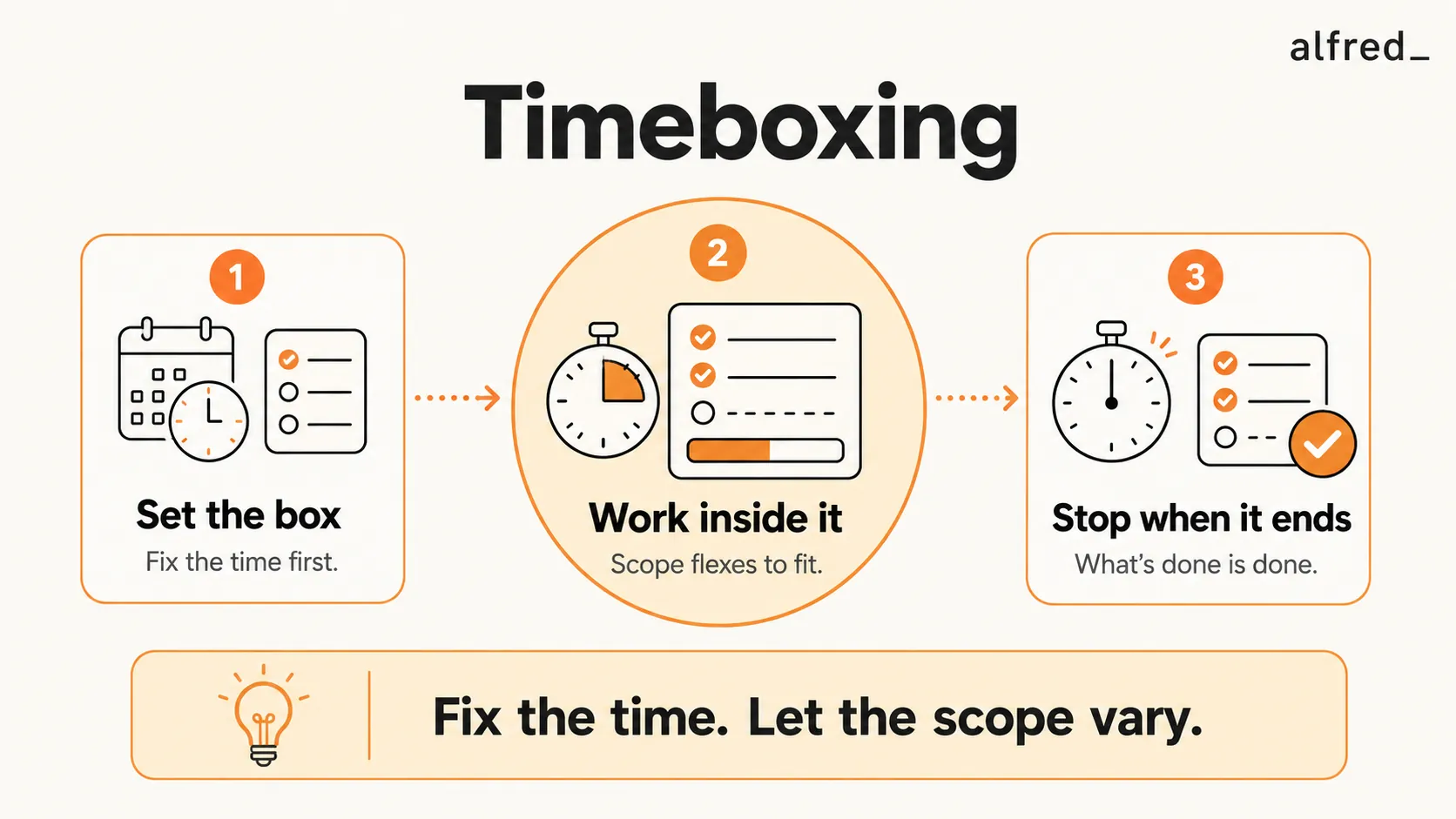
A task will take exactly as long as you give it. Give a report a week and it fills a week; give it an afternoon and, somehow, it ships that afternoon, often no worse for the compression. That is not a motivational trick, it is a structural law, and timeboxing is the method built to exploit it. Instead of fixing the work and letting time stretch, you fix the time and let the scope flex. Here is where the idea came from, why it beats open-ended schedules, and how to apply it to your own work without turning every task into a sprint.
Origin: James Martin and RAD
James Martin coined the timebox concept in Rapid Application Development (Macmillan, 1991). The book proposed a development methodology that contrasted with waterfall approaches, where full specifications were completed before any code was written and timelines extended until the specification was fully implemented.
Martin’s approach inverted this: fix the time available for development, and vary the scope completed within that time. A project with a 90-day timebox would deliver whatever functionality could be fully completed in 90 days. At day 90, the timebox ended and what was done was done. Incomplete features were deferred to the next timebox, not used as justification for extending the current one. This forced prioritization of the most important functionality and prevented scope creep from extending timelines indefinitely.
Fixed time, variable scope
The timebox principle: fix the time, vary the scope. This inverts the traditional project management model (fix scope, vary time) and forces continuous prioritization within a defined window rather than continuous timeline extension to accommodate fixed requirements.
Martin, J. (1991). Rapid Application Development. Macmillan.Ken Schwaber and Jeff Sutherland implemented the timebox as the Scrum sprint, presenting it at OOPSLA in 1995 and making it the most widely adopted form of timeboxing in software development. The sprint, a 1-4 week fixed window during which a defined set of features is built and tested, directly implements Martin’s timebox principle and has become the standard delivery cadence in agile software development globally.
Parkinson’s Law and the Efficiency Effect
C. Northcote Parkinson formulated his eponymous law in a 1955 essay in The Economist, later expanded in Parkinson’s Law: The Pursuit of Progress (John Murray, 1958): “Work expands so as to fill the time available for its completion.” The observation was satirical, originally applied to British civil service bureaucracy, but it captures a genuine psychological phenomenon: when more time is available, people use more of it, often without proportionally increasing output quality.
Timeboxing is the structural countermeasure to Parkinson’s Law. By defining an explicit endpoint in advance and committing to stopping at that point, the timebox makes expansion impossible. The person or team must triage, prioritize, and accept “good enough” for lower-priority elements rather than expanding the time to achieve perfection across all elements.
Applying Timeboxing to Individual Work
- Task-level timeboxing. Allocating a fixed amount of time to a specific task, “I will work on this proposal for 45 minutes, then move on regardless of where I am,” applies the timebox at the task level. The value is both attentional (the fixed endpoint creates urgency that counteracts Parkinson’s Law) and prioritization-forcing (knowing the timebox is finite pushes the most important elements to the front). The Pomodoro Technique is a widely-used implementation of task-level timeboxing with a 25-minute default interval.
- Meeting timeboxing. Meeting durations that are set as exact calendar blocks rather than flexible (“this ends at 2:00”) tend to produce more focused discussion and more actionable outcomes than open-ended meetings. Research on meeting effectiveness consistently finds that shorter, timeboxed meetings with clear agendas produce better decisions per minute than longer meetings with flexible scopes. Default meeting durations of 25 or 50 minutes (leaving buffer between calendar blocks) are a simple implementation.
- Weekly and daily timeboxes. The workweek is itself a timebox, 40-50 hours in which a professional must accomplish their priorities. Treating it explicitly as a timebox rather than an elastic container forces weekly prioritization: what are the two or three things that must be accomplished in this fixed window? The timebox lens converts “what do I need to do?” (unbounded) into “what is the most important thing given the time available?” (bounded and prioritized).
The Box Only Holds If Nothing Picks the Lock
A timebox makes one promise: at the end of the window, you stop. That promise quietly assumes the window was yours to begin with. In practice it rarely is. The forty-five-minute box you gave a task gets raided at minute ten by an email you “just glance at,” and the fixed endpoint becomes meaningless because the middle was never protected. Timeboxing controls how long work may take. It does nothing about the interruptions that prevent the work from happening at all.
alfred_ is what guards the inside of the box. It triages incoming email and messages, handles the routine replies, and surfaces only what genuinely cannot wait, so the window you fixed for a task is actually spent on that task rather than fragmented into a dozen reactive detours. Timeboxing gives the work a hard edge at the end. alfred_ gives it a clean run in the middle, which is the half of the equation the method itself never addresses.