

The Simulation Heuristic and Near-Misses
Kahneman and Tversky’s “simulation heuristic,” introduced in the edited volume Judgment Under Uncertainty: Heuristics and Biases (1982, Cambridge University Press), established that people assess the probability and emotional significance of events by imagining them, simulating how they might have happened or might unfold.
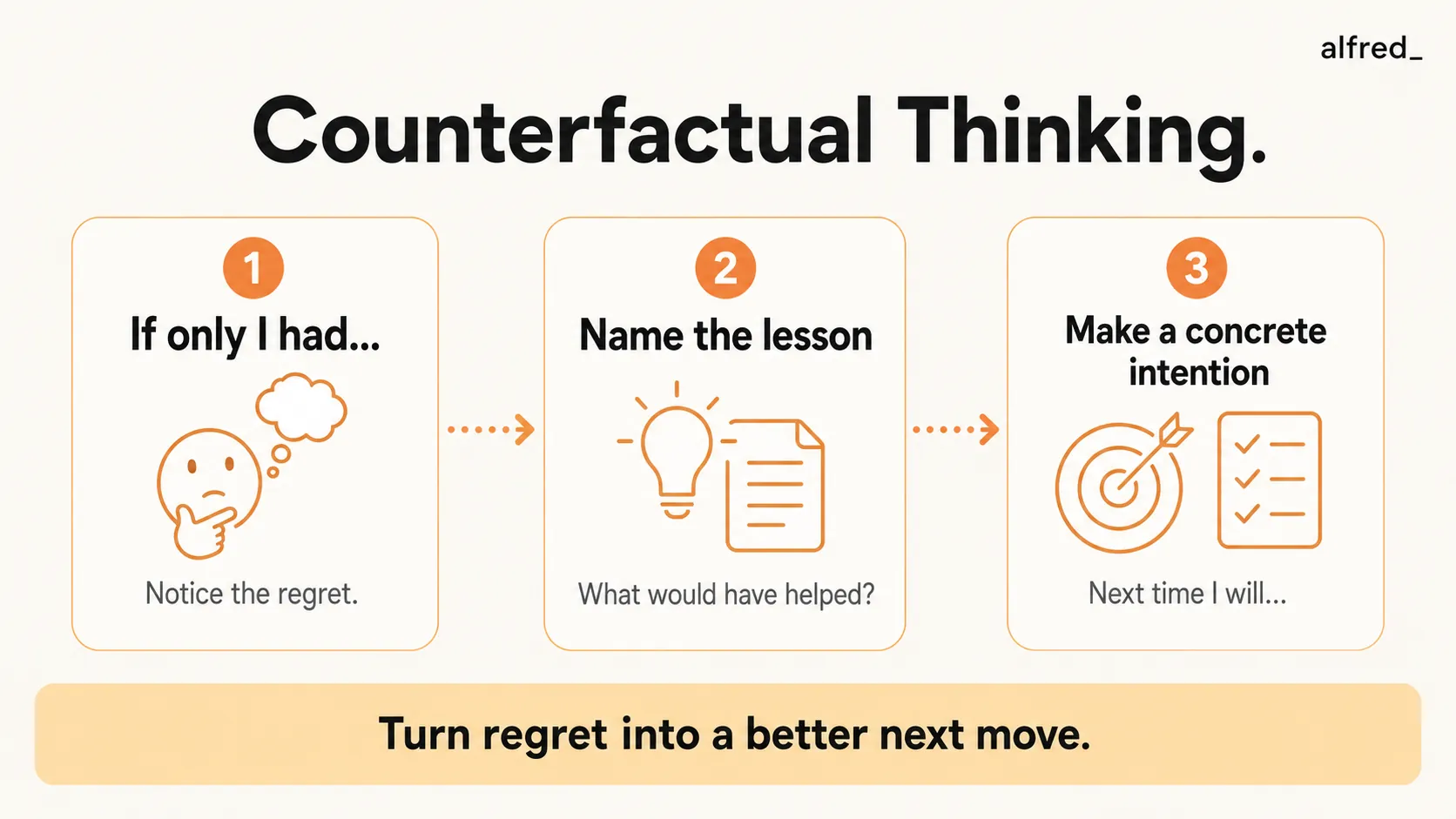
A key finding: counterfactual simulations (“it could have been different”) are generated most readily after near-misses and after exceptions to typical outcomes. A traveler who misses a flight by 5 minutes experiences more intense counterfactual thinking than one who misses it by 30 minutes, because the 5-minute case makes it easy to imagine the alternative (leaving 10 minutes earlier) while the 30-minute case requires imagining a much larger departure from what actually happened.
This means near-miss events are disproportionately salient in retrospective analysis. They generate more “what if” thinking, which can be either a distortion (if the near-miss was actually unlikely regardless of changes) or a useful signal (if the changes needed to avoid the near-miss are genuinely actionable). Understanding which type of near-miss is prompting the counterfactual is a prerequisite for using the thinking productively.
Upward vs. Downward Counterfactuals
Neal Roese’s functional theory of counterfactual thinking, published in the Journal of Personality and Social Psychology (1994) and elaborated with Epstude in Personality and Social Psychology Review (2008), distinguishes two categories with different functional consequences:
- Upward counterfactuals imagine better alternatives: “If only I had done X, the outcome would have been better.” These are typically generated after failure and feel like regret. But their functional consequence is positive: upward counterfactuals produce specific behavioral intentions. The “if only I had done X” naturally translates into “next time, I will do X.” Roese’s 1994 anagram study showed that subjects prompted to generate upward counterfactuals solved subsequent anagrams faster.
- Downward counterfactuals imagine worse alternatives: “At least it wasn’t as bad as Y.” These are generated to provide emotional relief after negative outcomes. Their primary function is affective: improving mood and reducing distress. While they can under specific conditions influence behavior, they do not reliably produce the specific behavioral intentions that upward counterfactuals generate. Downward counterfactuals are a coping mechanism, not a learning mechanism.
The functional distinction is critical for professional retrospectives: organizations that run post-mortems asking primarily “what went well?” are generating downward counterfactuals and feel-good recollections. Organizations that ask “what specifically could have been done differently, and what will we change?” are generating upward counterfactuals with actionable consequences.
Professional Applications
He et al. (2020) tested upward counterfactual prompting in a real professional setting: N=240 healthcare providers were prompted to generate upward counterfactuals about near-miss safety events. Over a 4-month follow-up, the counterfactual-prompted group showed significantly higher safety compliance than controls, mediated by increased knowledge acquisition. The effect transferred from retrospective analysis to prospective behavior change.
Three practical applications for executives:
- Redesign retrospectives. Replace “what went well / what went wrong” with “what specifically could have been done differently, and what would the outcome have been?” The latter structure generates upward counterfactuals with behavioral intentions. The former generates a mix of celebratory and blame-attributing statements with lower action conversion.
- Institutionalize near-miss review. Near-misses generate more counterfactual thinking than actual failures, and the counterfactuals they produce are more actionable because the changes needed are smaller. Organizations that track and review near-misses systematically produce more specific behavioral improvements than those that wait for actual failures.
- Create structured deferred-intention review. alfred_’s daily surfacing of deferred items and unanswered emails creates an institutionalized upward counterfactual prompt: “I intended to follow up, and I didn’t. What would have happened if I had, and what will I do now?” This is not just a reminder; it is a systematic retrospective applied to intentions vs. actions.
Organizations that run post-mortems asking primarily “what went well?” generate downward counterfactuals and feel-good recollections. Organizations that ask “what specifically could have been done differently, and what will we change?” generate upward counterfactuals with actionable behavioral consequences.