

The Research
William Samuelson and Richard Zeckhauser published “Status Quo Bias in Decision Making” in the inaugural issue of the Journal of Risk and Uncertainty in 1988 (Vol. 1, pp. 7–59). The paper combined two methodologically distinct strands of evidence.
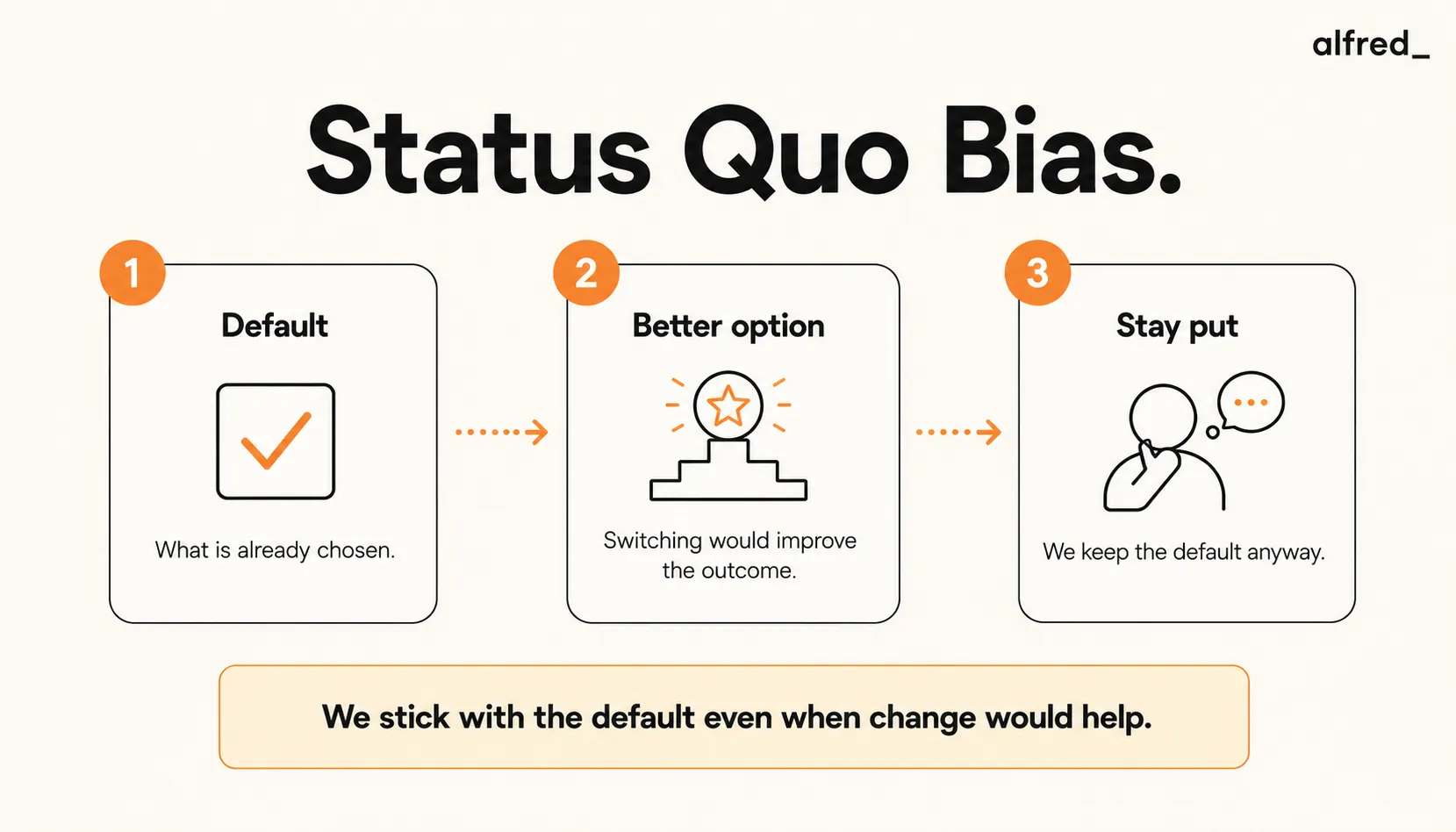
The experimental strand used questionnaire studies presenting participants with decision scenarios where one option was labeled as the current arrangement. Even when all options were objectively equivalent in expected value, participants chose the labeled “current” option significantly more often than chance would predict. As the number of alternatives increased, the advantage of the status quo option grew: each additional alternative made switching decisions feel costlier, and the cognitive effort of comparison pushed people toward the no-effort default of staying.
The archival strand examined two real-world data sources: the health insurance plan selections made by Harvard University employees, and the retirement contribution allocations made by faculty members in the TIAA-CREF system across the country. Both datasets showed the same pattern. Harvard employees disproportionately maintained their existing health plan even when alternative plans with similar or better coverage were available at the same or lower cost. TIAA-CREF faculty showed similarly extreme stickiness in their allocation choices: returning faculty members who had made initial allocation decisions rarely changed them, even over periods when market conditions changed substantially.
Three Mechanisms
Samuelson and Zeckhauser proposed three psychological mechanisms that individually and jointly produce status quo bias:
- Loss aversion. Departures from the status quo require giving up the known current state and acquiring an alternative, and prospect theory predicts that losses (what you give up) are weighted roughly 2x relative to equivalent gains (what you acquire). Even a switch that is objectively net-positive in expected value registers as psychologically costly because the losses from leaving the current state are felt more acutely than the gains from the new state.
- Regret avoidance. Kahneman and Miller’s norm theory predicts that action produces more regret than inaction when outcomes are bad, and switching is an action. If you switch to a new plan and it performs worse than your old plan, you bear the psychological cost of a choice that was actively made. If you stay and your plan underperforms, the regret is mitigated by the implicit frame that you didn’t actively choose to underperform. The asymmetric regret exposure from action versus inaction pushes toward staying.
- Cognitive effort and transaction costs. Evaluating alternatives requires time, attention, and cognitive effort. The current option requires none of this: it is already evaluated and familiar. When people are uncertain about the quality of alternatives, and when switching requires effort, the default option wins by default. This effect is amplified by the proliferation of alternatives: more choices means more evaluation effort, which increases the relative attractiveness of the no-effort status quo.
Default Design and Change Management
The status quo bias has two major practical implications that point in opposite directions: how to design systems, and how to lead change.
For system design, the bias means that the default option is extraordinarily powerful. Retirement plan opt-in versus opt-out defaults produce dramatically different enrollment rates, which is the empirical basis for nudge theory’s emphasis on defaults. Product auto-renewal, email subscription opt-outs, and privacy settings are all shaped by the asymmetric stickiness of whatever state users start in. Designing the beneficial default is the highest-leverage intervention available, because it works with the bias rather than against it.
For organizational change, the bias predicts that change initiatives will face systematic resistance regardless of the objective merit of the change, because the current state will be treated as the reference point against which gains are compared to losses. Communications that describe change as “avoiding a loss” (framing the status quo as the risky option) often outperform communications that describe the same change as “achieving a gain,” precisely because loss aversion amplifies the weight of the “what happens if we don’t change” frame.