


Psychology

Commitment Devices: The Science of Binding Your Future Self

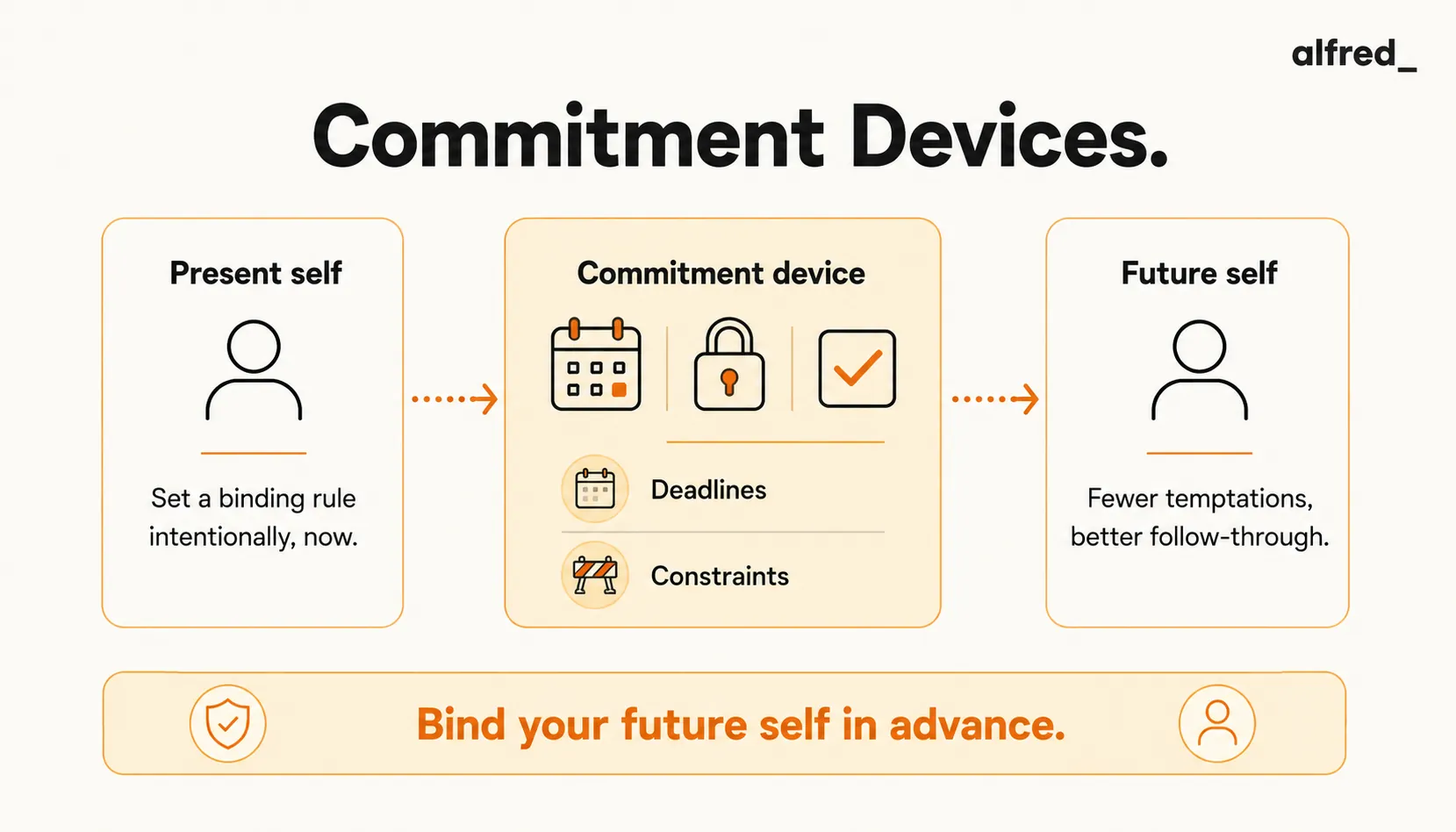
The problem with planning is that the person who makes the plan and the person who executes it are not the same person, in any practical sense. Future-you has different priorities, different energy levels, and different preferences than present-you making commitments. Commitment devices are mechanisms designed to constrain future-you to honor present-you's intentions.

Feb 19, 20266 min read
Quick Answer

What is a commitment device?

  • A commitment device is a mechanism that constrains your future choices to enforce your present intentions, making defection costly rather than easy
  • Present bias (Laibson, 1997) explains why plans fail: we are disproportionately impatient about now vs. tomorrow, so future-you has different preferences than planning-you
  • Ariely and Wertenbroch (2002) showed MIT students with external deadlines outperformed those with full freedom. Even self-chosen deadlines beat no deadlines.
  • Effective designs involve real consequences: financial stakes, social accountability to a named person, or structural elimination of the alternative

The test for whether something is a commitment device vs. an intention: would you skip it right now if something more attractive came up? If yes, it's an intention.

Present Bias: The Root Problem

David Laibson's 1997 paper in the Quarterly Journal of Economics ("Golden eggs and hyperbolic discounting") formalized the behavioral economics concept that explains why people reliably fail to follow through on their own plans: present bias.
Standard economic models assume consistent time preferences: if you prefer $100 today over $110 tomorrow, you should also prefer $100 in 30 days over $110 in 31 days. Laibson showed that humans don't work this way. The "now vs. soon" trade-off is evaluated completely differently from the "future vs. slightly-later-future" trade-off. People are disproportionately impatient about the immediate present, willing to make sacrifices in the future that they would not make if "the future" were now.

This is why Sunday's plan to work out Monday morning is abandoned on Monday morning, why ambitious project timelines approved in January produce deferrals in February, and why the email follow-up you intended to send today is perpetually deferred. The cold-state self makes plans; the hot-state self doesn't execute them. They are, in practical terms, different actors with different preferences.

The Research on Deadlines

Ariely and Wertenbroch (2002) in Psychological Science tested commitment device effectiveness directly with MIT students completing three assignments. Students were randomly assigned to: evenly-spaced external deadlines, self-chosen deadlines (any spacing they preferred), or a single deadline at the end of the course.

The results: students with external deadlines performed best on assignment quality and course grade. Students with self-chosen deadlines did better than the single-deadline group, but those with full flexibility tended to cluster their deadlines near the end of the course, replicating the cramming pattern that external deadlines prevented. Given freedom, people gravitate toward the temporally convenient rather than the behaviorally optimal.

The caveat worth noting: while the deadline effects on performance were clear, commitment devices don't always increase task completion rates in field experiments. The mechanism is most reliable when the commitment is genuinely binding: real consequences, not just stated intentions.

Try alfred_

See what this looks like in practice

alfred_ applies these principles automatically — triaging your inbox, drafting replies, extracting tasks, and delivering a Daily Brief every morning. Theory becomes system. $24.99/month. 30-day free trial.

Try alfred_ free

What Makes a Commitment Device Actually Work

Three design principles distinguish effective commitment devices from ineffective ones:

  • Real consequences. A commitment is only as strong as the cost of breaking it. "I'll work out tomorrow" is an intention, not a commitment device. Paying a personal trainer in advance who doesn't refund no-shows is a commitment device. Telling a friend you'll donate to a cause you dislike if you miss the workout is a commitment device. The consequence needs to be salient enough to compete with the in-the-moment preference to defect.
  • Social accountability to a named person. Accountability to a specific, named individual is substantially stronger than accountability to a group or to yourself. The named person creates a concrete social consequence (disappointment, judgment, damaged trust) that vague accountability mechanisms don't produce. A commitment to "be more responsive" is weak; a commitment to your assistant that you'll reply to the four flagged emails before leaving is much stronger.
  • Elimination of the alternative. The strongest commitment devices don't just make defection costly. They make it structurally unavailable. Writing the check before the work is done (put the charity check in the envelope, give it to a friend, and tell them to mail it if you miss your deadline) eliminates the future decision to defect. Blocking website access during work hours eliminates the choice to browse.
Intentions vs. commitment devices
A to-do list records intentions. A commitment device binds them. The difference is consequence. A to-do item with no deadline, no accountability, and no cost to deferral will be deferred whenever the present-bias moment arrives. Effective commitment devices attach a real cost (social, financial, or structural) to defection.

Frequently Asked Questions

Why do commitment devices feel uncomfortable even when we know they'll help?

Because making a binding commitment requires acknowledging, in advance, that you don't fully trust your future self to follow through on your present-tense intentions. This is psychologically uncomfortable. It conflicts with the self-image of a reliable, disciplined person. The discomfort is a form of ego protection: if I don't need a commitment device, I can maintain the belief that my intentions and my actions are reliably connected. The research shows they aren't, for most people, in most domains. The discomfort of adopting commitment devices is worth examining rather than acting on. It's usually revealing something about self-image, not providing useful information about whether the device is needed.

Are commitment devices compatible with intrinsic motivation? Does external accountability undermine enjoyment?

This is a real risk. The overjustification effect from self-determination theory research shows that external constraints can reduce intrinsic motivation for activities that were previously self-driven. The practical resolution: use commitment devices for activities where the primary obstacle is present bias, not motivation. If you genuinely want to exercise but keep not doing it, a commitment device helps. If you're uncertain whether you want to do the activity, a commitment device may produce compliance without engagement, undermining the motivation you need to develop. Commitment devices are most appropriate for bridging the gap between what you already value and what you actually do.

How is a commitment device different from a to-do list?

A to-do list records intentions. A commitment device binds them. The difference is consequence. A to-do item with no deadline, no accountability, and no cost to deferral will be deferred whenever the present-bias moment arrives. Effective commitment devices attach a real cost: social, financial, or structural. The test: would you be willing to skip this item on your to-do list right now if something more attractive came up? If yes, it's an intention. The commitment device converts it into something that competes on different terms with the in-the-moment alternatives.

Try alfred_

Make the outstanding visible.

alfred_'s daily briefing makes deferred commitments visible every morning, creating a daily accountability moment that converts vague intentions into salient, visible obligations. Not a binding commitment device, but a structured prompt that changes the cost of continued deferral. $24.99/month.

Try alfred_ Free