


The Forgetting Curve
Hermann Ebbinghaus spent years studying his own memory, memorizing nonsense syllables and testing his recall at precise intervals. The result was the forgetting curve: a mathematical description of how quickly information decays without review.
The curve is steep at first. Roughly 50% of new information is lost within 30 minutes of exposure without any subsequent engagement. By 24 hours, approximately 70–80% has faded. The decay rate then slows. What survives the first 24 hours decays more gradually over the following weeks.
The practical implication: a single exposure to information (reading a brief once, attending a meeting once, hearing a presentation once) leaves almost none of that information accessible within a day, regardless of attention during the original exposure. This is not a failure of intelligence or effort; it is how human memory is architecturally designed.
What the Meta-Analysis Found
Cepeda, Pashler, Vul, Wixted, and Rohrer (2006) published a comprehensive meta-analysis in Psychological Bulletin covering 839 assessments across 317 experiments. The question was whether distributed (spaced) practice reliably outperforms massed (cramming) practice, and by how much.
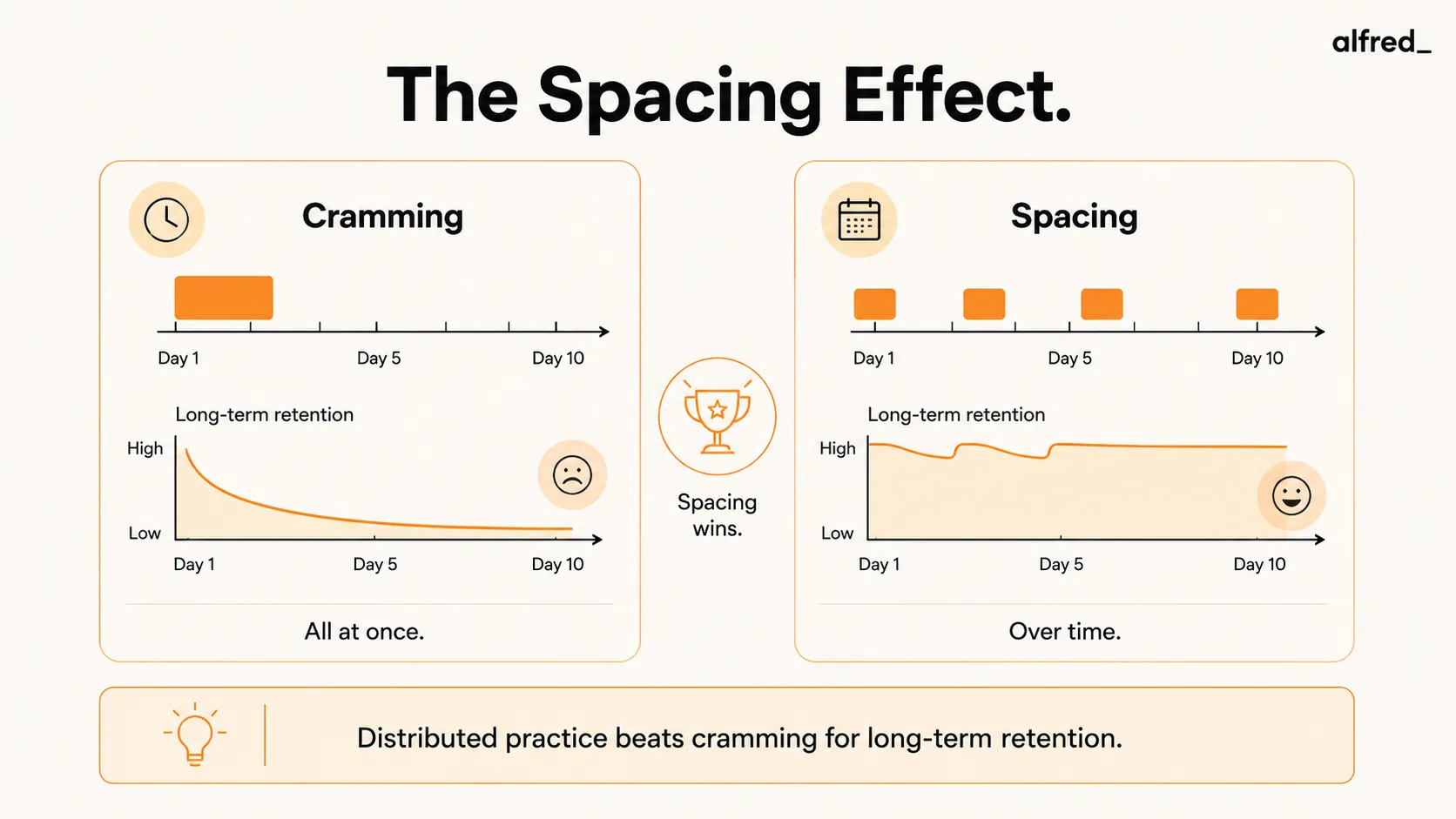
The answer was consistent across domains, materials, and populations: spaced practice produced substantially better long-term retention in the overwhelming majority of comparisons. The advantage was not marginal. In many conditions, massed practice produced near-zero retention at longer delays while spaced practice maintained meaningful recall.
A 2008 follow-up by Cepeda et al. in Psychological Science (N=1,350) addressed the question of optimal interval: how much time should pass between study sessions? The answer depends on the desired retention window. The optimal gap is approximately 10–20% of the interval you need to retain the material. If you need to remember something for a year, the optimal gap between sessions is 1–3 months. If you need to remember it for a week, optimal gap is roughly 1–2 days.
Why Spaced Practice Works
Two mechanisms explain the spacing effect’s durability:
- Desirable difficulty. When you return to material after a delay, some forgetting has occurred: retrieval requires genuine effort. That effortful retrieval strengthens the memory trace more than re-reading already-fresh material. The difficulty of retrieval is a feature, not a bug. Easy review produces weak encoding; difficult retrieval produces strong encoding.
- Multiple encoding contexts. Studying material in different contexts (different days, different times, sometimes different locations) creates multiple retrieval pathways. The information becomes associated with more varied cues, making it accessible from more starting points in memory.
Massed practice fails because it produces strong recognition memory (the content feels familiar immediately after a session) but weak recall later. Familiarity decays; but well-encoded, multiply-contextualized memory does not decay at the same rate.
Professional Applications
The spacing effect applies to any professional knowledge that needs to be retained and used: client context, strategic frameworks, procedural knowledge, and technical skills. Several practical implications:
- Brief review beats rereading. A 5-minute review of notes from a meeting 24 hours later produces better retention than spending an additional 30 minutes in the original session. The timing is more important than the duration.
- Recurring briefings are retention tools. A daily morning review of client context, open commitments, and follow-up items is not just operational. It is a naturally spaced re-encounter with information that would otherwise be lost. The briefing structure creates spacing without requiring intentional study sessions.
- Single-session training has predictable decay. A full-day workshop that covers all material in one block will retain almost nothing within a week without structured follow-up. Any training investment should include a spaced review component to realize the learning value of the initial investment.